Physical AI for Logistics: Reclaim Your Margin with Intelligence That Reasons
Deploy computer vision trained on facility physics. Eliminate damage disputes, stop cargo theft, automate ESG compliance—without replacing infrastructure.
The Reasoning Gap

The logistics industry has crossed a decisive divide. McKinsey’s 2026 Global Tech Agenda confirms that AI pioneers are now outperforming laggards by 4 percentage points in EBIT margins. For operations running on razor-thin spreads, dock-level "invisibility" is no longer an inconvenience but rather a compounding financial crisis.
The Failure of Passive Systems
Traditional infrastructure is designed to record, not to reason. When a pallet arrives light, a seal is compromised, or a high-value component is "skimmed," your current systems fail you:
- Cameras record the loss, but offer no real-time verdict.
- Systems log the transaction, but lack the physical context.
- The Result: You are left with evidence of a loss, but no accountability.
The Compounding Cost of Invisibility
This "Visibility Gap" manifests as three critical threats to mid-market viability:
- The Financial Leak: 3–5% of Gross Revenue lost to "Invisibility Taxes" and value leakage (PwC 2026).
- The Security Surge: 60% Surge in Cargo Theft during 2025, driven by sophisticated skimming networks.
- The Regulatory Wall: Scope 3 Mandates (California SB 253) requiring audit-ready logs by 2027.
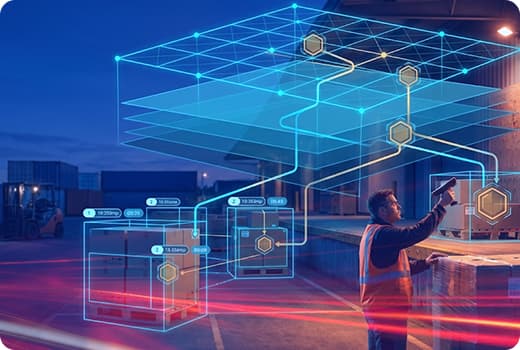
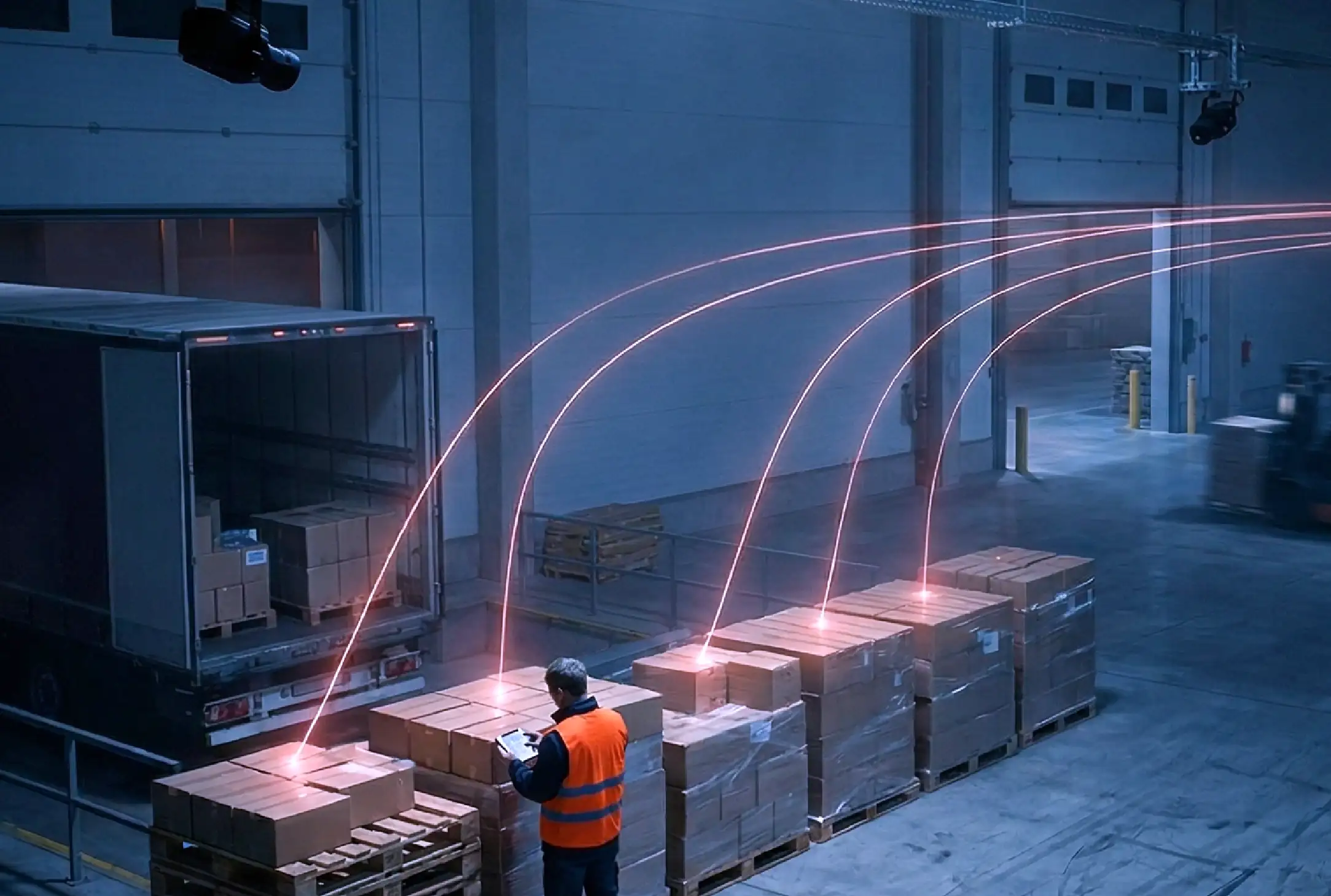
At CodeNinja, we deploy Physical AI—an execution layer that activates the latent intelligence in your existing camera infrastructure. By training models on facility-specific dock physics and specialized tampering signatures, we move beyond passive surveillance.
The result: Cameras that generate verdicts, not just evidence.
.webp&w=2048&q=75)
Operational Constraints Creating Visibility Gap
Dock Operations
- 330–50 admin hours weekly that's 80% redundant but legally necessary
- Dispute resolution in days; customers repeat accounts
- Footage provides recordings not reasoning; cannot prove moment seal compromised or pallet skimmed
Operational Scale
- Scope 3 requires shipment-level data; fleet averages don't satisfy SB 253 or enterprise clients
- Audit readiness constructed retroactively, not embedded as workflow byproduct
- Visual evidence lacks temporal context to prove when, how, or whose watch
Compliance & Risk
- Cargo theft detected after loss; networks operate at machine speed vs. human defense
- 20% volume growth requires proportional headcount; scaling intelligence means replacing infrastructure
- Growth breaks volume-margin link; manual verification caps profitable expansion
The Cost of Invisibility in a Hyper-Volatile Logistics Landscape
Discover how the Physical AI execution layer enables logistics leaders to reclaim dock door control and build sustainable margin advantages.

Engineering Physical Intelligence for Dock Execution
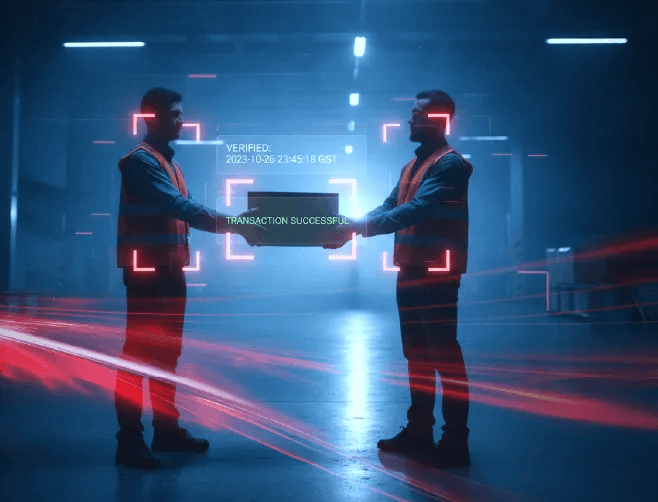
Visual Receipt & Dispute Resolution
Automates timestamped chain-of-custody documentation at every handoff.
- Performance: Compresses resolution from 3–7 days to 4–8 hours.
- Impact: Reduces claim payouts by 60% and slashes admin burden to under 8 hours/week.
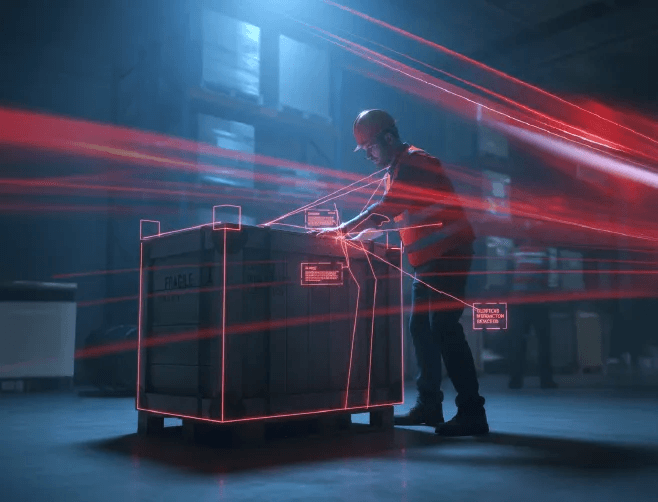
Cargo Threat Detection & Pre-Emption
Real-time identification of theft sequences targeting high-value components (RAM, Sensors, GPU).
- Precision: Distinguishes factory-sealed tape from professional tamper-evident replacements.
- Impact: Flags risks before cargo leaves the facility, achieving an 85%+ per-emption rate.
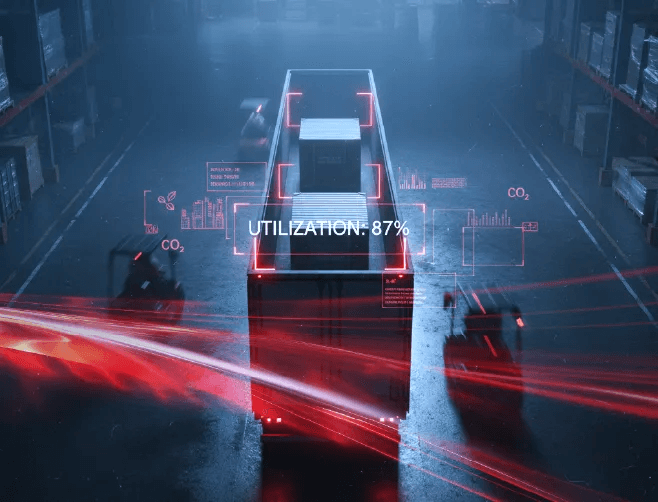
Scope 3 Visual Log Pipeline
Automated shipment-level carbon data derived from visual load-factor analysis.
- Mechanism: Analyzes vehicle utilization via overhead cameras (actual cargo volume vs. capacity).
- Impact: Satisfies CSRD and SB 253 requirements, converting a compliance liability into a contract asset.

Solution Architecture: The Physical AI Execution Layer
To compete in 2026, providers must close the "Reasoning Gap." Our architecture interposes between raw data streams and operational decisions.

Layer 1: Edge Processing & Model Intelligence
- Zero-Disruption Integration: Connects via RTSP/ONVIF—no new cabling or camera replacement required.
- Process Reward Modeling (PRM): Our Knowledge Teams reward models at each reasoning step, ensuring the AI understands causation, not just correlation.
- Temporal Logic: Evaluates event chains (e.g., Identifying a seal was intact at 04:00 and compromised at 04:15 during a shift change).
- Adversarial Validation: Double-blind evaluations ensure 99%+ accuracy that stands up to insurance and legal scrutiny.

Layer 2: Operational Integration & Sovereign Intelligence
- Visual Receipt Generator: Auto-files timestamped documentation directly to the WMS.
- MCP-Enabled Connectors: Bidirectional WMS/TMS integration ensures no parallel data systems or manual re-entry.
- Total Sovereignty: All fine-tuned models and Golden Path datasets transfer to the operator at completion zero vendor dependency.
Use Case of Physical AI for Production Operations
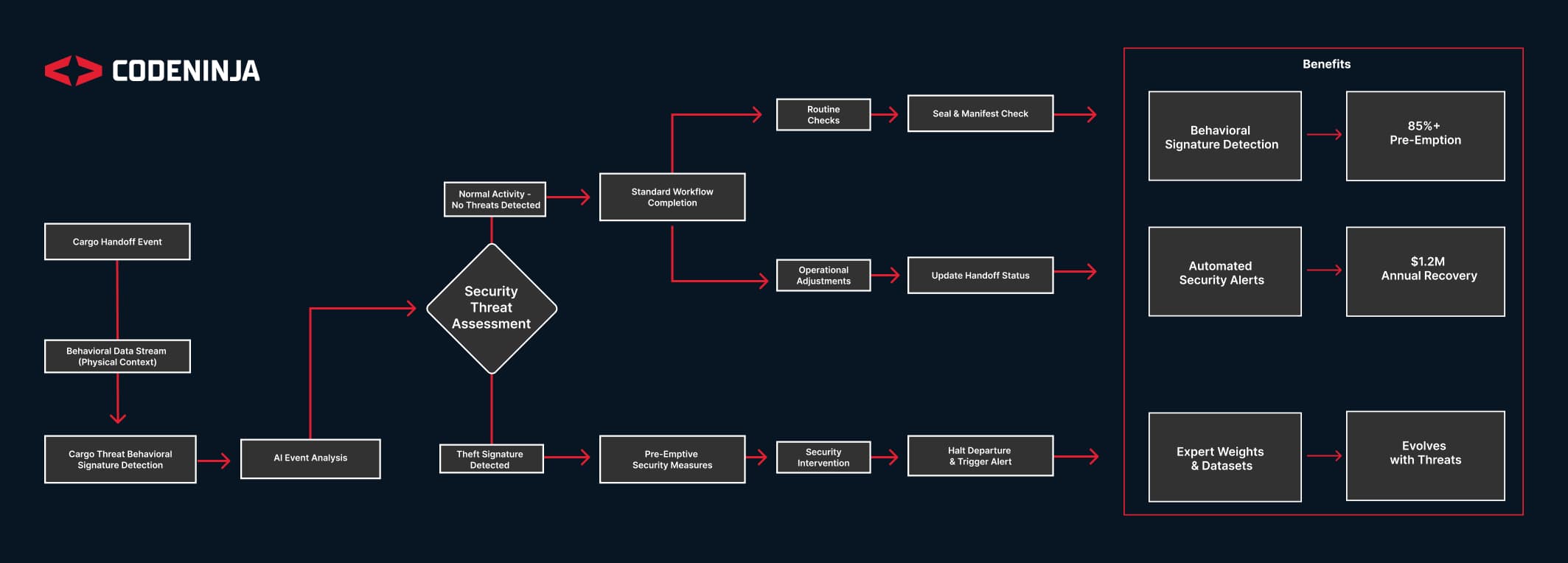
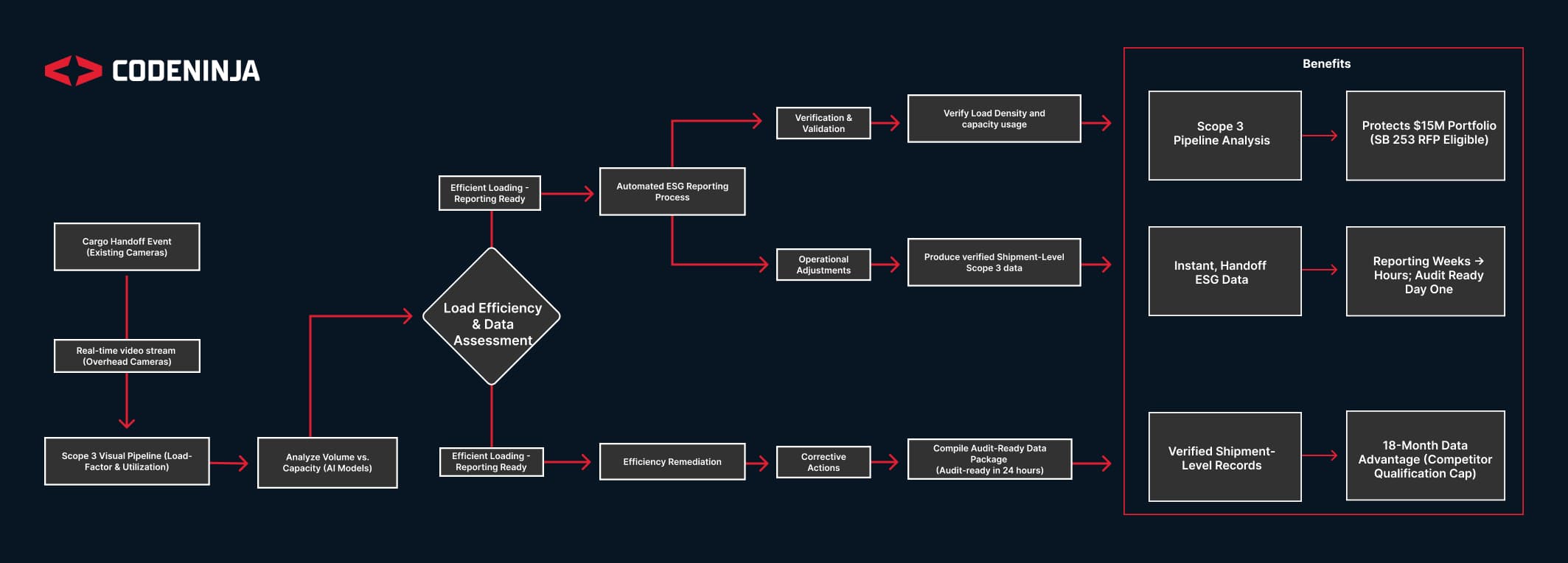
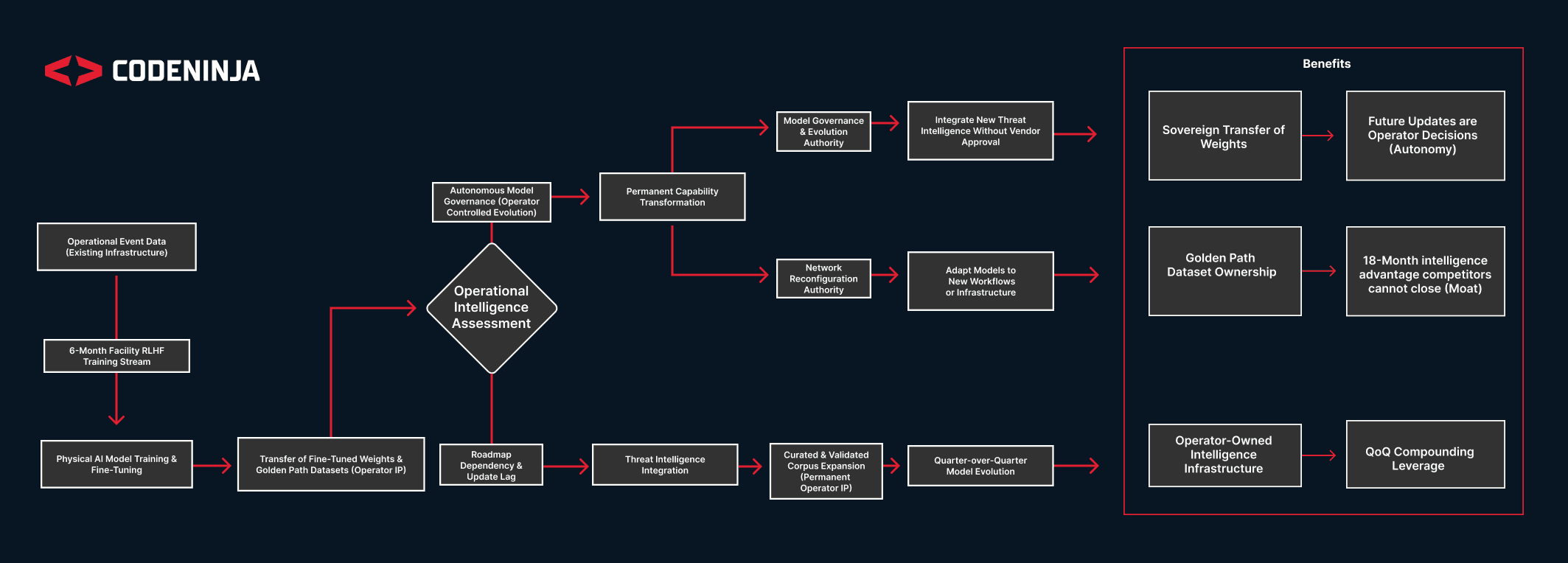
- Visual Receipt & Dispute Velocity
- Cargo Threat & Theft Pre-Emption
- Scope 3 & ESG Contract Retention
- Sovereign Weights & Independence
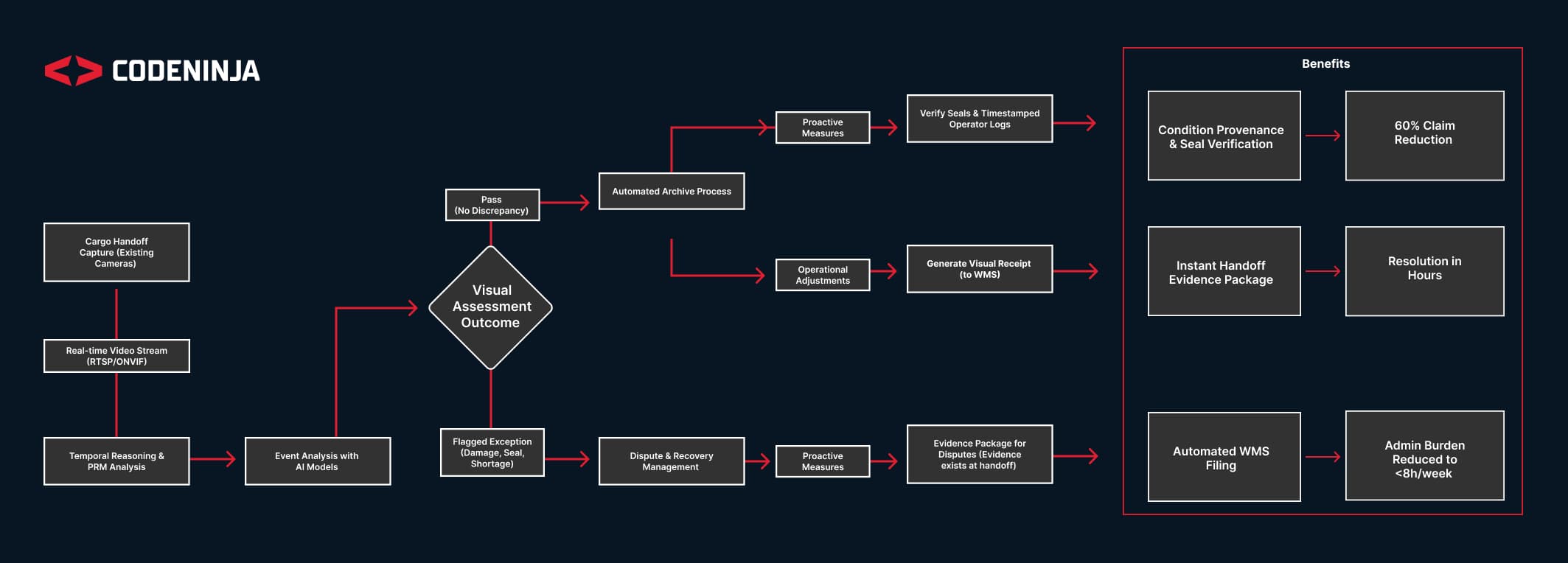
Visual Receipt & Dispute Velocity
The Problem: Manual Photo-Matching Trap
Mid-scale 3PLs absorb 30–50 hours weekly on manual damage photo-matching. When disputes arrive, staff locate footage, timestamp frames, cross-reference reports, produce packages that may not satisfy insurers. Process is 80% redundant but 100% legally necessary. Resolution takes 3–7 days. Signals opacity, not accountability.
The Solution: Automated Visual Receipt Pipeline
Visual Receipt Generator deploys at every handoff. Generates timestamped captures, condition classification, seal status, operator logs. Auto-filed to WMS. The 30–50 hour burden drops to under 8. Evidence exists at handoff, not constructed retroactively.
The Result
- Velocity: Resolution reduced 3–7 days to 4–8 hours
- Recovery: 60% reduction in claim payouts via instant proof
- Compliance: Audit trails as workflow byproduct
Frequently Asked Questions
Explore Latest Insights About Physical AI in Logistics
3 April, 2026
From Damage Detection to Operational Orchestration: The Strategic Value of CV Infrastructure
Discover how US logistics providers can leverage computer vision infrastructure to control the intelligence layer that defines customer trust, streamline dispute resolution, and own customer relationships.
28 March, 2026
Architectural Subordination: The Cost of Vendor-Controlled Computer Vision in U.S. Logistics
Discover the hidden cost of outsourcing Computer Vision in U.S. logistics industry and why sovereignty over operational intelligence is now a competitive moat.
18 March, 2026
Cargo Theft and the New Trust Infrastructure in U.S. Logistics Operations
Learn how computer vision moves U.S. logistics providers from passive surveillance to sovereign trust infrastructure that protects enterprise relationships.

12 March, 2026
2027 ESG Compliance Cliff: Why U.S. Logistics Providers Need Automated Carbon Tracking by Q4 2026
Explore how automated Scope 3 carbon tracking under CSRD and SB 253 is converting ESG compliance into a contract retention asset for U.S. logistics providers.