From Damage Detection to Operational Orchestration: The Strategic Value of CV Infrastructure
.jpg&w=96&q=75)

3 April, 2026

Key Takeaways:
- U.S. Logistics is bifurcating into two structural positions: providers who own the verified record of what occurred at every handoff and providers who execute within accountability frameworks built by others. The dividing line is computer vision infrastructure and whether it is owned or rented.
- The orchestration pattern that defined Amazon, Uber, and Netflix is now materializing in U.S. logistics through computer vision infrastructure. Whoever controls the time-sequenced record of condition, custody, and compliance at the dock door governs the customer relationship, regardless of who moves the freight.
- Enterprise procurement in 2026 evaluates logistics partners on four criteria: real-time visibility, verified dock condition, hours-not-days resolution, and shipment-level ESG data that passive camera infrastructure, without a CV reasoning layer, cannot satisfy and manual verification workflows cannot produce.
- Facility-specific computer vision infrastructure intelligence compounds with every shipment processed. A provider who builds this layer in 2026 establishes a data position competitors cannot close. The intelligence is environment-specific and cannot be acquired externally.
- CodeNinja's Physical AI Execution Layer activates the reasoning capability latent in existing computer vision infrastructure, building sovereign, facility-specific intelligence that transfers permanently to the operator. Turning the dock door from a cost center into a compounding competitive moat.
A damaged pallet lands at a customer's dock. The claim is filed within hours. The investigation begins. Driver reports are retrieved. Footage is reviewed manually. Timestamps are cross-referenced. A documentary record is assembled over three to seven days while the customer waits, and the relationship absorbs the delay.
The freight moved as planned. The evidence did not.
In U.S. logistics, operational execution and relationship ownership operate on separate axes. Most providers have scaled execution through network expansion, routing optimization, and warehouse efficiency. Relationship ownership is determined by a different control point. Who owns the verified, time-sequenced record of what occurred at every handoff, and whether the computer vision infrastructure generating that record belongs to the operator or not.
That record functions as infrastructure. It defines how trust is established, how disputes are resolved, and how accountability is assigned in moments of failure. Providers who control this layer define the narrative of events. Providers who do not operate within a narrative constructed by others. The infrastructure that determines which position a provider occupies is computer vision. Most logistics providers already own the physical layer. What they are missing is the intelligence that makes it reason.
Execution vs Orchestration: The Structural Divide Defining Market Leaders
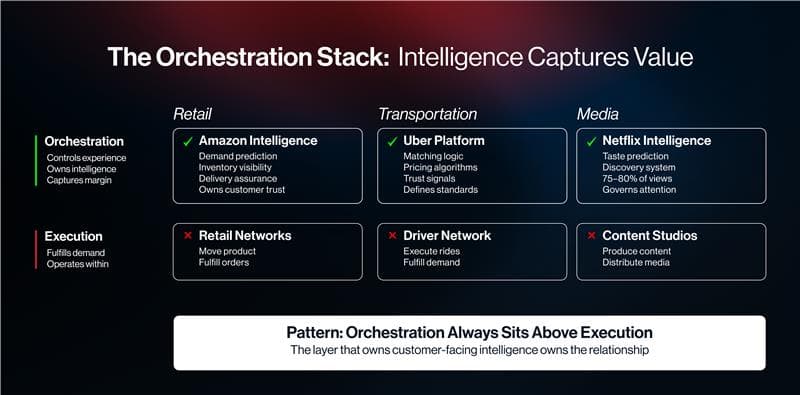
Every major industry transition of the past two decades follows a consistent structural pattern. Market leaders emerge by controlling the layer that defines how customers experience the category. Execution creates value. Orchestration captures it.
The distinction is structural. The execution layer moves goods, performs tasks, and operates assets. The orchestration layer controls visibility, defines decision-making, and owns the customer interface through which trust is established and retained. In logistics, that interface is built on computer vision infrastructure; the system that converts physical events into verified, decision-ready intelligence.
Amazon: Inventory Intelligence as Relationship Control
Amazon built a closed-loop intelligence system that governs how retail is experienced (Amazon, 2021). Demand prediction, real-time inventory visibility, and delivery assurance operate as a unified layer that informs customers before uncertainty emerges (Klover, 2025). That layer draws on satellite imagery, weather signals, and behavioral data to optimize inventory placement across global fulfillment networks before a single order is placed (Amazon, 2025). Each interaction strengthens the system, increasing prediction accuracy and reinforcing customer reliance on the platform. Retail networks continue to move product. Amazon governs the relationship through intelligence that defines expectation and resolution.
Uber: Accountability Layer as Market Control
Uber established control through the coordination layer that governs matching, pricing, and accountability across a distributed driver network. The platform defines service standards, enforces transparency, and maintains a continuous feedback loop between the rider and system. Each trip contributes data that refines routing efficiency, pricing logic, and trust signals (Uber, 2025).
Its adherence to a network orchestration model, as opposed to the capital-intensive service provider framework traditional transportation companies subscribe to, delivered higher profit margins and the agility to respond to market changes faster than asset-owning competitors (Harvard Business School, 2015). Drivers execute the movement of passengers within this system. Uber governs the experience through the infrastructure that determines reliability, visibility, and recourse.
Netflix: Taste Intelligence as Engagement Infrastructure
Netflix operates as a system of predictive engagement driven by proprietary taste intelligence. The platform continuously learns from viewing behavior, session patterns, and interaction signals to shape discovery in real time (Netflix, n.d.). 75-80% of viewing decisions originate from this recommendation system, embedding the platform into the decision-making process before intent is fully formed (Netflix Tech Blog, 2012; Wired, 2017). Content production remains distributed across studios and creators. Netflix governs the relationship through the intelligence that directs attention and sustains engagement.
Across industries, the orchestration controls the intelligence layer that defines visibility, decision-making, and trust. The execution layer fulfills demand within parameters set by that intelligence.
U.S. Logistics Is Entering the Same Structural Transition
Logistics is now entering this phase of transformation. The execution layer in logistics is established and optimized across global networks. Freight moves efficiently across routes and facilities (OliverWyman, 2025). Competitive differentiation at this layer continues to compress as operational benchmarks converge.
The orchestration layer in U.S. logistics is emerging through a different form of intelligence. It is computer vision infrastructure, AI-driven, facility-trained, and capable of reasoning over physical events rather than merely recording them (DHL, 2024). It captures the verified record of condition, custody, and compliance at every handoff point. This layer transforms operational activity into a continuous system of context that defines accountability in real time.
The logistics provider who controls this system defines how events are interpreted, how disputes are resolved, and how trust is maintained. Relationship ownership follows control of this intelligence layer.
Why U.S. Logistics Is Misaligned with Emerging Enterprise Requirements
The structural transition in U.S. logistics is already in motion. The logistics providers winning enterprise freight contracts in 2026 are building intelligence directly into dock operations, converting every inbound and outbound movement into a verified, time-stamped record of condition, custody, and handling sequence (DHL, 2024). These records are shaping how shipments are monitored, how exceptions are handled, and how accountability is established across facilities.
Providers operating outside this intelligence layer follow a repeatable pattern. Vendor engagements initiate pilots that produce localized outputs confined to the deployment environment. Intelligence generated in one cycle does not persist into the next. Each deployment restarts from a generic baseline, performing in controlled validation and degrading under live dock variability. Facility-specific handling patterns, cargo configurations, and risk signatures remain unlearned. The system does not accumulate context. Capability does not compound.
The constraint is structural. The underlying data, training signal, and model outputs are not retained as operator-owned assets. Without ownership of facility-level proprietary datasets and fine-tuned models, each implementation resets the learning curve instead of advancing it.
Learn More:Architectural Subordination - The Cost of Vendor-Controlled Computer Vision in U.S. Logistics
The commercial impact is now visible in procurement decisions. Over 40% of enterprise shippers include AI capability as a selection criterion in logistics RFPs, while only one in ten providers has deployed AI at scale across core operations (BCG, 2026). Enterprise buyer expectations have moved ahead of execution.
New Procurement Filter: The Criteria Redefining Relationship Ownership in Enterprise Logistics
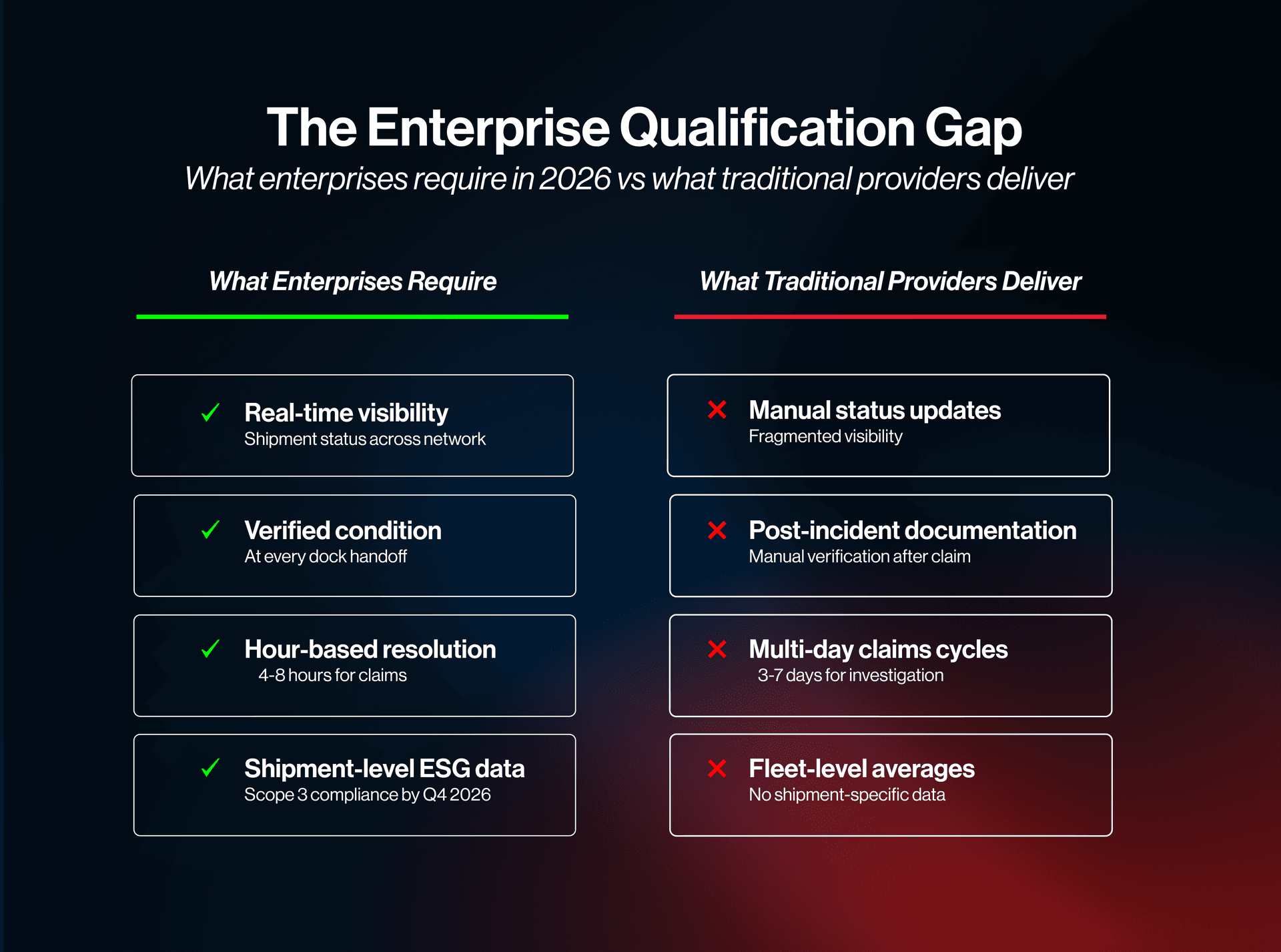
Enterprise procurement in U.S. logistics is consolidating around a defined set of operational expectations that directly shape provider selection and retention:
- Real-time network-wide shipment visibility
- Verified condition at every dock handoff
- Resolution timelines measured in hours
- Shipment-level ESG data aligned to regulatory reporting
These requirements are now embedded into RFP criteria and vendor scorecards across large U.S. supply chains. They function as filters that determine contract eligibility, renewal outcomes, and volume allocation across enterprise supply chains. Providers without production-grade computer vision infrastructure cannot fulfill them through manual workflows or passive surveillance alone.
ESG compliance introduces an additional constraint. Customer preference is shifting toward logistics partners who can produce shipment-level Scope 3 emissions data and auditable records as part of standard execution in 2027, without escalation or delay.
Learn More: 2027 ESG Compliance Cliff - Why U.S. Logistics Providers Need Automated Carbon Tracking by Q4 2026
Furthermore, cargo theft is becoming more organized and intelligence-driven. In this environment, timestamped handling records determine accountability and resolution speed. Providers who control this evidentiary layer establish trust through verification and anchor the customer relationship at the infrastructure level.
Learn More: Cargo Theft and the New Trust Infrastructure in U.S. Logistics Operations
U.S. logistics providers retaining enterprise accounts through verified performance are embedding intelligence directly into dock-level workflows. Each shipment generates a structured record of condition, custody, and compliance. These records accumulate into a proprietary, facility-specific intelligence base that compounds with every movement processed.
The infrastructure generating them is not new. It is the computer vision infrastructure operators already own, activated by a reasoning layer trained on their specific environment.
Computer Vision Infrastructure as the Relationship Control Point
The Architectural Gap
U.S. distribution centers operate with dense camera coverage, continuous sensor input, and WMS and TMS platforms generating high-frequency operational data. The infrastructure captures events. It does not reason them.
The constraint is architectural. The real AI bottleneck is not technological limitations or cost. Most logistics providers identify unclear ROI and internal capability gaps as the limiting factors in AI adoption (BCG, 2026). The underlying computer vision infrastructure is already in place. The footage is already being generated. The missing layer is the reasoning system that transforms this data into verified operational reasoning within the flow of execution.
From Recording to Reasoning: What Computer Vision Requires
A recorded event establishes that a condition exists. A CV-enabled reasoning system reconstructs the sequence of handling events that produced that condition, identifies the precise handoff at which it occurred, and generates a verified record before the shipment exits the facility. The same computer vision infrastructure. The same operational environment. The difference lies in the intelligence applied to the data stream.
Operational Integration
This capability is embedded directly into existing workflows through a visual intelligence layer integrated with WMS and TMS systems. Each inbound, handoff, and outbound movement generates a structured Visual Receipt linked to the shipment record. Condition classification, seal integrity verification, and handling sequence logs are produced as part of the operational cycle. The record is complete at the point of movement and immediately available for downstream decisions.
The same computer vision system produces shipment-level Scope 3 emissions data through dock-level load factor analysis. Cargo risk patterns surface in real time based on handling behavior, dwell intervals, and sequence anomalies. These signals feed directly into operational workflows, enabling immediate intervention and aligning with the reporting requirements enterprise shippers are standardizing for 2027 compliance.
Customer Trust as a System Output
When every shipment carries a verified, time-stamped record, trust is established through system output. Exception handling occurs with evidentiary clarity at the moment of disruption. Resolution timelines compress into hours, supported by a complete and auditable record. Customer interpretation aligns with the system-generated account of events, removing ambiguity from the resolution process.
This layer governs how events are recorded, how accountability is assigned, and how decisions propagate across the network. It activates existing computer vision infrastructure without requiring hardware replacement or parallel systems. Each shipment processed contributes to a growing intelligence base built on actual operating conditions. Over time, this system compounds into a proprietary, operator-owned asset that strengthens decision accuracy, accelerates resolution, and reinforces control over the customer relationship.
The Strategic Choice for U.S. 3PLs: Orchestrate or Be Orchestrated
The logistics industry is not bifurcating gradually. It is stratifying now, and the divide is permanent. At the center of this divide is control over a single asset: the verified, time-sequenced record of how freight moves through physical environments.
One category of logistics providers will compete on execution capacity. Freight will move. Facilities will hit throughput targets. Contracts will be competed on cost and transit performance, within standards defined by others, resolved by evidence they do not hold.
The second category will own the intelligence layer: the verified record of every handoff, the reasoning system that produces it, and the proprietary dataset that compounds with every shipment processed. That dataset is expert reasoning generated inside a specific physical environment, organized over time, and impossible to replicate retroactively through capital expenditure or vendor engagement.
The window to determine which category a provider will occupy is Q2–Q3 2026. Providers deploying production-grade computer vision infrastructure now will have accumulated 12 to 18 months of proprietary operational data before competitors begin the same journey.
Operationalizing the Visual Intelligence Layer
Establishing the latter position requires a Physical AI execution layer that activates the latent intelligence already present in existing camera infrastructure and builds the facility-specific training corpus that makes that intelligence sovereign.
CodeNinja’s computer vision infrastructure, deployed as a Physical AI execution layer for logistics is built on this foundation. It activates across three integrated layers, each building on the CV infrastructure operators already own:
Intelligence Activation
The system evaluates event sequences across time and camera coverage, reasoning over dock activity rather than recording it. Outputs meet evidentiary standards required for claims resolution, audit validation, and enterprise ESG reporting.
Operational Integration
The Visual Receipt Generator files timestamped condition records directly into the WMS at the point of each freight movement. MCP-enabled connectors create bidirectional WMS and TMS integration; no parallel data environments, no manual re-entry. The verified record exists inside the operational systems, attached to every shipment without additional intervention.
Sovereign Intelligence Layer
At the conclusion of the 6-Month Model Maturation Cycle, the fine-tuned models and the Golden Path datasets transfer permanently to the logistics operator. Zero vendor dependency. The intelligence generated inside the operator's network belongs to the operator. It does not reset when a contract ends, and it does not get repriced when a vendor re-calibrates its commercial terms.
The full methodology is detailed in our latest research publication.
Download Whitepaper: The Cost of Invisibility in a Hyper-Volatile Logistics Landscape
Competitors may license the same foundation models. They cannot replicate the Golden Path dataset accumulated through sustained production exposure. That reasoning, derived from specific dock physics, load patterns, and exception sequences, defines an intelligence position that cannot be replicated.
Sovereign Intelligence as Competitive Moat
Logistics has historically competed on execution. Speed. Capacity. Network reach. Cost per mile. These metrics defined performance in a system where freight movement was the primary variable.
In 2026, the variable has shifted. Performance is determined at the moment accountability is required.
A shipment arrives compromised. A seal shows variance. A claim is filed. The provider who can produce a verified, time-sequenced record of condition, custody, and handling establishes authority in that moment. Resolution follows the system that produced the record. The customer aligns with the source of truth. This is where market control is now decided and where it will be held.
The intelligence layer compounds with every shipment processed. Facility-specific reasoning, owned permanently, strengthening with every production cycle. That compounding is the moat. It cannot be purchased retroactively.
By 2028, U.S. logistics providers who established this infrastructure in 2026 will hold a data position that no competitor can reconstruct. Each quarter of delay is a quarter that cannot be recovered.
The strategic question resolves to a single point of control. Who owns the intelligence layer in the computer vision infrastructure that defines operational truth across the network because the provider who controls that layer owns the customer relationship, regardless of who moves the freight.
Explore CodeNinja’s Physical AI for Logistics
Initiate a controlled pilot to evaluate visual intelligence within live logistics operations. Contact Our Team
Bibliography
- Amazon. 2021. "The Evolution of Amazon's Inventory Planning System." Amazon Science. https://www.amazon.science/latest-news/the-evolution-of-amazons-inventory-planning-system
- Amazon. 2025. "Amazon Announces 3 AI-Powered Innovations to Get Packages to Customers Faster." About Amazon. https://www.aboutamazon.com/news/operations/amazon-ai-innovations-delivery-forecasting-robotics
- BCG. 2026. "AI Is Already Moving the Logistics Industry Forward." Boston Consulting Group. https://www.bcg.com/publications/2026/ai-is-already-moving-the-logistics-industry-forward
- DHL Customer Solutions & Innovation. 2023. "Trend Report: AI-Driven Computer Vision." DHL. https://www.dhl.com/content/dam/dhl/global/csi/documents/pdf/DHL%20Trend%20Report%20AI-Driven%20Computer%20Vision%20-%20Full%20Report.pdf
- DHL Customer Solutions & Innovation. 2024. "DHL Logistics Trend Radar 7.0." DHL. https://www.dhl.com/content/dam/dhl/global/csi/documents/pdf/glo-csi-logistics-trend-radar-7-0.pdf
- Harvard Business School Digital Initiative. 2015. "Uber: A Winning Strategy." Technology and Operations Management. https://d3.harvard.edu/platform-rctom/submission/uber-a-winning-strategy/
- Klover. 2025. "Amazon's AI Strategy: Analysis of Dominance in Customer Experience AI." Klover.ai. https://www.klover.ai/amazon-ai-strategy-analysis-of-dominance-in-customer-experience-ai/
- Netflix. n.d. "How Netflix's Recommendations System Works." Netflix Help Center. https://help.netflix.com/en/node/100639
- Netflix Technology Blog. 2012. "Netflix Recommendations: Beyond the 5 Stars (Part 1)." Netflix TechBlog. https://netflixtechblog.com/netflix-recommendations-beyond-the-5-stars-part-1-55838468f429
- Oliver Wyman. 2025. "Navigating AI Innovation in the Logistics Industry." Oliver Wyman. https://www.oliverwyman.com/content/dam/oliver-wyman/v2/publications/2025/dec/navigating-ai-innovation-in-the-logistics-industry.pdf
- Uber Engineering. 2025. "Reinforcement Learning for Modeling Marketplace Balance." Uber Blog. https://www.uber.com/en-PK/blog/reinforcement-learning-for-modeling-marketplace-balance/
- Wired. 2017. "How Do Netflix's Algorithms Work? Machine Learning Helps to Predict What Viewers Will Like." Wired. https://www.wired.com/story/how-do-netflixs-algorithms-work-machine-learning-helps-to-predict-what-viewers-will-like/