Architectural Subordination: The Cost of Vendor-Controlled Computer Vision in U.S. Logistics
.jpg&w=96&q=75)

28 March, 2026

Key Takeaways:
- U.S. logistics is entering the operational intelligence era, where CV data compounds facility-specific insights with every shipment.
- Vendor-dependent CV deployments create a structural intelligence deficit, accumulating knowledge outside the operator’s control and widening the ownership gap.
- Rented intelligence strengthens the vendor, not the logistics provider, leaving operational advantage and margin at risk.
- Sovereign CV is now a competitive threshold: operators without control face subordination, audit friction, and erosion of enterprise credibility.
- CodeNinja’s Physical AI Execution Layer for logistics embeds reasoning inside operations, turning raw visual data into owned intelligence that compounds over time, closing the reasoning gap without disrupting workflows.
Introduction
Every computer vision system deployed across a U.S. logistics facility generates a specific category of intelligence: a facility-level, sequence-level, temporally reasoned understanding of how freight moves, where it fails, and when liability transfers. That intelligence does not exist in any public dataset. It is built from the logistics provider’s footage, operational patterns, cargo sequences, and handling physics.
In vendor-dependent deployments, that intelligence accumulates inside infrastructure the vendor controls and the operator cannot independently extract, retrain, or transfer.
This is a sovereignty argument. The logistics providers deploying vendor-dependent computer vision in 2026 are actively contributing to the development of a proprietary operational intelligence asset that will belong to their vendor, improve with every cycle their facility generates, and remain inaccessible when the contract ends, the pricing changes, or a competitor engages the same vendor (Gartner, 2025)
The arrangement has a precise structural name: architectural subordination. This blog examines how this structure forms, what it costs, and why an alternative architecture is emerging among providers building sovereign intelligence at the core of their logistics systems.
From Visibility to Ownership: The Divide Now Defining the Industry
The competitive structure of U.S. logistics is entering its third architectural shift. Network expansion established reach. Digital platforms established visibility. The current shift is decisional intelligence; systems that interpret what happens to freight at every point of custody, assign accountability in real time, and generate verifiable records that withstand disputes, compliance audits, and enterprise contract renewals.
Furthermore, volatility is no longer episodic. It is the baseline operating condition in U.S. logistics. Tariff realignment, nearshoring transitions, geopolitical freight disruption, and labor instability have reshaped supply chain execution across networks.
In this environment, the inability to verify what happens to freight at the point of custody translates directly into financial exposure, claims risk, and compliance gaps. Existing logistics infrastructure, built for tracking and reporting, was never designed to deliver real-time operational verification or audit-ready intelligence.
For more than a decade, the industry responded through supply chain visibility platforms and logistics tracking systems. Providers deployed dashboards, exception management workflows, and transportation management system integrations to improve operational awareness across distributed networks. Visibility became the mechanism through which logistics data informed decisions.
What this produced was visibility without accountability. Systems could surface a delay, a cargo damage event, or a fulfilment discrepancy. They could not establish causation, assign liability in real time, or generate verifiable shipment-level records required for dispute resolution, insurance claims, or ESG compliance reporting.
Read More: 2027 ESG Compliance Cliff - Why U.S. Logistics Providers Need Automated Carbon Tracking by Q4 2026
The data existed. The operational truth behind it remained unresolved. This is the Reasoning Gap: the distance between what supply chain technology can detect and what logistics operations require it to understand
Identifying that a pallet is damaged does not establish when the condition occurred, how it was created, or where accountability resides. That distinction determines whether claims are resolved with evidence or negotiated under uncertainty, and whether compliance audits are satisfied instantly or reconstructed manually.
The Reasoning Gap is where operational value, customer trust, and margin consistently erode.
Logistics Industry’s Response to the Reasoning Gap
The industry’s response followed a predictable path. Enterprise AI vendors introduced computer vision in logistics positioned as accelerated deployment models for warehouse operations, freight verification, and cargo monitoring.
The promise centered on faster implementation and access to pre-trained computer vision models for supply chain use cases. The structure that followed was consistent. Extended deployment timelines. Model architectures trained on generalized logistics datasets rather than facility-specific operational conditions, and a dependency model in which intelligence accumulated within vendor-controlled AI infrastructure.
The ownership structure never changed. The logistics provider retained physical infrastructure, workflows, and operational liability. The vendor retained the computer vision models, the training pipelines, and the compounding operational intelligence generated from shipment data and warehouse activity.
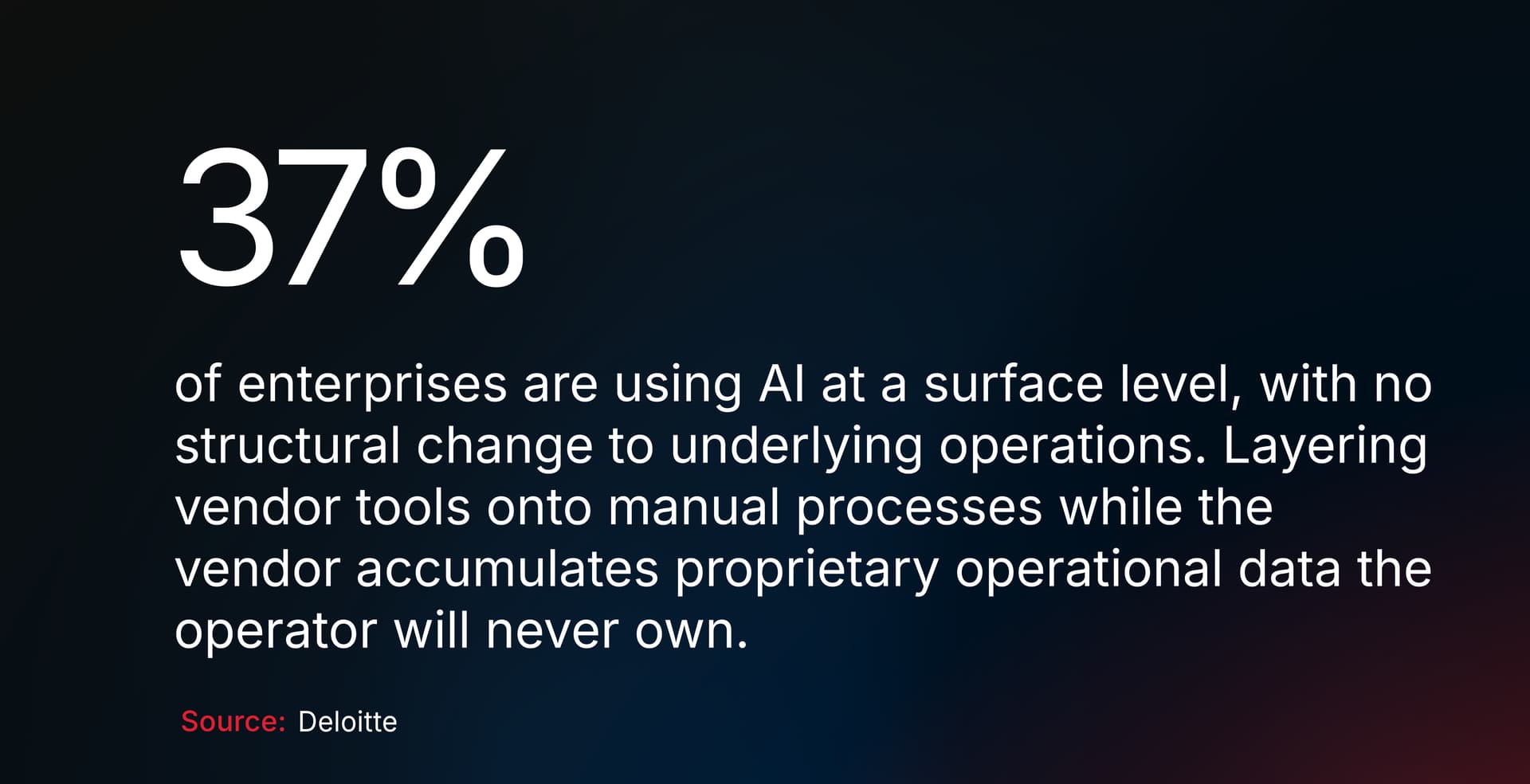
37% of organizations are still operating at a surface level of AI adoption, layering vendor systems onto existing processes without embedding intelligence into core operations (Deloitte, 2026). In logistics, this manifests as computer vision deployments that generate outputs while the underlying operational intelligence accumulates outside the organization.
Moreover, 92% of operations leaders report that their legacy technology investments have not delivered full ROI (PwC, 2026). The investment has been made across cameras, WMS infrastructure, TMS platforms, and vendor AI engagements. The intelligence has not been built.
The Reasoning Gap remains open. The enterprise vendor model is what kept it open, while appearing to close it.
The Logistics Core Is Now Contested by Intelligence Ownership
The competitive threat to mid-market 3PLs is intelligence ownership. Operators embedding sovereign AI and computer vision into their workflows are compounding facility-level intelligence with every shipment processed. This creates a form of operational advantage that strengthens continuously and scales with volume.
Amazon’s logistics network operates as an integrated intelligence system where computer vision, robotics, and warehouse data continuously train optimization models across fulfillment operations (Amazon, 2025). Each cycle improves routing accuracy, inventory flow, and dock-level execution. The physical network generates data. The data trains the models. The models refine the network. This closed-loop system compounds into a proprietary logistics intelligence layer that remains fully owned and continuously improving.
This reflects a broader structural principle shaping AI in supply chain operations. Logistics providers that own the environment where operational data is generated develop facility-specific reasoning systems trained on real-world workflows, cargo behavior, and handling conditions. This intelligence compounds over time and remains embedded within the organization’s infrastructure.
For mid-market logistics providers, the implication is immediate. Providers building sovereign computer vision systems in 2026 are accumulating proprietary operational data that translates directly into measurable capability. By 2027, this capability will surface in enterprise procurement through verifiable shipment records, automated damage detection, audit-ready compliance logs, and real-time chain-of-custody validation.
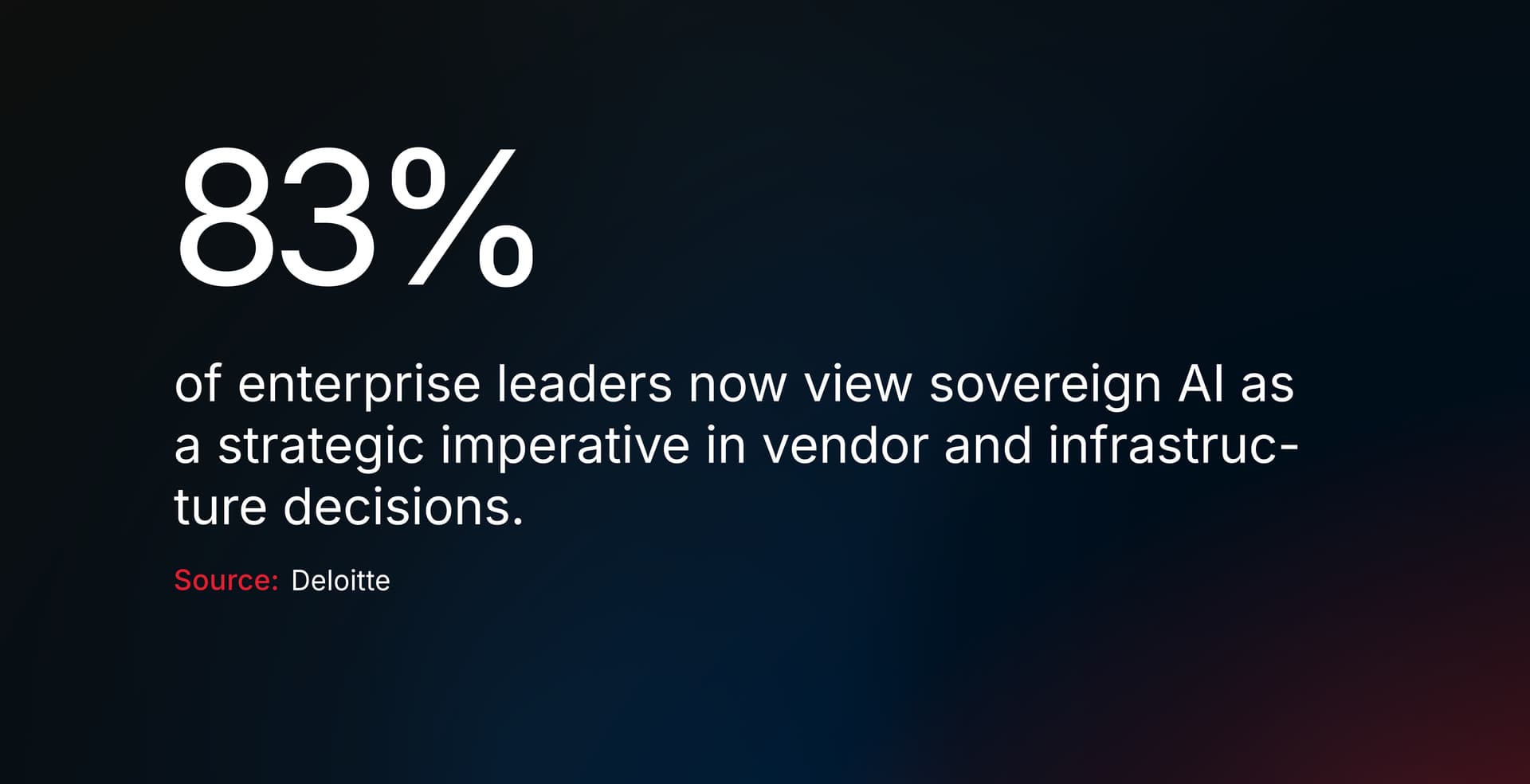
The providers who control the intelligence layer own the customer relationship. 83% of enterprise leaders view sovereign AI as a strategic imperative in vendor and infrastructure decisions. The logistics providers building that sovereignty in 2026 will not need to make that argument to enterprise shippers in 2027. Their operational record will make it for them.
Operators who start in 2027 will be starting from scratch. They'll face competitors who built 18+ months of facility-specific intelligence; time that capital expenditure cannot buy back.
Sovereign Intelligence by Architectural Design – Physical AI Layer
A different architectural model is taking shape across logistics networks that treat intelligence as a core operational layer. These systems are designed around a single principle. The intelligence generated within the operation remains owned by the operation.
The five structural costs outlined above trace back to deploying computer vision through infrastructure the operator does not control. The resolution is architectural. It does not require replacing existing hardware or rebuilding WMS workflows. It requires an intelligence layer where every training signal, model update, and operational insight compounds within the operator’s environment.
This is not a software deployment model. It is an ownership architecture.
This is the physical AI execution layer. A software and model intelligence architecture that interposes between the raw visual data stream produced by existing camera infrastructure and the operational systems the logistics network already runs. It converts footage into reasoning and recordings into evidence. CCTV systems across U.S. logistics facilities integrate directly through standard RTSP and ONVIF protocols. Processing occurs within the facility perimeter, ensuring data sovereignty, eliminating latency, and maintaining control over sensitive operational data.
The objective is to transfer ownership of the intelligence that produces them.
CodeNinja operates as an architect of the intelligence layer, designed so that dependency terminates at deployment and ownership persists with the operator.
Every training cycle, every model refinement, and every operational insight remains within the operator’s environment as a permanent asset. Nothing is abstracted behind external infrastructure. Nothing compounds outside the network that generates it.
Dependency ends at the point of architecture. Sovereignty begins at the point of control.
This architectural approach addresses the structural vulnerabilities that create margin erosion in modern logistics operations.
Download Whitepaper: The Cost of Invisibility in a Hyper-Volatile Logistics Landscape
to learn the six-month maturation cycle CodeNinja deploys to achieve production-ready Physical AI systems.
Closing the Reasoning Gap at the Training Signal
The Reasoning Gap is resolved at the training signal. Computer vision systems in U.S. logistics require more than labeled images. They require training architectures that encode how freight moves, how risk emerges, and how accountability is established across custody events.
- CodeNinja applies a structured training model built to transfer ownership of intelligence through layered architecture. Each layer contributes a distinct capability that compounds within the operator’s environment.
- The foundation begins with open-weight models. Computer vision systems are built on architectures where model weights remain accessible, ensuring that no external vendor controls the underlying intelligence layer.
- Security is embedded at the infrastructure level. Access control, auditability, and threat modeling are integrated into the training and deployment lifecycle, aligning the intelligence layer with enterprise security requirements.
- Domain-specific fine-tuning transforms the model into a system trained on the operator’s workflows. Cargo handling patterns, dock operations, and facility-specific edge cases become part of the model’s reasoning structure.
- Context is embedded directly into the training layer. Operational policies, historical shipment data, exception logic, and compliance rules are encoded into the system so that reasoning reflects how the network actually operates.
- Infrastructure ownership anchors the architecture. Training and inference occur within environments controlled by the operator, whether on-premise, in a private cloud, or within a sovereign deployment boundary.
This layered approach produces a system where intelligence compounds inward. Every shipment processed strengthens the operator’s model. Every operational cycle expands a proprietary reasoning base that remains aligned to the network that generates it.
The Multimodal Reasoning Engine applies temporal logic across multi-camera sequences to evaluate event chains. Seal condition at inbound scan. Pallet position during transit. Handoff state at outbound. These sequences establish causation across time and location, producing outputs that meet the evidentiary standard required for dispute resolution, compliance audits, and enterprise reporting.
Operational Integration Without Structural Disruption
The intelligence layer enters the operational workflow at the point of execution. Computer vision outputs are embedded directly into WMS and TMS systems through MCP-enabled bidirectional connectors.
Shipment-level events are evaluated in real time. Visual verification, anomaly detection, and compliance records are attached to operational workflows as they occur. High-risk shipments are prioritized based on cargo value, exposure patterns, and facility conditions.
Execution improves without introducing parallel systems. Visual data is converted into operational signals that drive decisions inside the systems logistics providers already use.
Sovereign Weights and Golden Path Datasets: The Architecture of Permanent Ownership
At the conclusion of the model maturation cycle, all fine-tuned weights transfer permanently to the operator’s infrastructure. The training datasets developed during this process become a proprietary asset owned by the operator.
This establishes a closed ownership loop. Training, inference, and refinement remain inside the operator’s environment. Models can be extended, retrained, and deployed without external dependency.
Each shipment processed expands a proprietary intelligence base that compounds over time. This accumulation cannot be replicated through access to shared models or external platforms. It is built from operational time within a specific network.
This is the structural difference between accessing intelligence and owning it. One produces outputs. The other compounds advantage.
From Vendor Dependency to Sovereign Visual Intelligence
Enterprise procurement in U.S. logistics has shifted from capability evaluation to control verification. Computer vision is no longer assessed on what it detects. It is assessed on who owns what it learns.
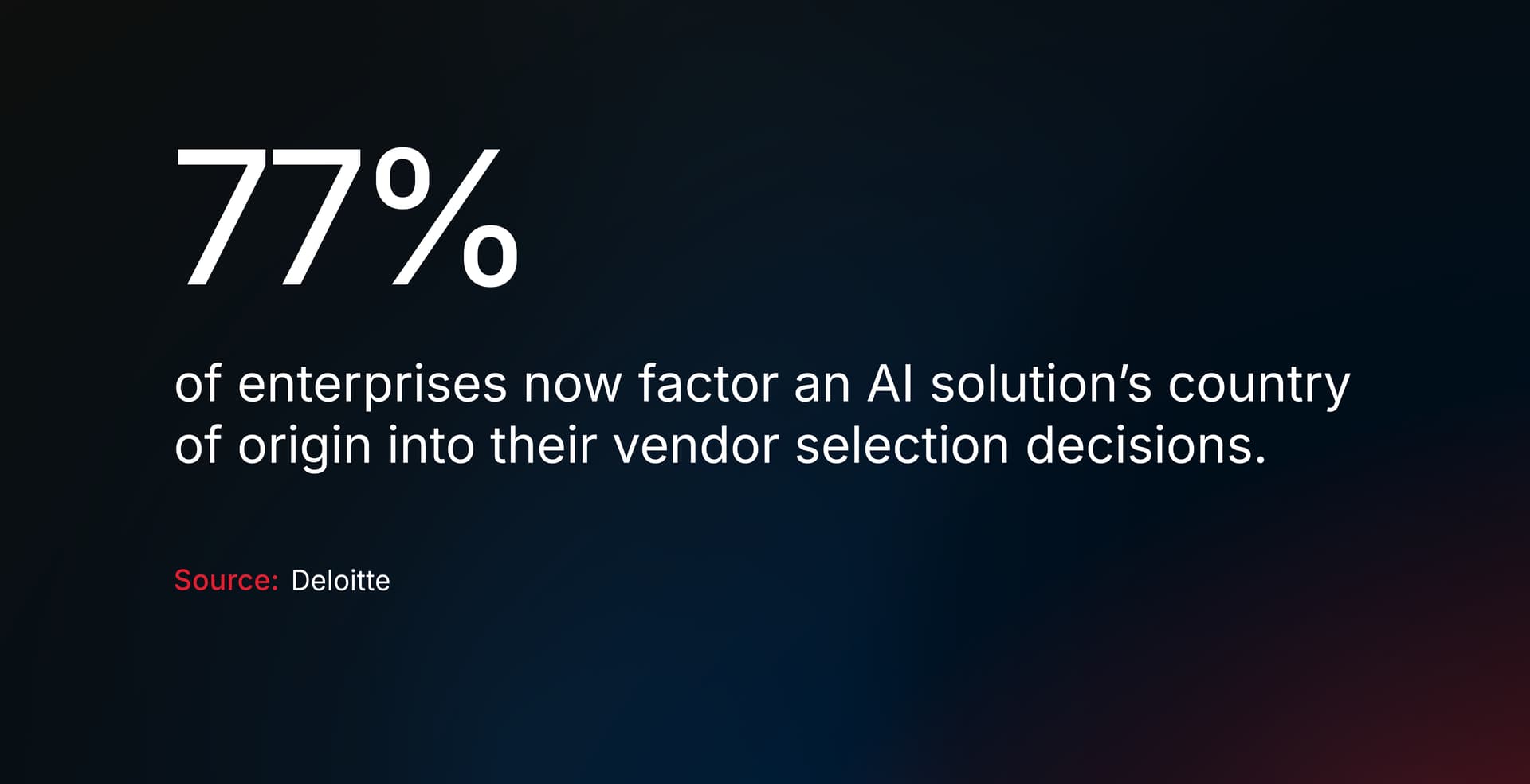
77% of enterprises now factor an AI solution's country of origin into their vendor selection decisions (Deloitte, 2026). That figure signals that sovereign AI has crossed from boardroom conviction into commercial qualification criteria.
Enterprise buyers now anchor evaluation on three conditions:
- Ownership of the intelligence generated inside the network.
- Jurisdiction over where that intelligence resides.
- Control over how it evolves across deployment cycles.
These conditions define eligibility. Logistics providers operating vendor-controlled computer vision cannot establish verifiable ownership of the intelligence layer. They cannot guarantee containment of operational data. Or demonstrate jurisdictional clarity across deployments.
This introduces a structural constraint at procurement. Capability is evaluated alongside control. Performance is evaluated alongside ownership. The absence of sovereignty becomes a measurable risk in enterprise contracts.
Sovereign visual intelligence resolves this constraint at the architectural level. Intelligence compounds inside the operator’s environment. Training remains within the operator’s control. Deployment aligns with the operator’s jurisdiction.
Enterprise buyers are selecting for operators who can prove this structure. Ownership is now the qualifying signal.
Strategic Subordination by Design
The logistics providers deploying vendor-dependent computer vision in 2026 are funding the construction of an intelligence asset they do not own.
Every shipment processed contributes to a training corpus the operator cannot access. Every theft signature detected strengthens a model the operator cannot retrain. Every facility expansion resets the dependency at greater cost. Every competitor who engages the same vendor benefits from operational patterns the operator revealed.
This is architectural subordination. The operator owns the infrastructure, carries the liability, and generates the data. The vendor owns the intelligence, controls the training loop, and compounds the advantage. Framing that arrangement as a partnership does not change its structure.
Enterprise procurement has already adjusted to this reality. Ownership is now the qualifying signal. Operators who cannot demonstrate control over their intelligence layer enter the market with a structural constraint that performance alone cannot resolve.
Outsourcing computer vision transfers the reasoning layer that defines operational accountability, audit defensibility, and competitive differentiation in U.S. logistics.
The alternative is already in motion. Intelligence that compounds inside the operator’s environment. Training that remains under operator control. Systems that strengthen with every shipment and remain aligned to the network that generates them.
In an industry where operational intelligence compounds with time, ownership becomes accumulation. Accumulation becomes advantage. Advantage, sustained across cycles, becomes a moat competitors cannot replicate.
Discuss sovereign Computer Vision infrastructure for your logistics network
Bibliography
- Amazon. 2026. "Amazon Has More Than 1 Million Robots That Sort, Lift, and Carry Packages—See Them in Action." Amazon News. https://www.aboutamazon.com/news/operations/amazon-robotics-robots-fulfillment-centera
- CargoNet. 2026. "Cargo Theft Losses Surge to Estimated $725 Million in 2025, Verisk CargoNet Analysis Reveals." Verisk Analytics. https://www.verisk.com/company/newsroom/cargo-theft-losses-surge-to-estimated-$725-million-in-2025-verisk-cargonet-analysis-reveals/
- Deloitte. 2026. "The State of AI in the Enterprise." Deloitte. https://www.deloitte.com/cz-sk/en/services/consulting/research/the-state-of-ai-in-the-enterprise.html
- Gartner. 2025. “5 Ways SaaS Vendors Are Increasing Costs and What to Do About It.” Gartner. https://www.gartner.com/en/documents/7092230
- PwC. 2025. "2025 Digital Trends in Operations Survey." PricewaterhouseCoopers. https://www.pwc.com/us/en/services/consulting/business-transformation/digital-supply-chain-survey.html