AI System and Agent Infrastructure
CodeNinja builds AI systems, agentic workflows, and processing intelligence on AWS, with every agent configuration, model artifact, and pipeline transferred permanently to your accounts at close.
Most AI programs are built on infrastructure the client never fully controls.
Agents, models, and processing pipelines built on partner-managed infrastructure work, but the organization that funded them does not fully own them. When the commercial relationship changes, the AI capability does not automatically transfer.
The intelligence a program produces should transfer permanently at close, but most delivery models do not produce this outcome by default. The infrastructure design is where ownership is decided.
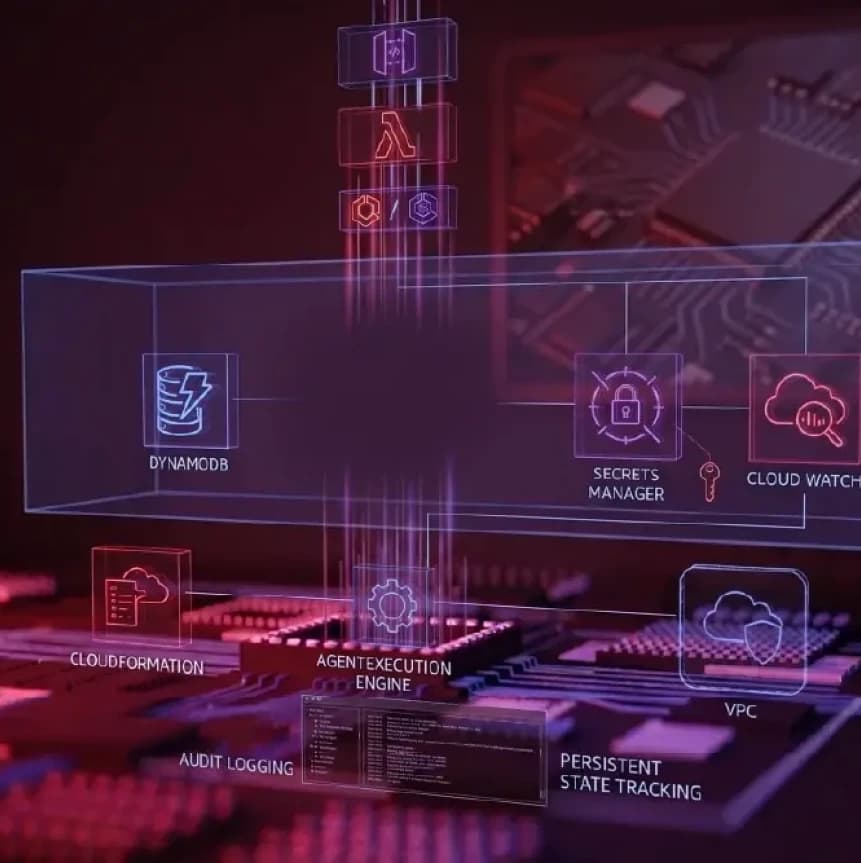
CodeNinja builds AI systems on AWS that transfer completely at close, with every agent configuration, model artifact, and processing pipeline living in your repositories and running from your accounts. CodeNinja access is removed at close.
96%
Extraction accuracy on automated document workflows
94%
Reduction in end-to-end automated processing time
60+
AWS services running across our delivered platforms
40%
Lower infrastructure cost after migration to AWS
Four AI Engagements on AWS
Production Agents, Document Intelligence, Ai Search, And Managed Operations.
Agentic AI Systems and AgentOps Platform
Production agents that act, not demos that stall.
- Agent Design, Reasoning Architecture, and Task Orchestration
- Amazon Bedrock and AgentCore Deployment and Tool Integration
- AgentOps Control Plane: Routing, Security, and Observability
- Human-in-the-Loop Escalation and Policy Enforcement
- Full Artifact Transfer: Agent Configurations, Prompts, and Runbooks
WHAT TRANSFERS AT CLOSE
Orchestrated agents running in your AWS accounts, with full ownership of every configuration, prompt, and runbook. The AgentOps control plane operates inside your environment. CodeNinja access is removed at close.
.webp&w=1920&q=75)
Intelligent Document Processing
Turn documents into clean, validated data.
- Extraction at Scale with Amazon Textract and Amazon Comprehend
- Custom Model Training for Document Type and Edge Case Coverage
- Confidence Scoring and Human Review Workflow Integration
- Event-Driven Pipeline Architecture Triggered by Your Systems
- Results Delivered into Your Systems of Record
WHAT TRANSFERS AT CLOSE
Extraction pipelines, custom models, and confidence scoring infrastructure running inside your AWS accounts. Processing workflows triggered by your events, results delivered to your systems of record.
Generative AI Applications: Retrieval and Semantic Search
An assistant that answers from your data, with citations.
- Secure Knowledge Base Architecture on Amazon Bedrock
- Retrieval Augmented Generation with Source Citation
- Role-Based Access Control and Safety Evaluation
- Arabic and English Language Support
- Delivery in Web Applications, Microsoft Teams, or Embedded Interfaces
WHAT TRANSFERS AT CLOSE
Knowledge bases, retrieval pipelines, and application code in your repositories. Assistants running on your Amazon Bedrock accounts, with no CodeNinja dependency at close.

Managed AI Operations, MLOps, and FinOps
Keep AI sharp and your cloud bill lean.
- Continuous Model Evaluation, Drift Detection, and Quality Monitoring
- Amazon SageMaker Pipelines, Model Registry, and Retraining Infrastructure
- Guardrails, Audit Trail, and Compliance Reporting
- Savings Plans, Commitment Optimization, and Waste Cleanup
- FinOps Reporting and Spend Governance Inside Your Accounts
WHAT TRANSFERS AT CLOSE
MLOps pipelines, model registry, and monitoring infrastructure running in your accounts. FinOps governance and reporting inside your AWS environment, with no partner dependency for spend visibility.
AI Systems That Transfer Completely
Standard Delivery
- AI systems deployed on default configurations inside the delivery partner's environment, with no defined path for transferring ownership at close.
- Inference costs tracked at account level, with no attribution to individual workflows or use cases.
- MLOps and model management infrastructure configured inside partner tooling, creating dependency on partner access for retraining.
- Observability and drift detection accessed through partner platforms, requiring ongoing engagement for performance visibility.
- Engagement ends, partner access maintained for infrastructure governance and compliance reporting.
CodeNinja
- AI systems built in your AWS accounts from the first deployment, with every agent configuration and model artifact transferred permanently at close.
- Per-workflow inference cost attribution built into the infrastructure from day one, without reliance on partner data exports.
- Training pipelines, model registry, and retraining infrastructure built in client repositories and operated inside client AWS accounts.
- Monitoring and observability infrastructure runs inside your accounts. No partner dependency for performance visibility at close.
- Engagement ends, partner access removed, AI infrastructure operates independently inside client accounts.

Sovereign by Design
Every AI infrastructure engagement CodeNinja delivers is designed to transfer completely at close. The ownership architecture, covering model endpoints, training pipelines, inference routes, and observability infrastructure, is defined before the first configuration is applied. SageMaker environments, Bedrock deployments, AgentCore configurations, and governance infrastructure continue operating inside client-controlled AWS accounts after transfer. CodeNinja access is removed.
Where This Service Fits
AI and Cloud Readiness
Earlier in the Program
If you are not yet clear on which AI use cases are worth building or whether your infrastructure is ready for AWS, a Readiness Assessment gives you a ranked roadmap before any build begins.
Cloud Migration and Modernization
Next in the Program
If your AI systems are defined but your estate is still on-premises, Cloud Migration and Modernization moves you to AWS with zero downtime and AWS MAP funding built in.
The Sovereignty Audit Scopes Your First Build
Before selecting a service, know which AI use cases are worth building on your infrastructure, what they will cost to own, and whether your AWS environment is ready for production deployment.
What you receive:
- A ranked AI use case portfolio scored on impact, data readiness, and AWS build feasibility
- A target AWS architecture for your first build with a defined ownership and exit condition
- A named first engagement with a delivery timeline and a cost model
Delivered in 2 to 4 weeks. No commitment required beyond the assessment itself.