Agentic Systems for Renewable Energy and Storage
Own the Decisions That Price and Trade Your Assets
The economics of a wind farm, solar site, or battery are determined less by the asset than by the decisions made on top of it. Today those decisions increasingly run on vendor-controlled platforms. CodeNinja builds agentic systems that execute them on your forecasts and assets, inside your environment, and transfer the capability to you at engagement close.
%20(1).jpg&w=3840&q=75)
%20(1).jpg&w=3840&q=75)
The Economics of Power Have Changed, and the Money Moved to the Decision
Renewable and storage returns used to track output. They now track timing. The International Energy Agency reports that curtailment volumes rose roughly fifty-five percent in 2024, reaching about 4.1 percent for wind and 3.2 percent for solar, and the hours of negative prices have surged as solar peaks collide across markets (IEA, 2025). Revenue now depends less on how much an asset generates and more on whether the megawatt is worth anything when it arrives.
That value is captured or lost in decisions made thousands of times a day. A battery earns by charging before a price spike and discharging into it, a portfolio earns by bidding the right block and curtailing ahead of a negative-price window, and a storage owner protects its returns by trading only as hard as its warranted degradation allows. These are agentic decisions, at a cadence and complexity no human desk optimizes by hand.
So the decisions have moved to AI, but usually to a vendor's optimizer whose logic the operator cannot inspect, tune, or keep. The owner has outsourced twice: the forecast and degradation models that price the asset, and the decision that monetizes it. When the platform reprices or the contract ends, the intelligence that made the money stays with the vendor, and the operator is left holding steel and a spreadsheet.
What the Changed Economics Put at Risk
The Forecast Sets the Debt
A generation model prices the capital stack before construction, fixing the P90, the debt the asset carries, and the PPA it can guarantee.
Degradation Sets the Ceiling
A battery's real duty, not its warranty, decides how hard it can trade before it breaches guarantees and forces early augmentation.
The Decision Is Rented
Dispatch and trading run on a vendor optimizer whose logic the operator cannot see, tune, or keep when the contract ends.
.jpg&w=3840&q=75)
Why a Vendor Optimizer Doesn't Trade Your Book
A trading or dispatch model built for the market gives you the market's average behaviour, not your asset's. Your sites have their own generation shape, your batteries their own degradation and thermal reality, your portfolio its own obligations, positions, and risk tolerance, and a shared optimizer averages exactly the differences that decide your margin.
Worse, when the agent that trades your assets runs on a vendor's platform, the intelligence that monetizes your portfolio compounds on someone else's system, improving a product sold across the market while you pay for access to it per seat or per megawatt. An owner in that position rents the decision layer of assets it owns outright.
Decisioning Captured as Owned Infrastructure
The owners pulling ahead are not making fewer decisions with AI. They are making the same decisions with agents they own, trained on their own forecasts, telemetry, and positions, running in their own environment, and sharpening with every settlement period the portfolio trades.
The architecture deploys on top of the forecasting and degradation signals and the market and SCADA connections already in place, and every consequential action runs within the risk limits and approvals the operator defines.
.jpg&w=2048&q=75)
Agents Trained on Your Assets, Not the Market Average
Work AI for renewables and storage is agentic decisioning built on your operational and commercial reality. The agents reason over your generation and degradation forecasts, real-time prices, asset state, and open positions, and they act through the energy-management, dispatch, and trading systems your teams already run. Nothing routes through CodeNinja infrastructure, and every autonomous action runs inside your defined risk limits with a complete audit trail.
.jpg&w=3840&q=75)
The Deployment Cycle
Signal Baseline connects to your forecasting, historian, SCADA, and market-data infrastructure and captures your current decision rules and risk limits. Reasoning Fine-Tuning develops portfolio-specific decision agents validated against your own settlement history, so bidding, dispatch, and augmentation logic is proven on your past markets before it acts.
Production Deployment transfers the agent stack permanently into your environment, with agent weights, decision logic, golden-path datasets, and documentation, and nothing retained by CodeNinja
Work AI Across Renewables and Storage: Four Deployments
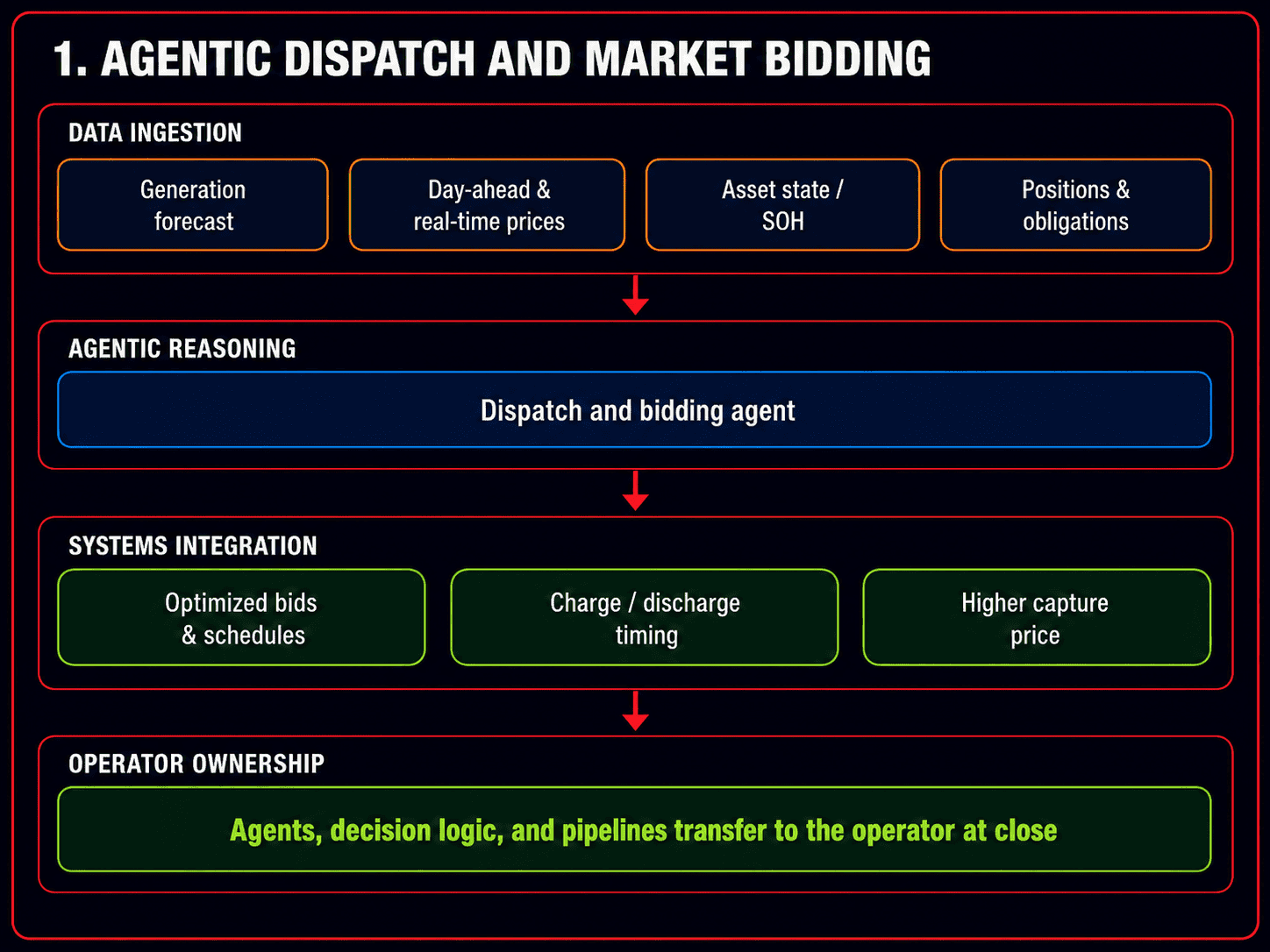
1. Agentic Dispatch and Market Bidding
THE PROBLEM
A generation forecast and a price curve are only worth the bids and schedules built from them, and those are decided thousands of times a day across day-ahead and real-time markets. Optimized by a generic tool, the asset captures the market average; optimized poorly, it spills capture price every settlement period.
THE SOLUTION
The dispatch agent reasons over your forecast, prices, asset state, and positions and produces bids and charge and discharge schedules tuned to your assets and markets. It runs within your risk limits with a full audit trail, sharpens against your own settlement outcomes, and belongs to you at close.
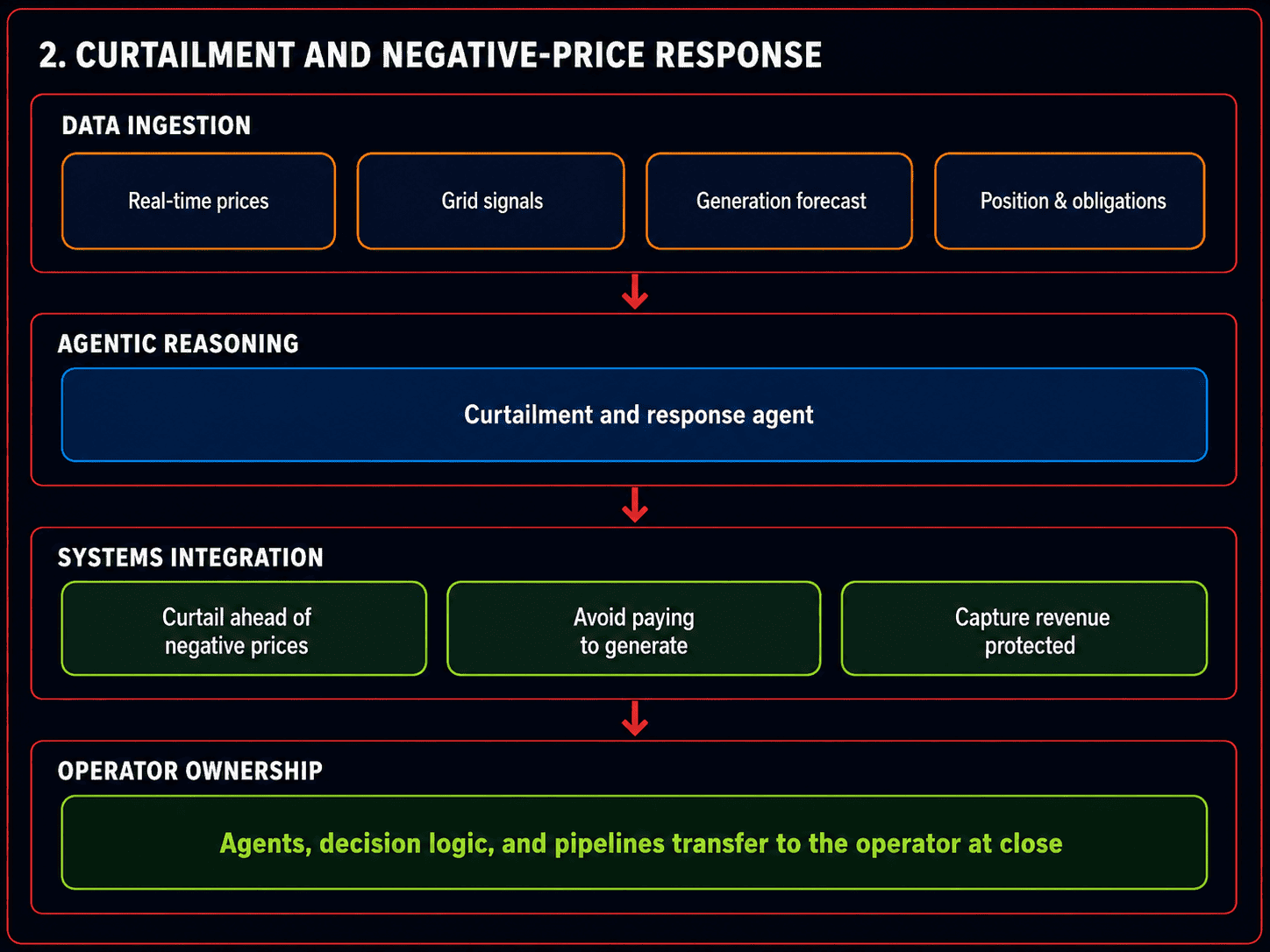
2. Curtailment and Negative-Price Response
THE PROBLEM
As negative-price hours surge, generating into them destroys value, but curtailment decisions made on generic rules either react too late or spill revenue by curtailing when the price would have recovered. The margin sits entirely in the timing.
THE SOLUTION
The response agent watches real-time prices, grid signals, and your forecast and curtails or holds ahead of negative-price windows against your specific position and obligations. It protects capture revenue by acting on your assets' economics rather than a market-wide default.
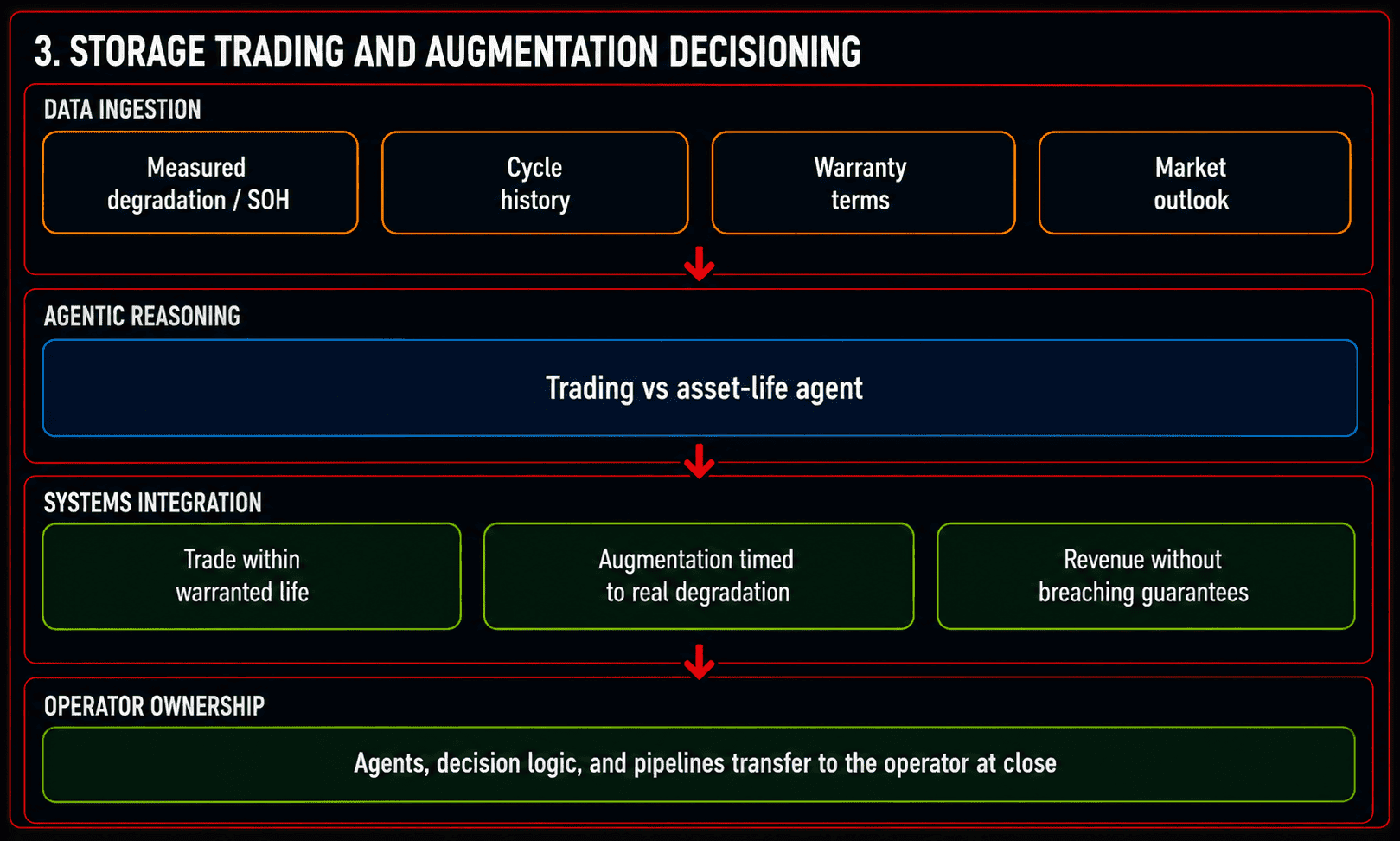
3. Storage Trading and Augmentation Decisioning
THE PROBLEM
Every cycle a battery runs to chase revenue also spends its warranted life, and the augmentation decision of when to add capacity is a large capital call routinely mis-timed against a generic degradation assumption. Trading and asset life are the same decision, and generic tools treat them separately.
THE SOLUTION
The agent trades the battery against its own measured degradation, maximizing revenue within warranted life and timing augmentation to the cells' actual state of health rather than a nameplate curve. Revenue and asset life are optimized together, on your assets, under your guarantees.
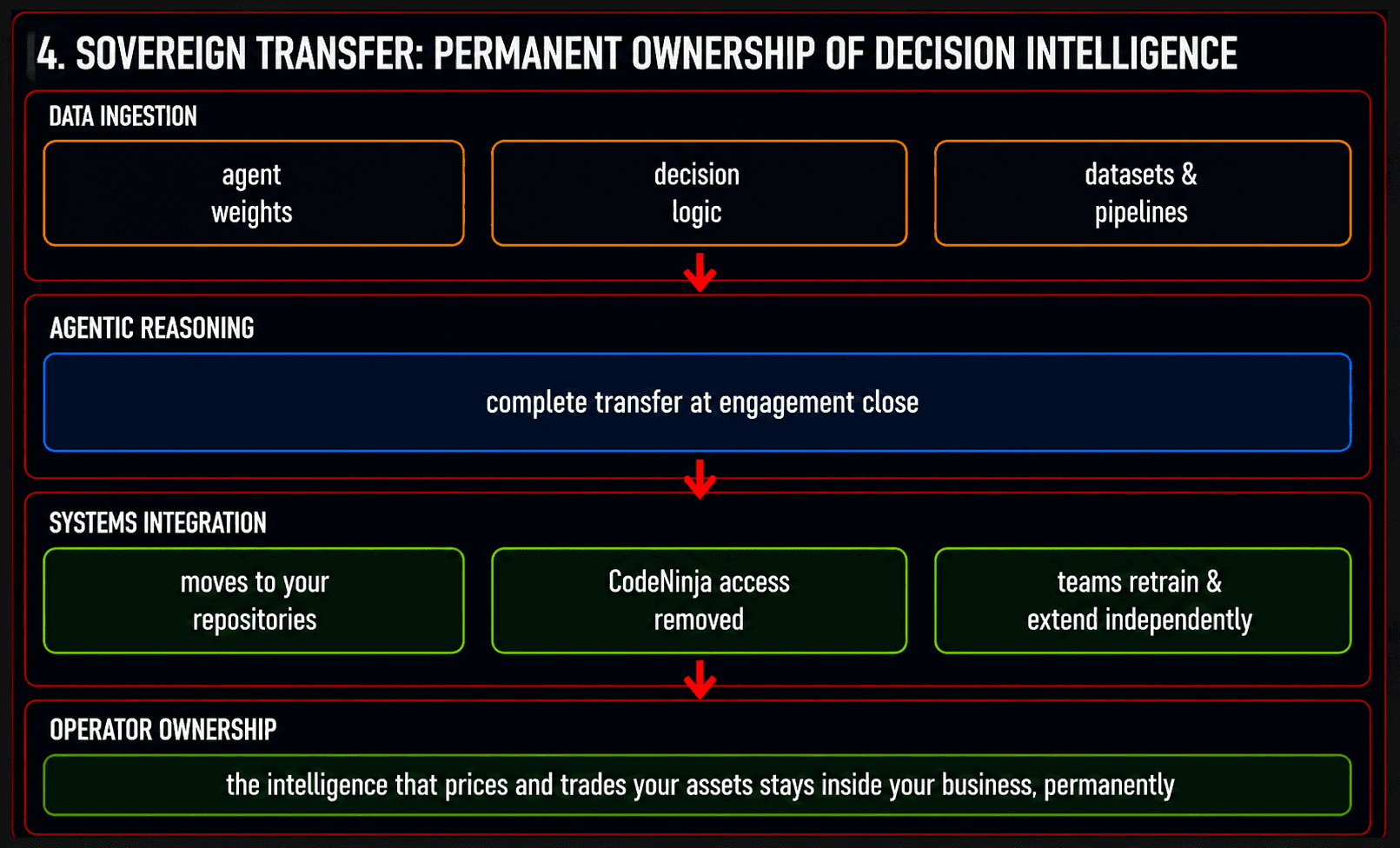
4. Sovereign Transfer: Permanent Ownership of Decision Intelligence
THE PROBLEM
Every decision routed through a vendor optimizer is a cycle that improves the vendor's model of the market, not your control of your assets. When the relationship changes, the decision intelligence built on your portfolio does not come with you, and the asset's economics stay hostage to a platform.
THE SOLUTION
Every engagement closes with complete transfer. Agent weights, decision logic, datasets, pipelines, and documentation move to your repositories, CodeNinja access is removed, and your teams retrain and extend independently. The intelligence that prices and trades your assets stays inside your business, permanently.
Frequently Asked Questions