Physical AI Solutions for Energy Operations
Turn Grid Signals into Intelligence You Own
Your assets already generate the signal that decides your reliability and your capacity position. Today most of it is discarded or quietly training a vendor's platform instead of yours. CodeNinja deploys Physical AI trained on your own equipment, inside your environment, with every model transferring to you permanently at close.
.jpg&w=3840&q=75)
%20(1).jpg&w=3840&q=75)
The Grid Has Crossed Its Operating Margin
The systems watching your equipment were built to log state, not to reason over it. A transformer drifts toward failure for weeks while the platform compares its signature to a fleet average instead of its own history, and your control room sees it only when the threshold trips. The weeks of warning in between belong to no one.
That gap reprices itself every cycle. In the largest US capacity market, clearing prices rose from 28.92 to 329.17 dollars per MW in a single cycle (PJM, 2025), so an unplanned failure no longer costs the repair, it costs replacement power bought at an order-of-magnitude higher price. Every maintenance decision made without asset-specific intelligence is a bet placed at those prices.
The load is not waiting. Data center demand is climbing toward 1,050 TWh globally this year, and US capacity is on a path from 4 to 123 GW by 2035 (IEA, 2025), arriving on networks whose asset intelligence is training on someone else's platform. The operators investing hardest in AI are accumulating it outside their own walls, and the window to correct that architecture closes with the next capital cycle.
What the Current Position Costs
The Capacity Price Shock
Clearing prices up tenfold in one cycle, repricing every unplanned outage, every forecasting miss, and every deferred maintenance bet.
The Interconnection Wall
New requests waiting up to seven years, making the performance of the assets already on the network the only capacity an operator fully controls.
The Rented Intelligence Drain
An energy AI market growing from 7.6 to over 25 billion dollars by 2034, with the models trained on operator data sitting on infrastructure operators do not control.
.jpg&w=3840&q=75)
Why Fleet Averages Fail Your Fleet
Energy assets do not fail like an industry average, as every transformer carries its own loading history, every turbine its own vibration baseline, and every feeder its own demand geometry. The model trained on a specific facility's failure signatures took months of that facility's signal data to build, and it cannot be repurchased if the vendor relationship changes, which is why generic monitoring calibrated to fleet averages produces the false alarm rates that teach control rooms to ignore warnings.
Critical infrastructure cannot outsource its reasoning layer to parties that do not share its risk profile, and the sector already learned in the deregulation era what happens when operational decisions move to intermediaries with different commercial incentives.
Critical Infrastructure Deserves Intelligence It Owns
The operators establishing durable advantage are not waiting for the vendor monitoring market to close this gap. They are building facility-specific intelligence as owned infrastructure, trained on their own signal data, running in their own environment, and sharpening with every operating cycle the way their physical assets never could.
The architecture that makes this possible deploys in months rather than capital-cycle years, and it starts from the sensor, SCADA, and historian infrastructure the operator already runs
.jpg&w=2048&q=75)
.jpg&w=3840&q=75)
Intelligence Trained on Your Assets, Not the Industry Average
Physical AI for energy is reasoning infrastructure built on the operational reality of your physical environment. The models train on your telemetry, thermal and vibration signatures, load curves, and inspection imagery, and they deploy inside your environment where the signal already lives.
Nothing routes through CodeNinja infrastructure, no equipment is replaced, and the systems act through the work order, dispatch, and operations tooling your teams already use.
The Six-Month Deployment Cycle
PHASE 1
MONTHS 1 TO 2
Signal Baseline
Data architecture established from existing sensor, SCADA, and historian infrastructure across covered assets. No equipment replacement, no interruption to operations.
PHASE 2
MONTHS 3 TO 4
Reasoning Fine-Tuning
Models trained against your failure signatures, load patterns, and asset imagery, validated against held-back operational history before anything touches live operations.
PHASE 3
MONTHS 5 TO 6
Deployment and Transfer
Live operation under operator sign-off, then full sovereignty transfer. Model weights, datasets, pipelines, and documentation move to your repositories and CodeNinja access is removed.
The Operating Cost of Recording Without Reasoning
Assets and Maintenance
Failure signatures develop for weeks inside telemetry that is logged but never reasoned over, so maintenance is scheduled by calendar interval while the equipment itself is announcing its own timeline.
Inspection and Coverage
Patrol-cycle inspection means every defect between flyovers advances unwatched, and the condition of thousands of line-miles is known only as of the last pass.
Forecasting and Position
Dispatch and procurement decisions run against averaged regional forecasts while territory-specific demand stress forms in the interconnection queue that nobody is modeling.
Physical AI Across Energy Operations: Four Deployments
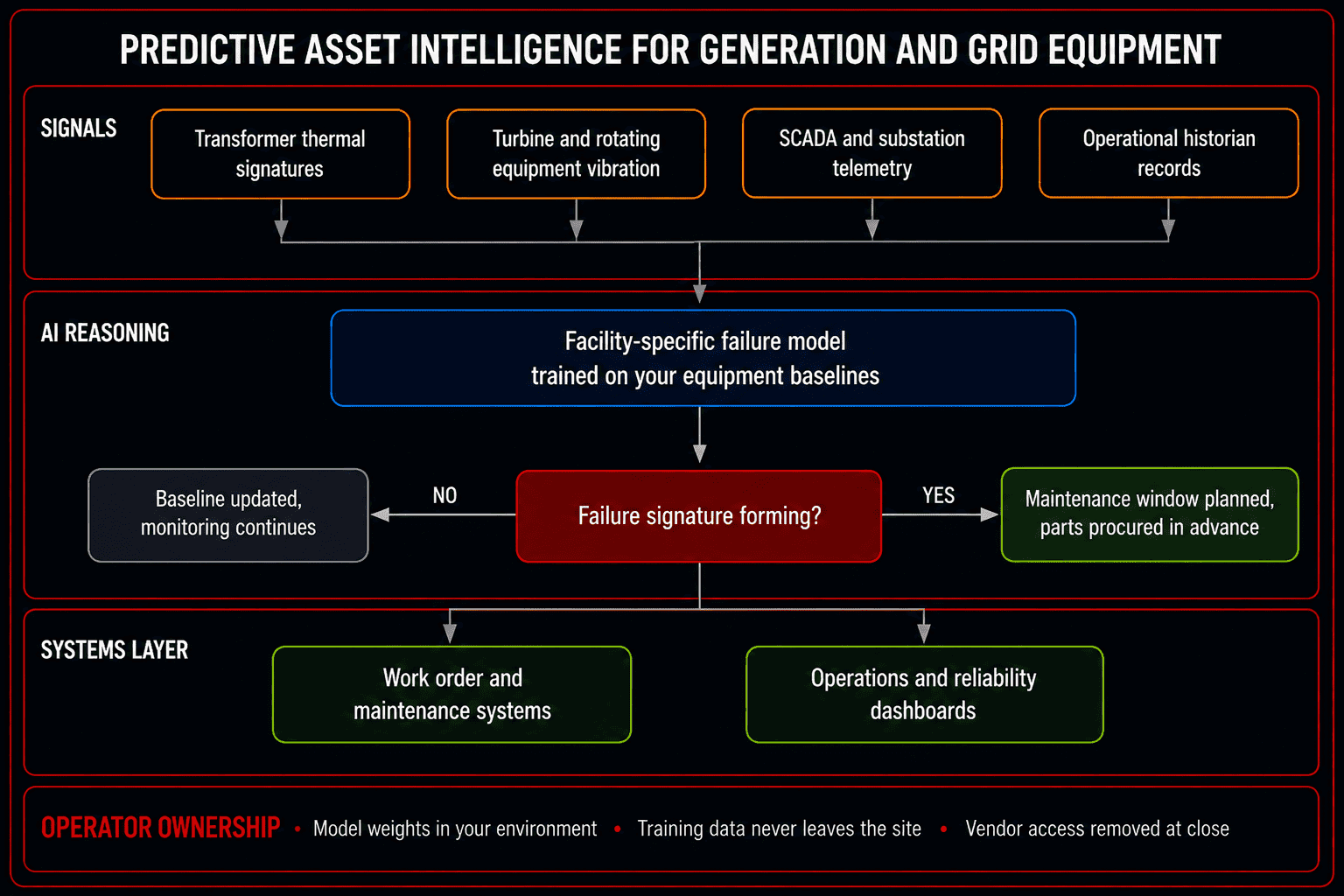
1. Predictive Asset Failure Detection Engine
THE PROBLEM
Transformer and rotating equipment failures announce themselves weeks in advance through thermal and vibration signatures, but thresholds calibrated to fleet averages either miss the pattern or bury it under false alarms. In a market where replacement power carries capacity prices that rose tenfold, every failure that arrives unannounced is paid for twice.
THE SOLUTION
The failure detection engine deploys across covered assets, ingesting thermal, vibration, current, and historian signals continuously. The model trains on each asset's own baselines and flags developing failure signatures with enough lead time to plan the maintenance window and procure parts on schedule rather than at premium, and detection sharpens with every operating cycle it observes.
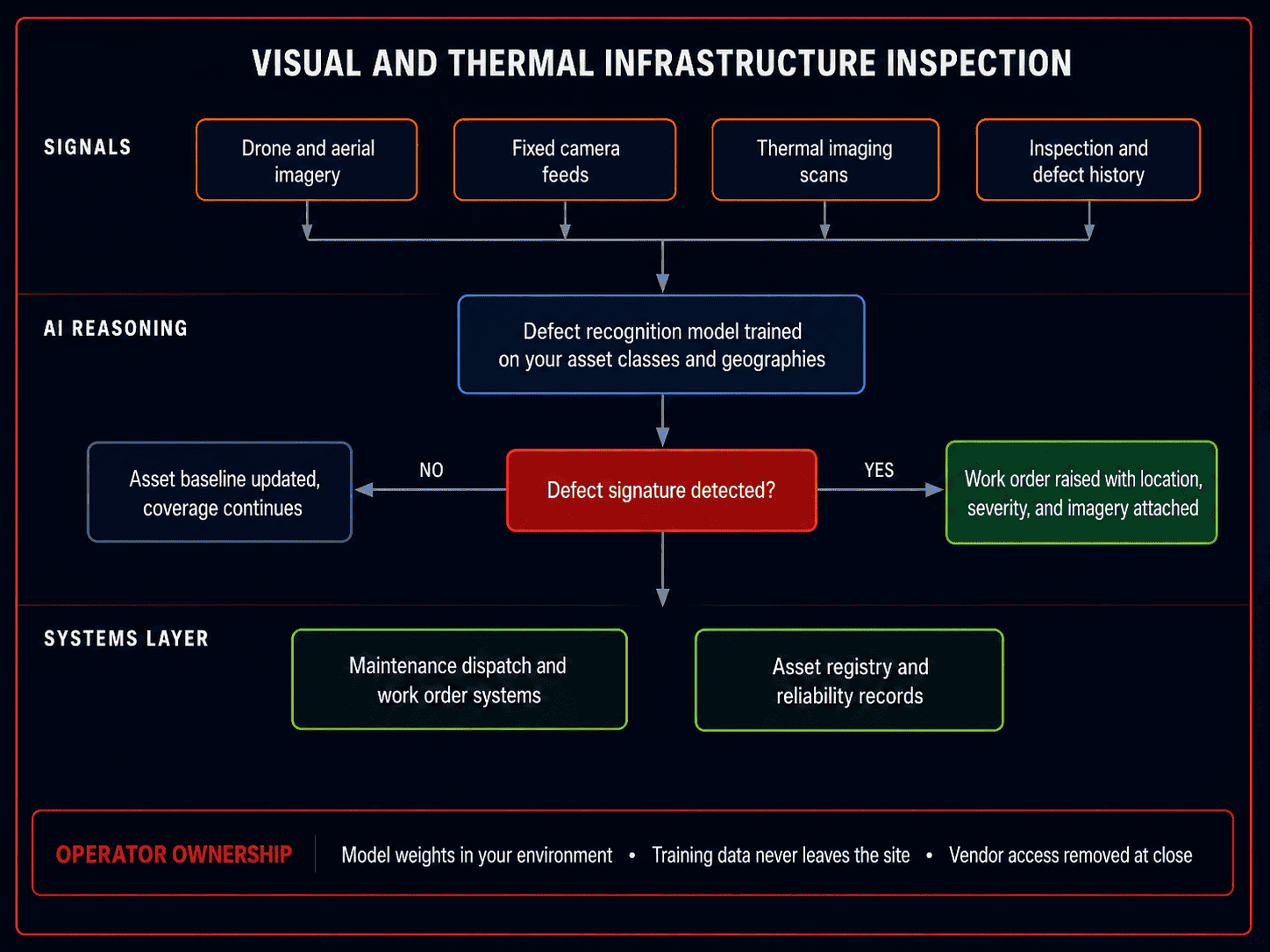
2. Visual and Thermal Infrastructure Inspection Module
THE PROBLEM
Transmission corridors, substations, and generation sites are inspected on patrol cycles, so defects are found on the calendar's schedule rather than when they form. Between patrols, corrosion advances, vegetation encroaches, and thermal anomalies develop unwatched, and the defects that matter most are the ones that do not wait for the next flyover.
THE SOLUTION
The inspection module runs computer vision and thermal analysis continuously across drone imagery, fixed camera feeds, and thermal scans, with defect recognition trained on your asset classes, your geographies, and your inspection history. Confirmed detections raise work orders with location, severity, and imagery attached, so inspection coverage moves from patrol frequency to permanent watch.
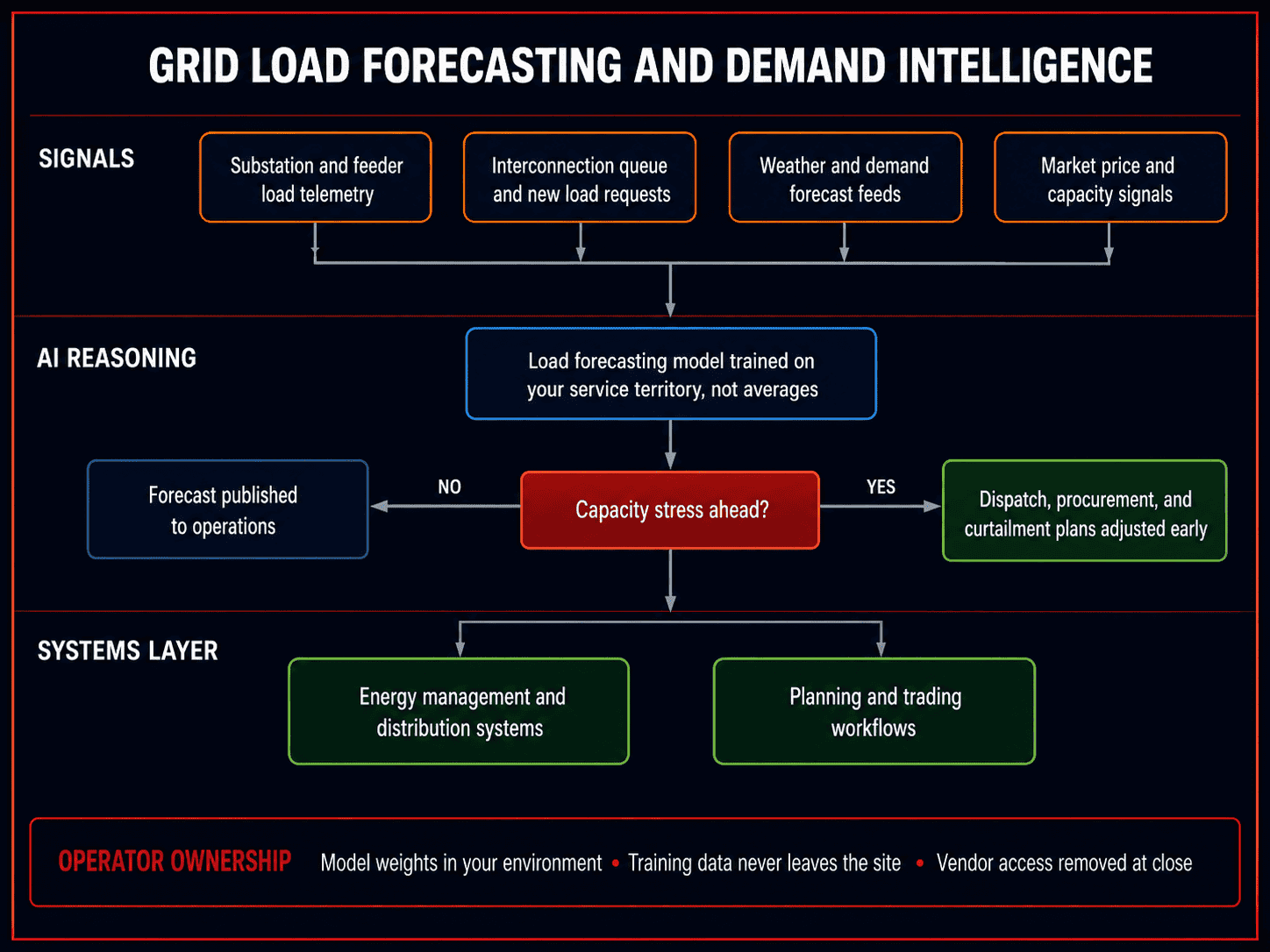
3. Grid Load and Demand Intelligence Module
THE PROBLEM
Data center interconnection requests are arriving at a scale that breaks forecasting models built on decades of stable demand growth. An operator planning dispatch, procurement, and capital allocation against averaged regional forecasts is exposed at exactly the moment the market prices that exposure most severely.
THE SOLUTION
The load intelligence module trains on your service territory's own telemetry, interconnection pipeline, and market signals, producing forecasts that see territory-specific stress forming before it reaches the dispatch desk. Procurement and curtailment decisions move ahead of the price curve instead of chasing it.
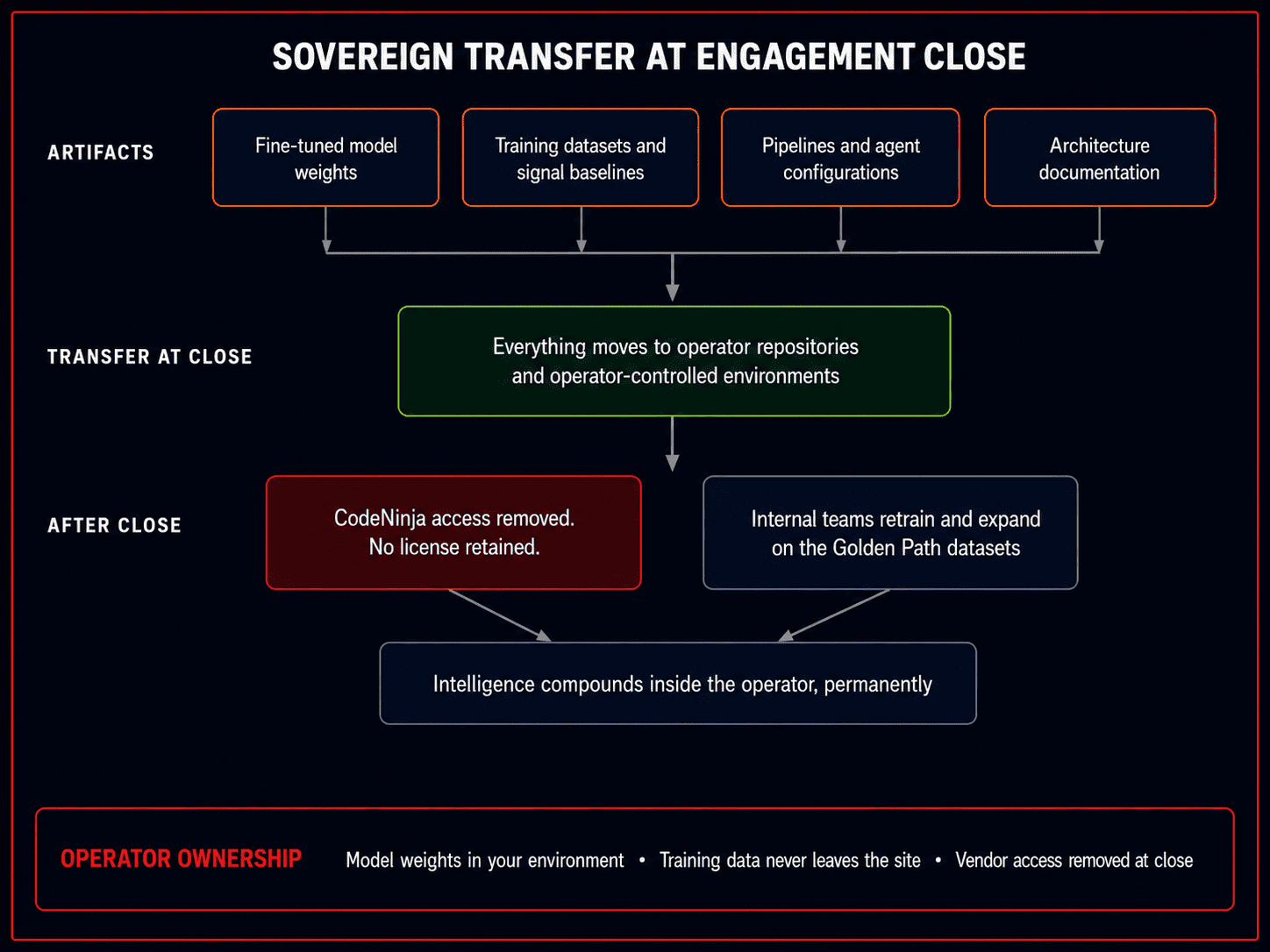
4. Sovereign Transfer: Permanent Ownership of Grid Intelligence
THE PROBLEM
Every deployment that routes operational telemetry through a vendor platform is a training cycle that improves the vendor's model rather than the operator's asset. When the commercial relationship changes, the intelligence built on your infrastructure does not automatically come with you, and critical infrastructure cannot carry that dependency.
THE SOLUTION
Every engagement closes with complete transfer. Fine-tuned model weights, training datasets, pipelines, and architecture documentation move to your repositories, CodeNinja access is removed, and your teams retrain and expand on the Golden Path datasets independently. The intelligence compounds inside the operator, permanently.
Frequently Asked Questions