Food Safety Decision Governance
Own the Decisions About What Ships and What Holds
Your inspection systems are making thousands of safety decisions a minute, faster than any quality team can verify. CodeNinja builds owned, auditable food safety decision systems tuned to your products and governed by your standards, so every pass and every hold is transparent, defensible, and under your control, and transferred to you in full at close.
.jpg&w=3840&q=75)
The Problem
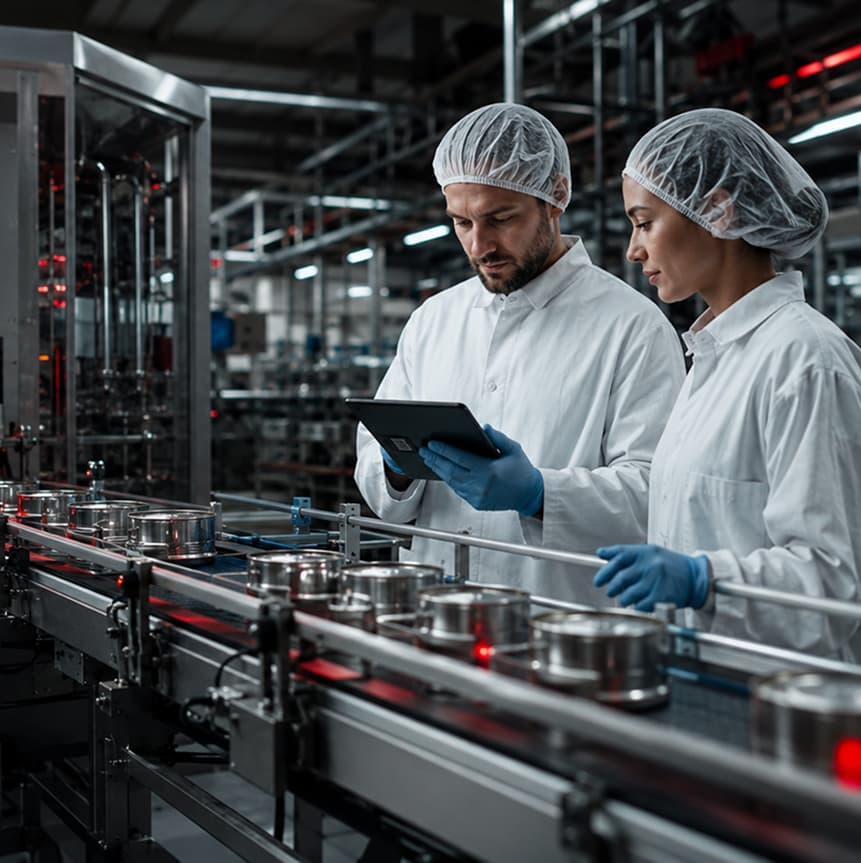
Vision systems, X-ray, metal detectors, weight checkers, and seal validators are each evaluating thousands of units a minute, and each decision carries the same stakes: is this unit safe to ship or does it hold. By design the systems inspect faster than any human can review, so the model is no longer an aid to judgment, the model is the judgment. Your quality team cannot verify those decisions in real time.
When the model making those calls is not transparent, when your team cannot see the reasoning, and when the rules come from a vendor rather than your standards, you have a governance problem: a food safety control functioning faster than you can verify it is functioning correctly. Most manufacturers control the equipment but not the decision logic, because the defect thresholds and tolerances that are the real control were set by a vendor on average production.
The stakes are rising as safety moves from a quality problem to a compliance and liability problem. AI defect-detection systems are reported to reach accuracy around 98 percent in manufacturing settings (2026 manufacturing AI adoption survey, 500 executives), yet accuracy without auditability is not defensible. One contamination event goes public before a recall is processed, and a decision delegated to a vendor model is accountability you cannot hand back in a liability event.
What Generic Approaches Put At Risk
Auditability
When an investigator asks why a unit shipped, the only answer is that the model decided it was safe.
Compliance Readiness
Traceability obligations assume a complete, auditable record of every decision made about every unit.
Line Efficiency
Generic parameters overreject and slow the line, or underreject and quietly lower the safety margin.
.jpg&w=3840&q=75)
Why Owning the Equipment Is Not Owning the Decision
Most manufacturers believe standard operating procedures, maintenance schedules, and validation documents mean they govern their inspection systems. They control the equipment; they do not control the decision-making logic. When a vision model decides whether a product is safe to ship, that call rests on defect thresholds, acceptable colour and fill ranges, and seal patterns set by someone.
If you did not set those parameters, do not understand them, and cannot explain why they are set as they are, you do not actually control the decision. True governance means you set the parameters, tune them to your products, validate them, monitor them, and change them only through your change control.
Accountability Requires Visibility Into the Decision
Accountability means your quality team can answer a specific set of questions about every unit that ships: why did this unit pass, what parameters evaluated it, were they in effect at the time, who approved them, how were they validated, and what would have caused a similar unit to fail. Most manufacturers cannot answer those questions about decisions made by vendor models, they can only report the outcome.
Owned, transparent systems let your team see why a call was made on a specific unit, verify it was correct, and identify when the system is deciding inconsistently, which is what a credible, continuous audit actually requires.
%20(1).jpg&w=2048&q=75)
Owned Food Safety Decision-Making, Governed by Your Standards
Owned safety decision-making means systems and processes entirely within your governance. Your quality team, with operations and product development, establishes the parameters for every product and the visual inspection criteria, documents the reasoning, and approves them. You set changeover procedures and the continuous monitoring that shows whether the model is still deciding the way it was trained to. The models are trained on your products, tuned to your parameters, and operate on your equipment, integrated with your existing workflow, so when a unit passes or fails your team knows why.
.jpg&w=3840&q=75)
The Deployment Cycle
An assessment baselines your current inspection process, acceptance and rejection rates, and the reasoning behind today's parameters, then develops the parameters you want for your specific products and equipment.
An owned model is deployed in parallel with your existing system to compare decisions, validated on your products, and governed with an audit trail and change control before it becomes the primary decision system. A Food Safety Decision System Assessment runs 8 to 12 weeks.
Four Deployments
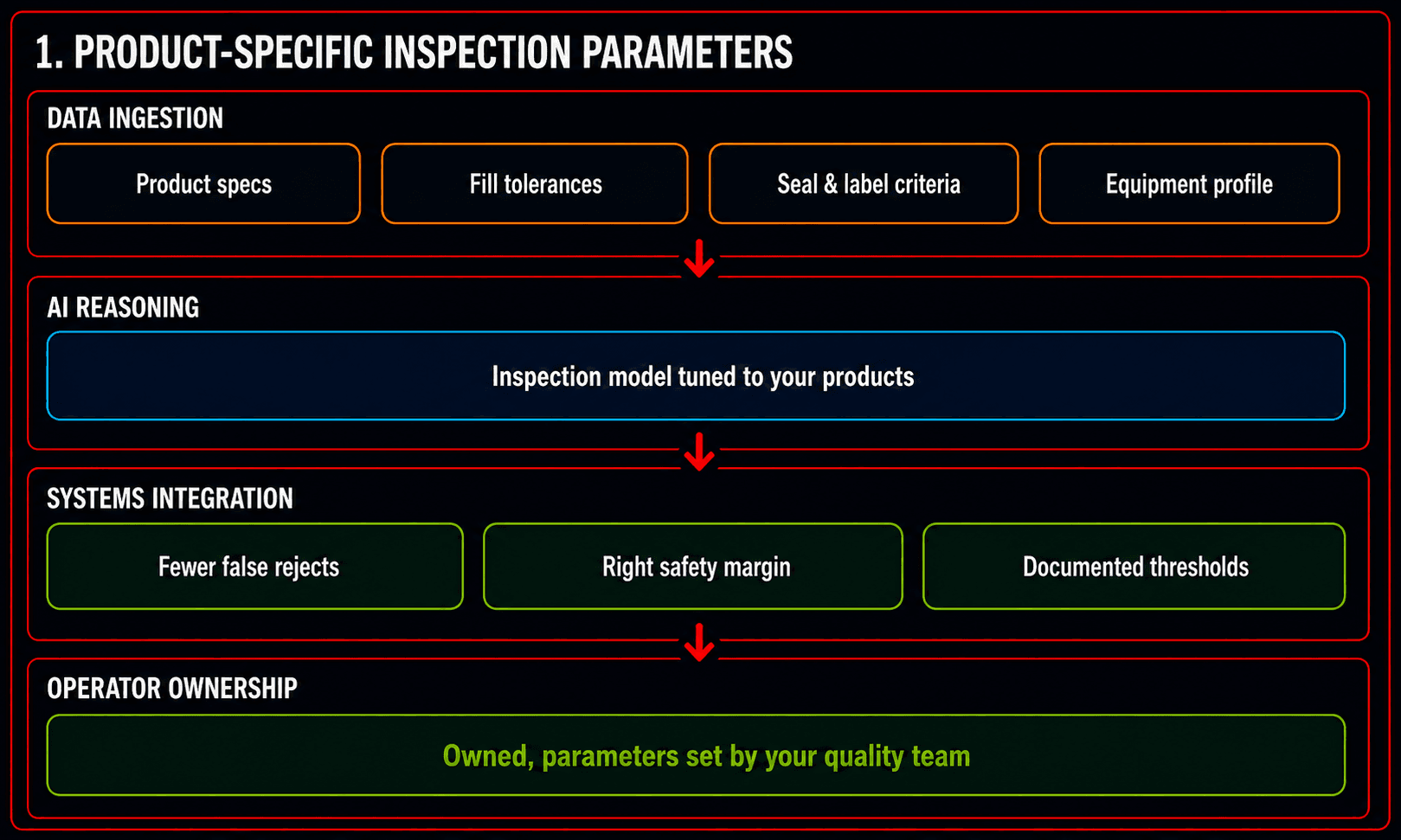
1. Product-Specific Inspection Parameters
THE PROBLEM
Vendor inspection models are tuned to average food production, but your products, fill machinery, and packaging are not average. When generic parameters do not fit, the model either overrejects and slows the line or underrejects and erodes the safety margin, and your team catches the symptoms without controlling the cause.
THE SOLUTION
Your quality team sets the defect thresholds, fill tolerances, and seal and label criteria for each product on your equipment, and the model is tuned to them. The parameters that actually govern what ships are documented, approved, and yours, not a vendor's average.
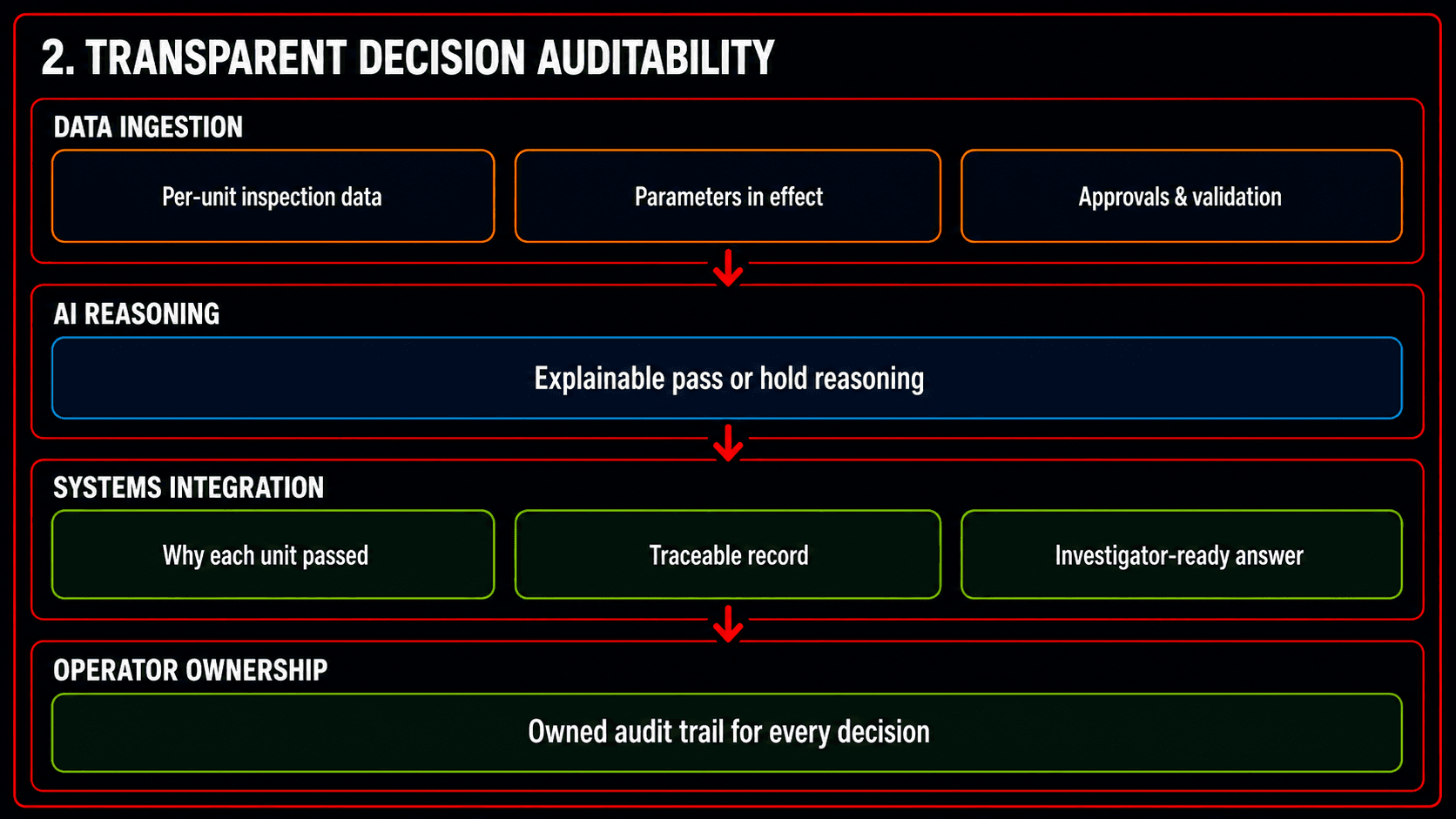
2. Transparent Decision Auditability
THE PROBLEM
Inspection systems evaluate thousands of units a minute, faster than any human can review, so the model is the judgment. When it is a black box, your team can only say the model decided it was safe, which is not an answer an investigator will accept.
THE SOLUTION
Every decision is explainable and traceable: your team can see why a specific unit passed, which parameters were in effect, who approved them, and how they were validated. A pass or a hold is a decision you can defend, unit by unit.
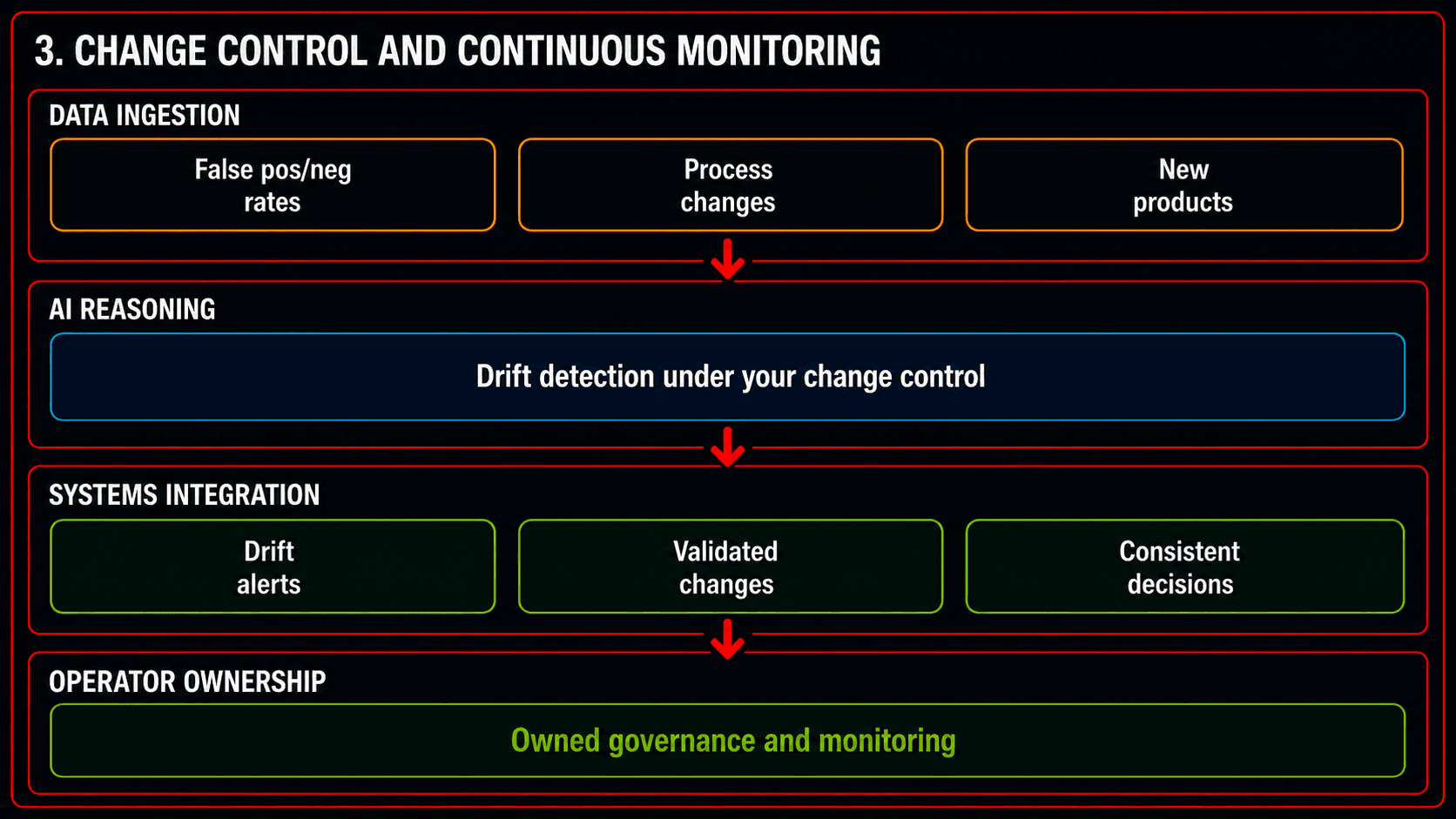
3. Change Control and Continuous Monitoring
THE PROBLEM
A model that drifts, or one a vendor updates on its own schedule, is a safety control changing outside your governance. False positive and false negative rates move, and you cannot prove the system is still deciding the way it was validated to decide.
THE SOLUTION
The system is monitored continuously under your change control. Drift is detected and alerted, parameter changes go through your validation and approval, and decisions stay consistent, so the control that governs food safety only changes when you decide and after you have validated it.
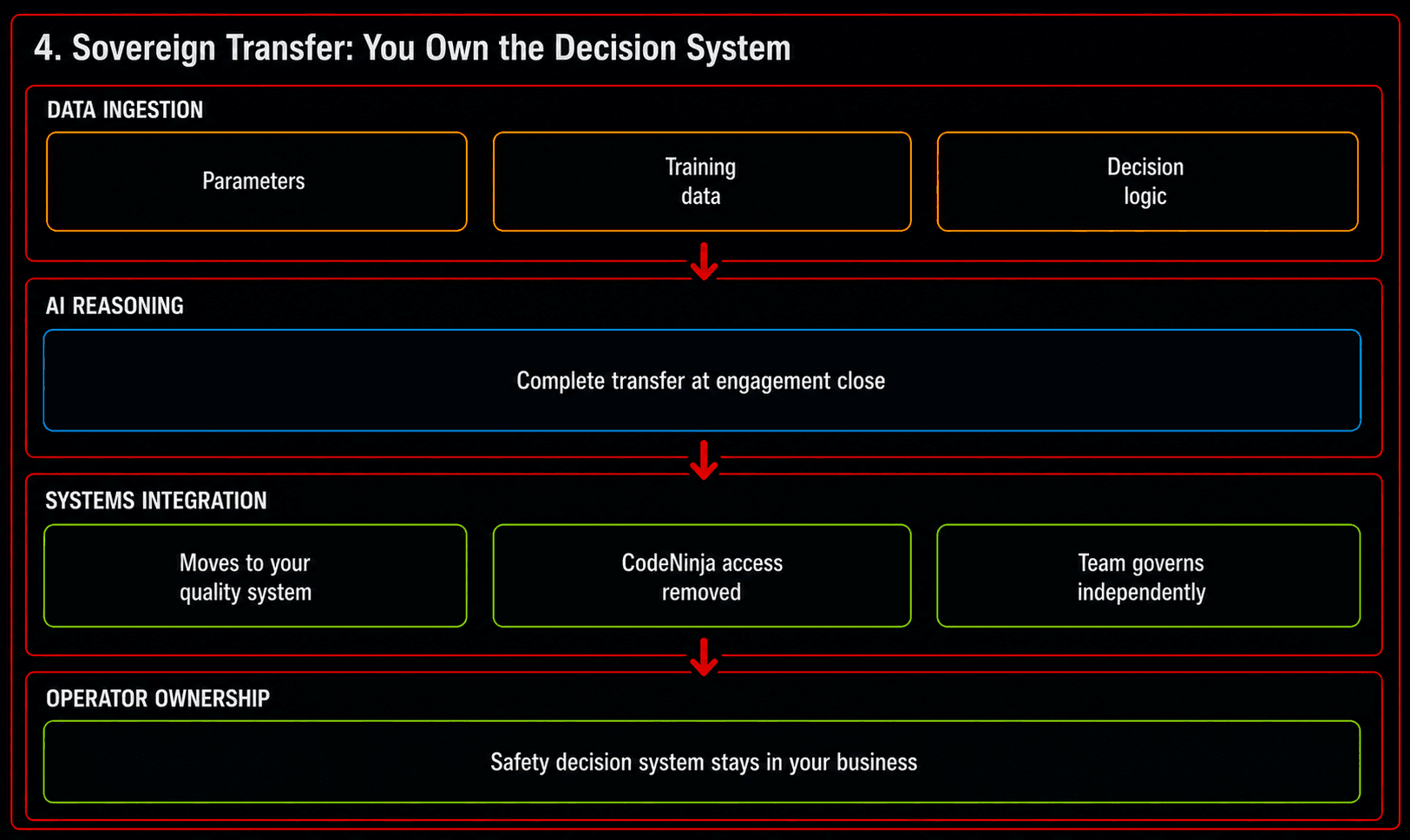
4. Sovereign Transfer: You Own the Safety Decision System
THE PROBLEM
A safety decision made by a vendor model is accountability you are delegating, and in a liability event that delegation is your problem, not the vendor's. The logic that decides what ships lives on a platform you do not control.
THE SOLUTION
Every engagement closes with complete transfer. The parameters, training data, decision logic, and audit trail move to your quality system, and your team governs, modifies, and defends them independently. The food safety decision system stays inside your business.
Frequently Asked Questions