Forecasting Built for Your Portfolio, Not the Industry Average
Forecasting Built for Your Portfolio, Not the Industry Average
Your demand is not the industry average, and it never is. Your product mix, your customers, and your market are unique, yet the forecasting systems most high-mix electronics manufacturers run were built for the average manufacturer across the average mix. CodeNinja builds owned demand intelligence trained on your specific portfolio, integrated with the systems you already run, and transferred to you in full at close.
.jpg&w=3840&q=75)
.jpg&w=3840&q=75)
The Problem
High-mix electronics demand is not the industry average, but the forecast is. Generic systems, whether statistical models trained on industry data or manual planning, are accurate at the portfolio level and wrong at the SKU level, which is where production, inventory, and supplier commitments are actually made. The result is inventory you cannot move, expedited shipments you should not need, supplier orders for products that get cancelled, and schedules built on wrong assumptions.
When SKU-level accuracy is 10 to 20 percent off across the portfolio, that error compounds across hundreds of SKUs and several quarters into millions in working capital, expedite cost, and obsolescence. On margins that have compressed from three-to-four percent to two-to-three percent (2026 manufacturing industry survey, 800 leaders across North America, Europe, and Asia), a forecast that is wrong by that much is the difference between hitting margin and missing it.
The pressure is rising, not easing. Supply chain volatility is higher than in decades, product lifecycles are compressing so historical patterns matter less, and customer demand is spikier and more custom. A forecast built on the assumption that the future looks like the past is increasingly wrong for a business that is changing faster than history can predict.
What Generic Forecasting Puts At Risk
Forecast Accuracy
Generic forecasts miss 10 to 20 percent of SKU-level demand while the portfolio total looks right.
Inventory Efficiency
Working capital tied up in slow-moving products, and stockouts in the SKUs customers actually want.
Supply Chain Stability
Constant expedites and reactive sourcing as the plan chases forecast error it never predicted.
.jpg&w=3840&q=75)
Why Generic Forecasting Fails for High-Mix
Generic systems are trained across thousands of manufacturers and thousands of product mixes, so they optimize for average. Your business is not average: your customer base is specific, your product introductions are unique, your supplier relationships are distinct, and your market dynamics are your own.
Even a system customized on your history is built on the assumption that the future resembles the past, and it does not understand that a steady customer is about to double orders or that a competitor is taking share. A forecast built for average is systematically wrong about what you actually need to build, SKU by SKU.
Owned Demand Intelligence, Built for Your Portfolio
The manufacturers pulling ahead are building forecasting tuned to their specific portfolio, customers, and market, and they are gaining planning advantage: they commit supplier orders with confidence, run tighter inventory, and hit delivery dates.
A forecast built for your business understands your customer base as individual accounts with their own cycles, your product roadmap and its transitions, your competitive position by segment, and your real supply constraints, and it learns continuously from every order you ship.
.jpg&w=2048&q=75)
A Forecast Trained on Your Business, Not the Average
Demand intelligence for high-mix electronics is a forecasting system built on your operational and commercial reality. It trains on your customer base, product roadmap, competitive intelligence, and supplier constraints, it produces SKU-level forecasts your planners can interrogate and override, and it integrates with the ERP and demand-planning systems your teams already run. Nothing is ripped and replaced, and every forecast is explainable: a planner can see which customers, transitions, and constraints drive the number.
.jpg&w=3840&q=75)
The Deployment Cycle
An assessment establishes today's SKU-level accuracy and the sources of error, gathers the data specific to your business, and trains a model on it.
The new forecast runs in parallel with your existing system for a like-for-like comparison, then integrates into your planning process with a review, override, and scenario workflow, and improves continuously as it learns your actual business. A Demand Intelligence Assessment runs 8 to 12 weeks.
Demand Intelligence Across Your Portfolio: Four Deployments
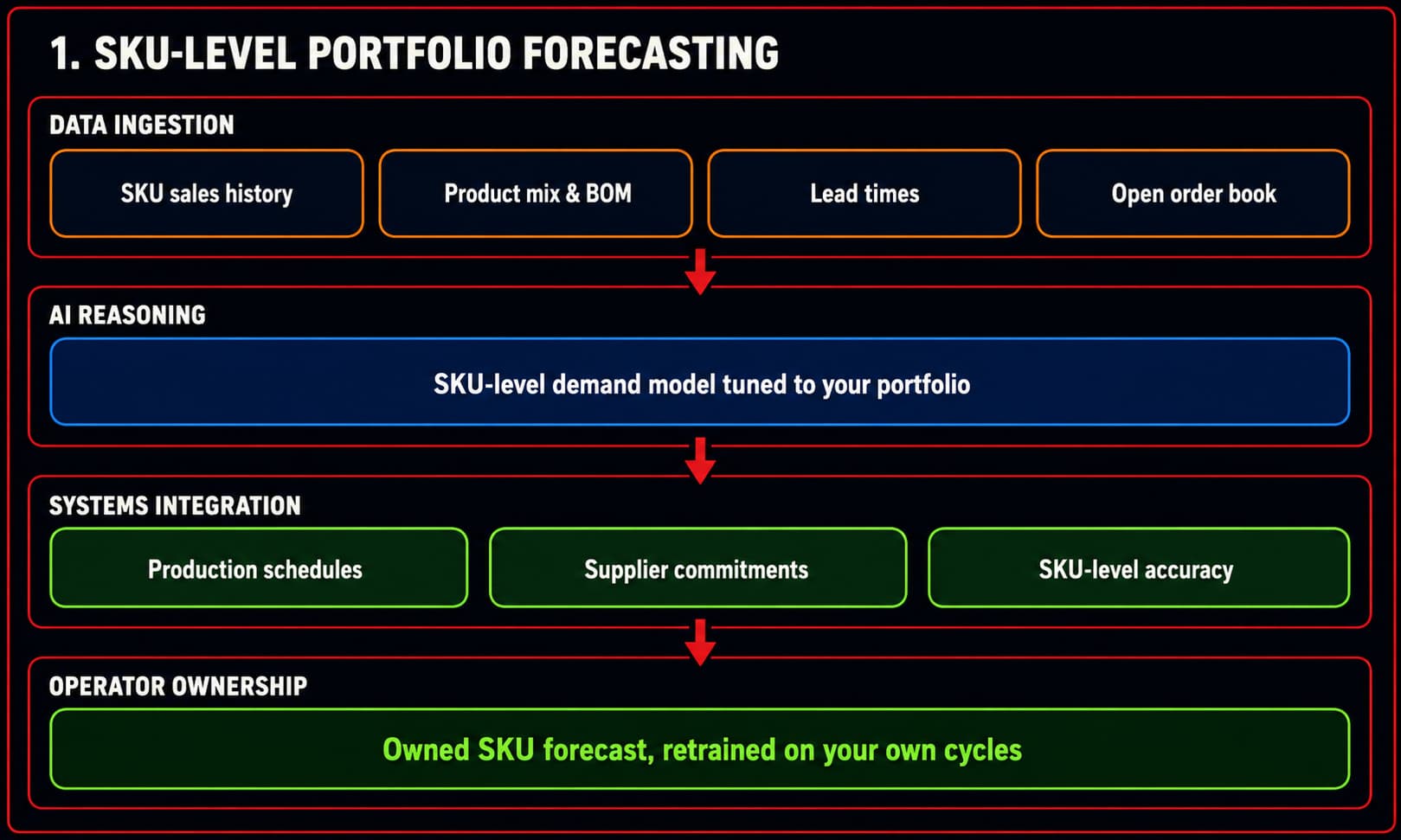
1. SKU-Level Portfolio Forecasting
THE PROBLEM
The portfolio total can be right while every individual SKU is wrong, and it is the SKU-level number that drives what you build and what you buy. Generic models cannot hold the specific dynamics of a wide, fast-changing mix, so error concentrates exactly where it is most expensive.
THE SOLUTION
A model trained on your customers, products, and market forecasts at the SKU level and sharpens with every cycle, so production schedules and supplier commitments are built on what you actually need to build rather than an industry average.
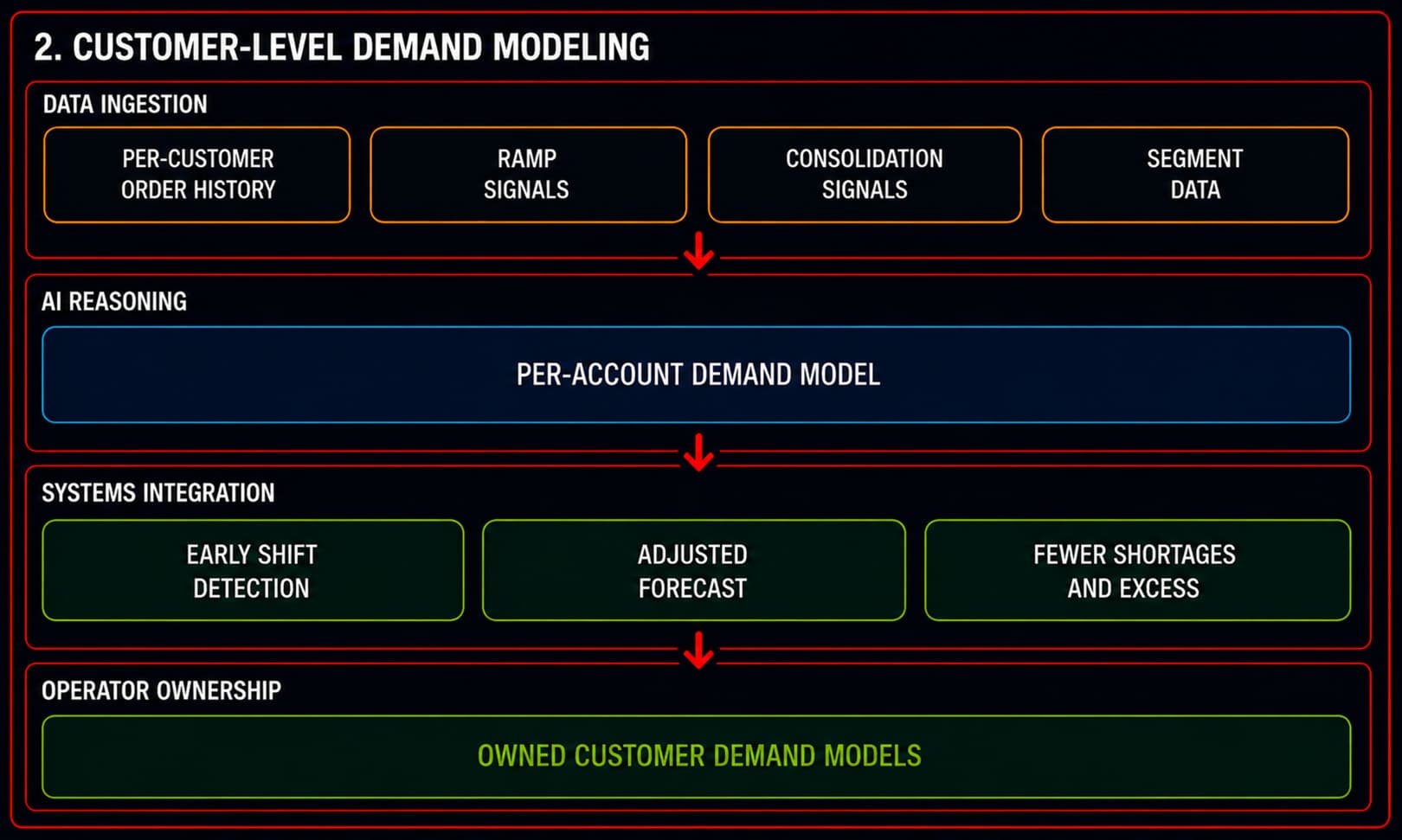
2. Customer-Level Demand Modeling
THE PROBLEM
Generic forecasts treat demand as an aggregate number, blind to the fact that one customer loads orders early and tapers, another is ramping capacity, and a third is consolidating suppliers and about to cut share.
THE SOLUTION
The system models each customer as an individual account with its own cycles, constraints, and trajectory, detects a shift in ordering behaviour as it happens, and adjusts the forecast before the change shows up as a shortage or a pile of excess.
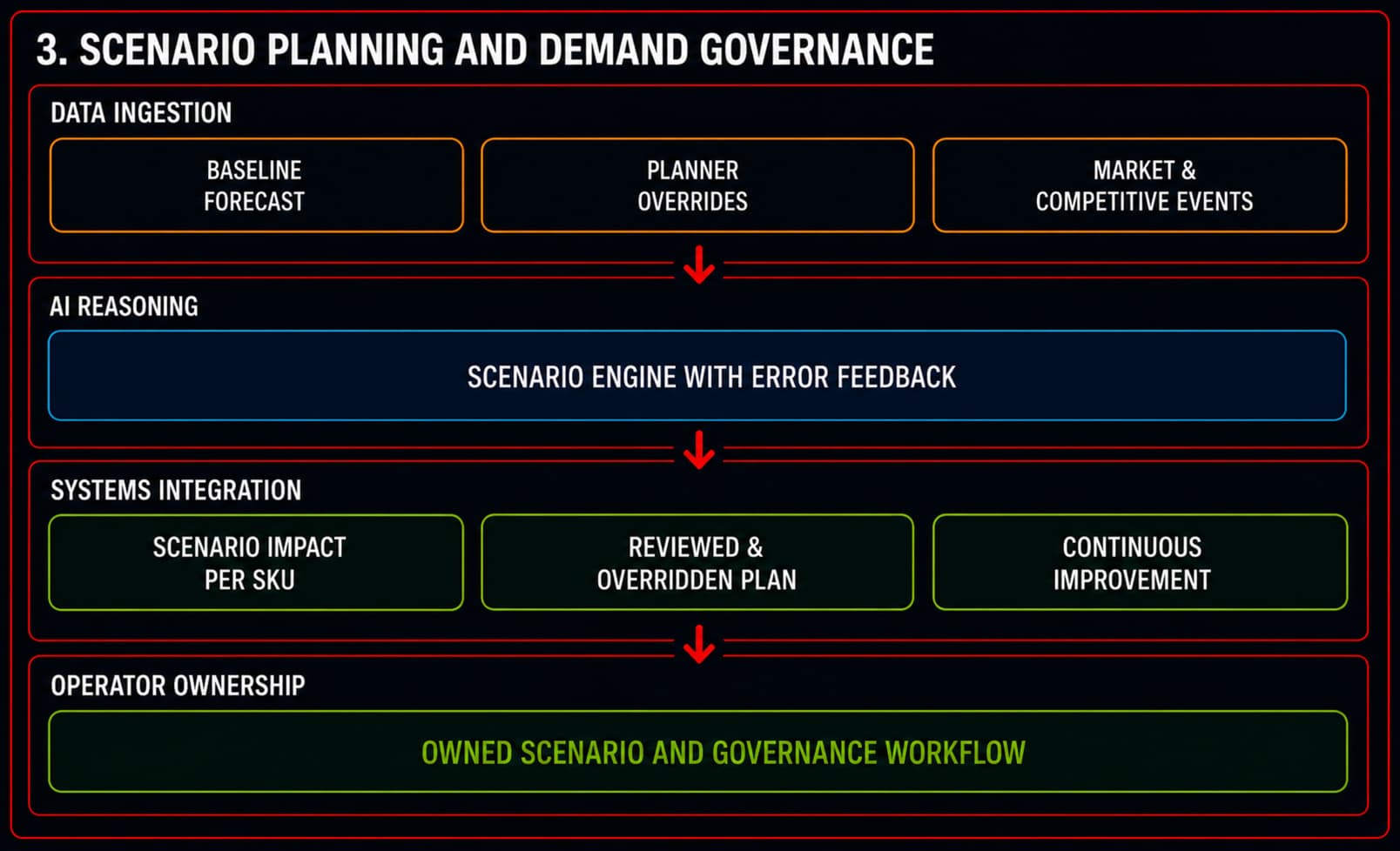
3. Scenario Planning and Demand Governance
THE PROBLEM
When a major customer announces an expansion or a competitor exits, planning teams have no rigorous way to test the impact, and forecast error goes uninvestigated, so the same mistakes repeat every quarter.
THE SOLUTION
Planners run scenarios against the model, see the impact on each SKU, and override the baseline with information the model does not have. Every forecast error is captured and fed back, so the system and the team improve together instead of repeating the same misses.
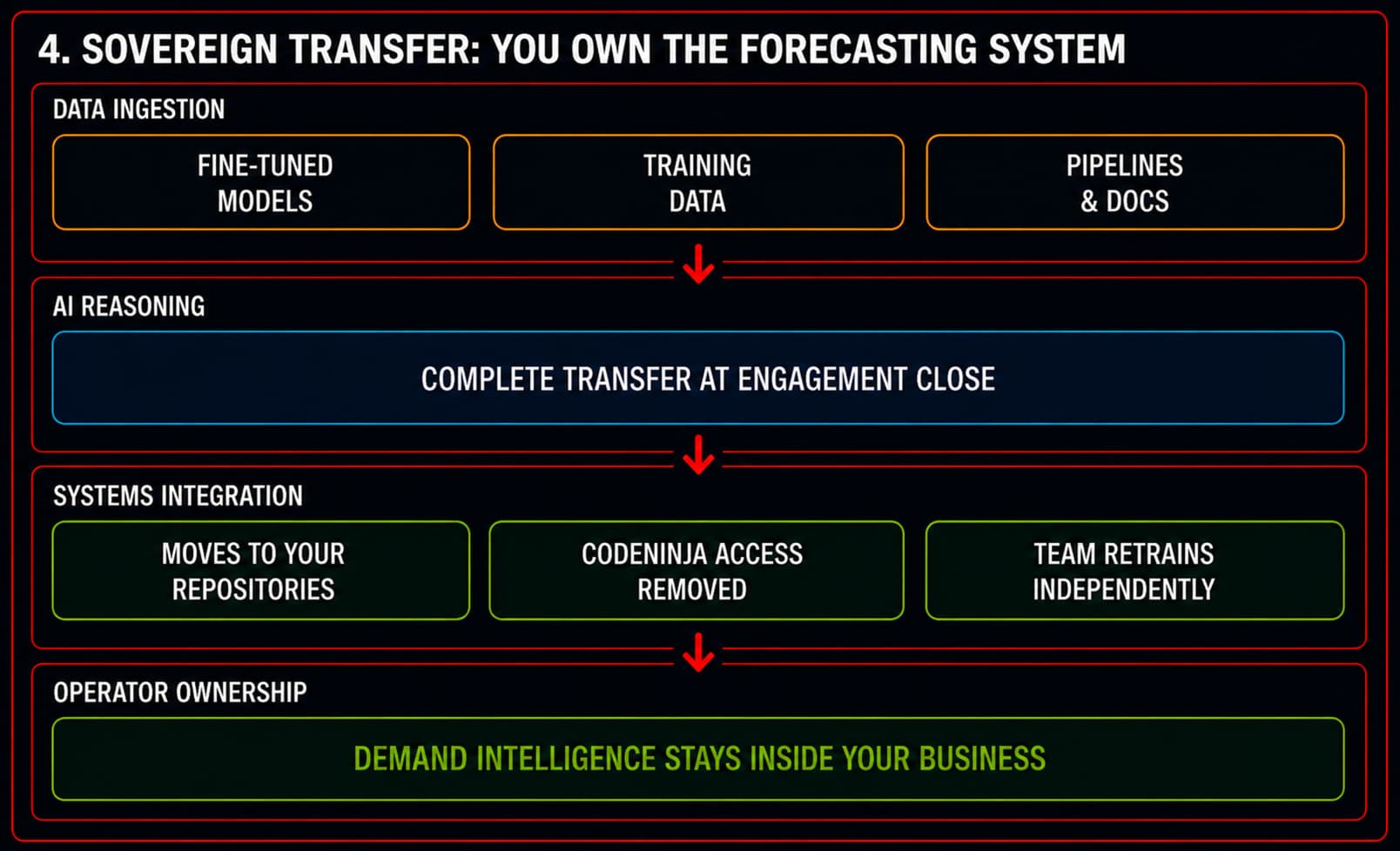
4. Sovereign Transfer: You Own the Forecasting System
THE PROBLEM
A forecast built and hosted by a vendor is a capability you rent, and the understanding of your own demand accumulates on someone else's platform. When the relationship changes, the intelligence built on your business does not come with you.
THE SOLUTION
Every engagement closes with complete transfer. The models, training data, and decision logic move to your repositories, and your team extends and retrains the system across new products and customer segments independently. The demand intelligence of your business stays inside your business.
Frequently Asked Questions