Supply Chain Visibility for Automotive
See Your Supply Chain As It Actually Is, Not As Suppliers Report It
Automotive supplier concentration is rising and it is structural, yet most manufacturers still manage risk through relationships and rear-view reports. CodeNinja builds owned supply-chain intelligence that reasons over supplier, financial, logistics, and geopolitical signals to give you a real-time view of your network, integrated with the systems you already run and transferred to you in full at close.
.jpg&w=3840&q=75)
%20(1).jpg&w=3840&q=75)
The Problem
Automotive supply chains are consolidating, and it is not temporary. Component, battery, and semiconductor suppliers are merging, capacity is concentrating, and geopolitical fragmentation is forcing regional supply chains. Your supply base is shrinking and your dependency on fewer suppliers is growing, so losing one is no longer an inconvenience, it is a production stoppage you cannot backfill on short notice.
For a decade the industry managed this through what looked like control but was opacity. You knew your suppliers and held quarterly reviews, but you did not have real visibility into their actual capacity, inventory, other-customer dependencies, or financial stability. When everything ran smoothly the opacity did not matter. Now, with concentration rising, that same opacity is the difference between resilience and crisis.
The pressure is compounding. Manufacturing data is set to grow sharply, with 86 percent of manufacturers expecting data to be essential to competitiveness by 2030 (Gartner-cited manufacturing data study, 600 facilities), while margins have compressed from three-to-four percent to two-to-three percent (2026 manufacturing industry survey, 800 leaders across North America, Europe, and Asia). Manual processes and supplier portals cannot navigate multi-tier, multi-region complexity at that scale.
What Generic Approaches Put At Risk
Disruption Exposure
A single-source supplier fails and you find out when the shipment does not arrive, with no backup and months of lead time.
Working Capital
Safety stock built against unknowns you cannot see, tying up capital the business needs elsewhere.
Negotiating Position
You negotiate on supplier presentation rather than data, paying premium prices for resilience you cannot verify.
.jpg&w=3840&q=75)
Why Reporting Is Not Visibility
A supplier portal, weekly shortage reports, and on-time scorecards describe what already happened. That is a rear-view mirror, not visibility. Real visibility answers questions you cannot answer today: how much inventory each supplier actually holds right now, their true lead time if you placed an emergency order, the upstream constraints they are managing across other customers, and their financial and geopolitical exposure.
Not for a few critical suppliers, but across your base; not quarterly, but continuously; not synthesized from what suppliers tell you, but derived from actual signals.
Predictability Matters More Than Prediction
Most manufacturers try to predict supplier performance and disruption from historical patterns and gut feel, and those guesses are often wrong. Predictability is different: it is understanding the actual factors driving supply-chain behavior and seeing them change in real time.
A supplier's inventory is dropping, a component is being pulled across multiple customers, financial metrics are deteriorating, all of that is observable. When you have predictability you respond before disruption happens; when you are predicting, you are guessing, and when you are wrong you are in crisis.
.jpg&w=2048&q=75)
Owned Supply Chain Intelligence, Built on Your Network
Supply chain visibility for automotive is infrastructure that gathers, normalizes, and reasons over data from many sources into one system you control. Supplier production, inventory, and order signals, financial and geopolitical risk data, logistics data, and your own demand and network data flow into reasoning systems that answer a single question: what is the actual supply-chain status right now, where are the constraints, and what breaks if nothing changes. It integrates with the systems your teams already run, and every view is interrogable by your supply-chain team.
.jpg&w=3840&q=75)
The Deployment Cycle
An assessment starts with your most critical component or supplier segment, establishes data feeds and a baseline view of inventory, lead times, and upstream constraints, then adds scenario planning and continuous monitoring with alerts on the changes that precede disruption.
The visibility runs alongside your current process, then becomes the system your team uses to see risk early and respond. A Supply Chain Visibility Assessment runs 12 to 16 weeks.
Four Deployments
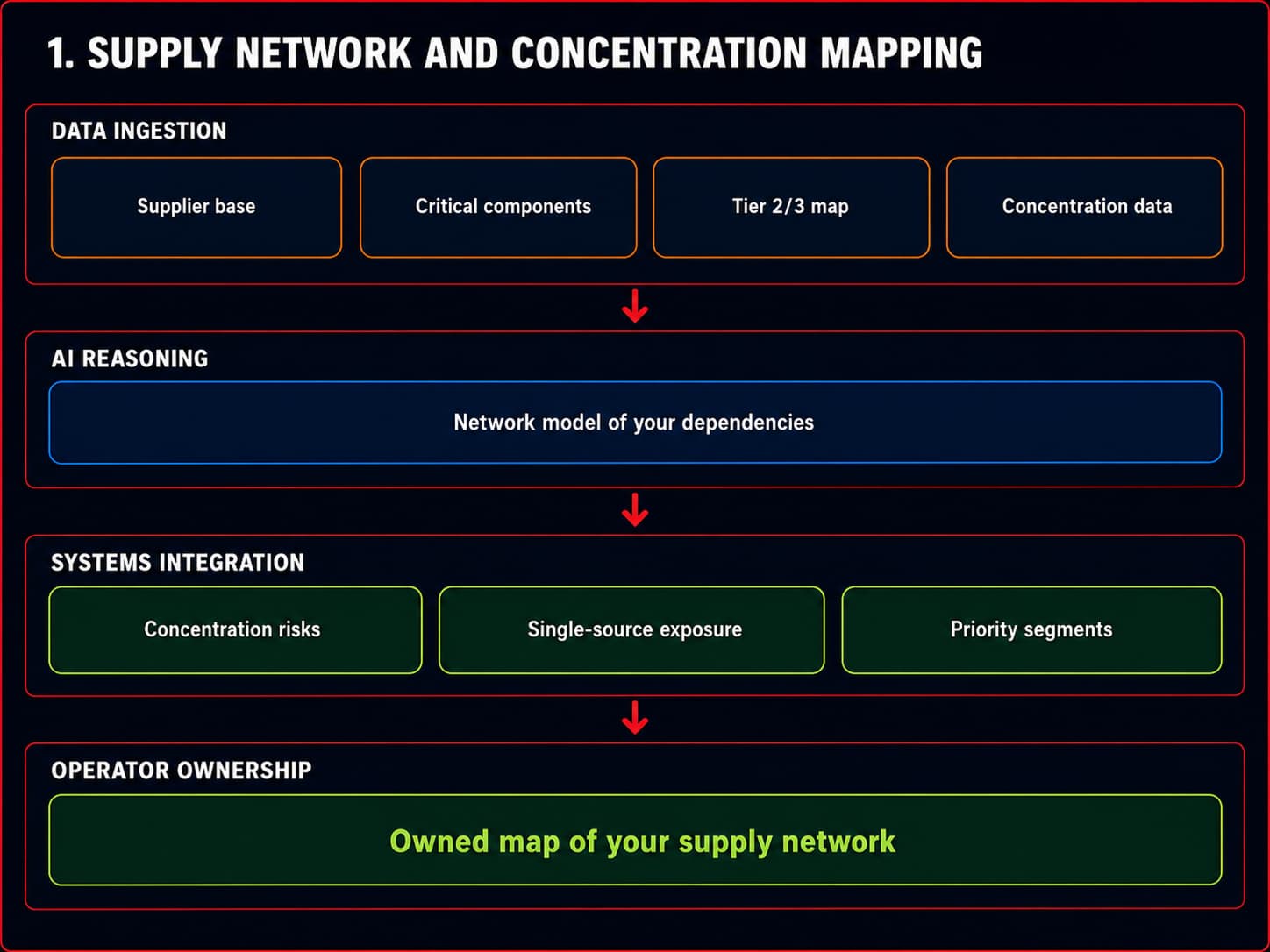
1. Supply Network and Concentration Mapping
THE PROBLEM
Most manufacturers manage supplier risk through relationships and quarterly reviews, which look like control but are actually opacity. You do not have a live map of where your dependency is concentrated, which components are single-sourced, or how your Tier 2 and Tier 3 exposure runs, so concentration risk stays invisible until a supplier fails.
THE SOLUTION
The system maps your supplier base, critical components, and multi-tier dependencies into a model you own, surfacing concentration risk and single-source exposure before it becomes a stoppage, and marking the segments where resilience has to be built first.
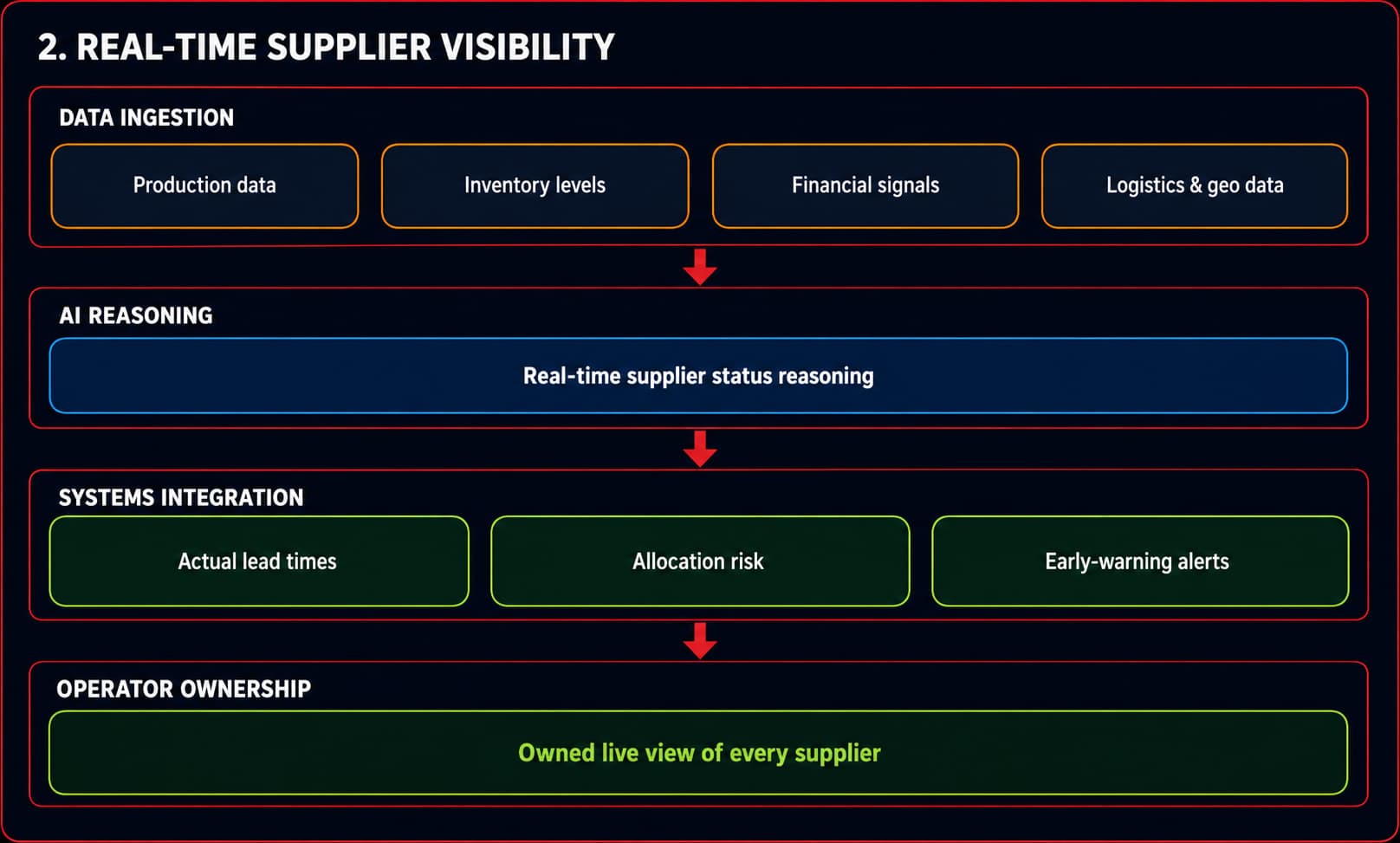
2. Real-Time Supplier Visibility
THE PROBLEM
A supplier portal and weekly shortage reports tell you what already happened, not what is happening now. You do not see actual inventory, true lead times, allocation across a supplier's other customers, or financial deterioration until it reaches you as a shortage notice or a bankruptcy.
THE SOLUTION
Production, inventory, financial, logistics, and geopolitical signals flow into reasoning systems you control, giving you the real supply-chain status right now: actual lead times, allocation risk, and early-warning alerts when inventory drops or a supplier's metrics deteriorate.
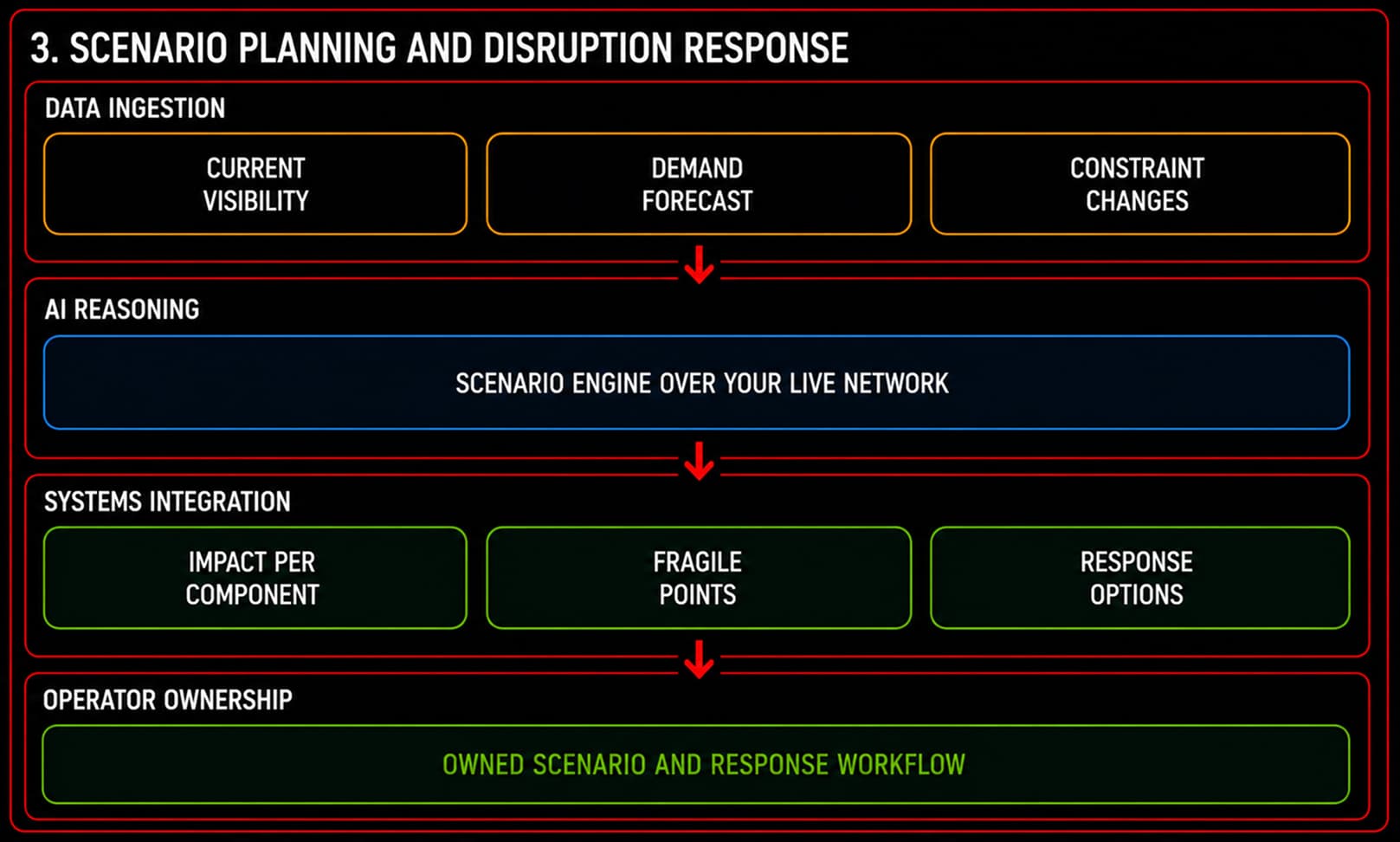
3. Scenario Planning and Disruption Response
THE PROBLEM
When a supplier's output drops or a geopolitical constraint emerges, teams have no rigorous way to test the impact before committing capacity, so they discover fragility in crisis mode and pay premium expedite costs to recover.
THE SOLUTION
You run scenarios against your live network to see the impact per component, identify where the chain is fragile, and develop response options before disruption hits. The scenarios are not predictions; they are responses to observed changes in your supply chain.
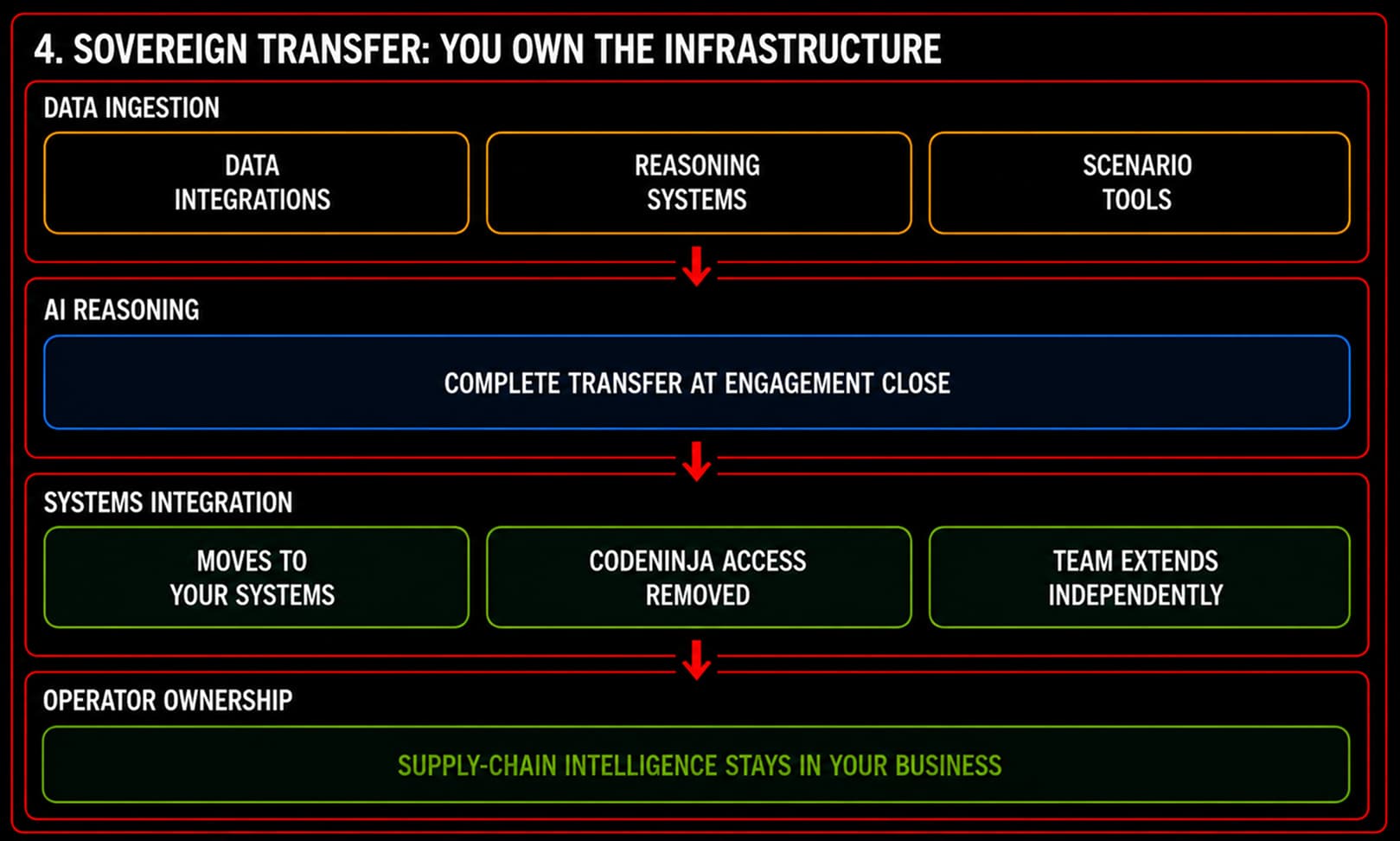
4. Sovereign Transfer: You Own the Visibility Infrastructure
THE PROBLEM
A visibility platform built and hosted by a vendor is a capability you rent, and the map of your own supply chain accumulates on someone else's system. When the relationship changes, the intelligence built on your network does not come with you.
THE SOLUTION
Every engagement closes with complete transfer. The data integrations, reasoning systems, and scenario capabilities move to your systems, and your team extends them to new suppliers and new risks independently. The supply-chain intelligence of your business stays inside your business.
Frequently Asked Questions