Smart Manufacturing Explained: What a Smart Factory Actually Means in 2026


28 September, 2026

"Smart manufacturing" has become a catch-all term that means almost everything and therefore nothing. Without clear maturity tiers, a plant manager cannot tell whether they are actually behind or just behind the marketing language. Smart manufacturing is not a single decision. It is a progression, and most manufacturers are stuck in the same place because they misunderstood what comes next. Progress stalls not because the tools are hard to deploy, but because the foundational data and organizational work is not valued until it is too late.
Why smart manufacturing plateaus
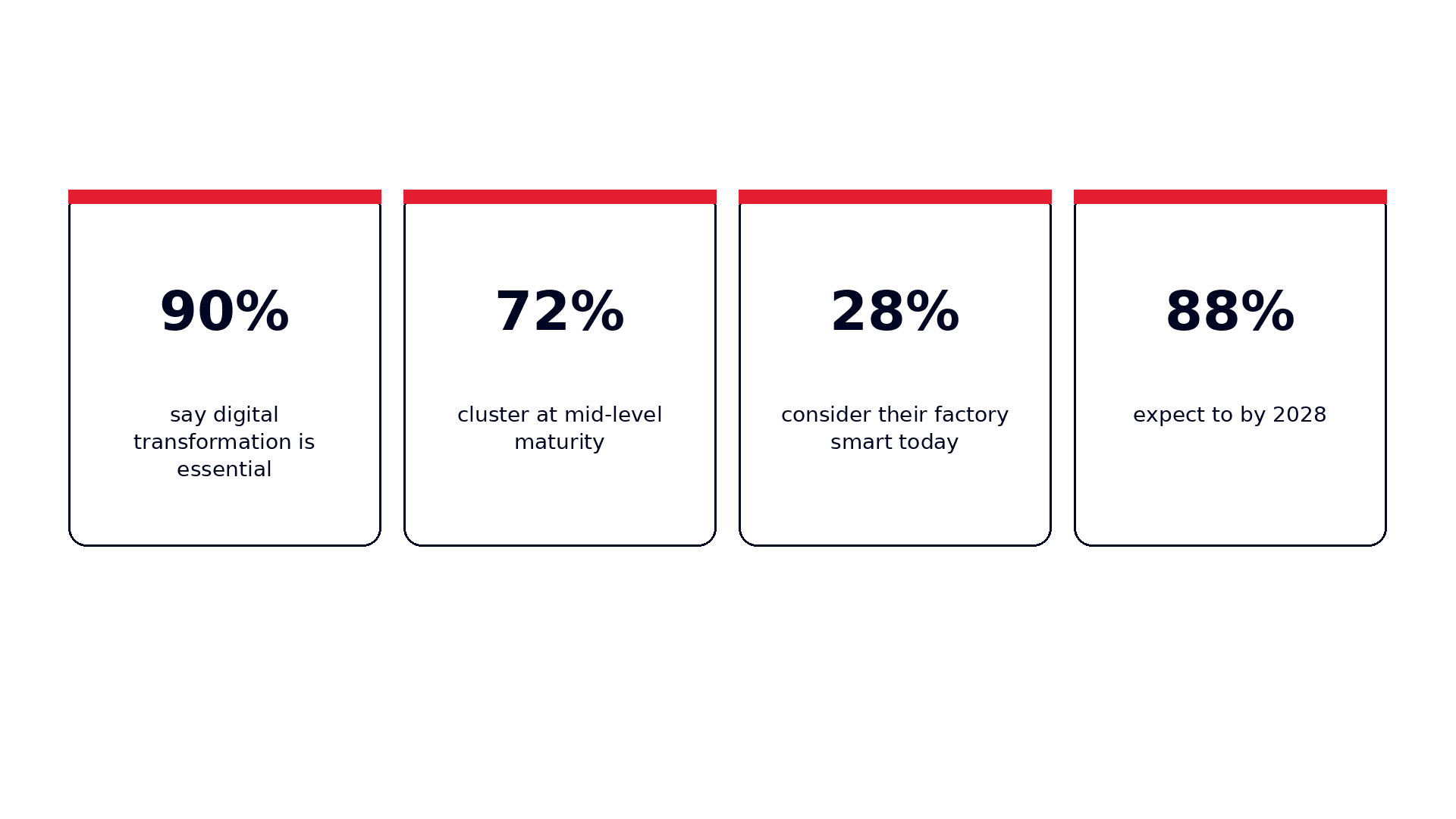
Ninety percent of manufacturers say digital transformation is essential to remaining competitive, yet when the same manufacturers self-assess maturity on a ten-point scale, 72 percent cluster at mid-level and only 10 percent reach the top (Rockwell Automation, 2026). Investment is accelerating, but the plateau is consistent, which means it is systemic, not random. The technology works. The constraint is organizational. Data integration, trust, and operational readiness do not scale automatically, and you cannot buy past them with better vendors or more spend. A plant with fragmented systems and skeptical teams will plateau no matter the budget; a plant with disciplined data work and aligned leadership can progress on older technology. Eighty-three percent cite raw-material costs as their top challenge this quarter, which argues for picking the tier that solves your actual problem, not the one that sounds most impressive.
The four tiers of maturity
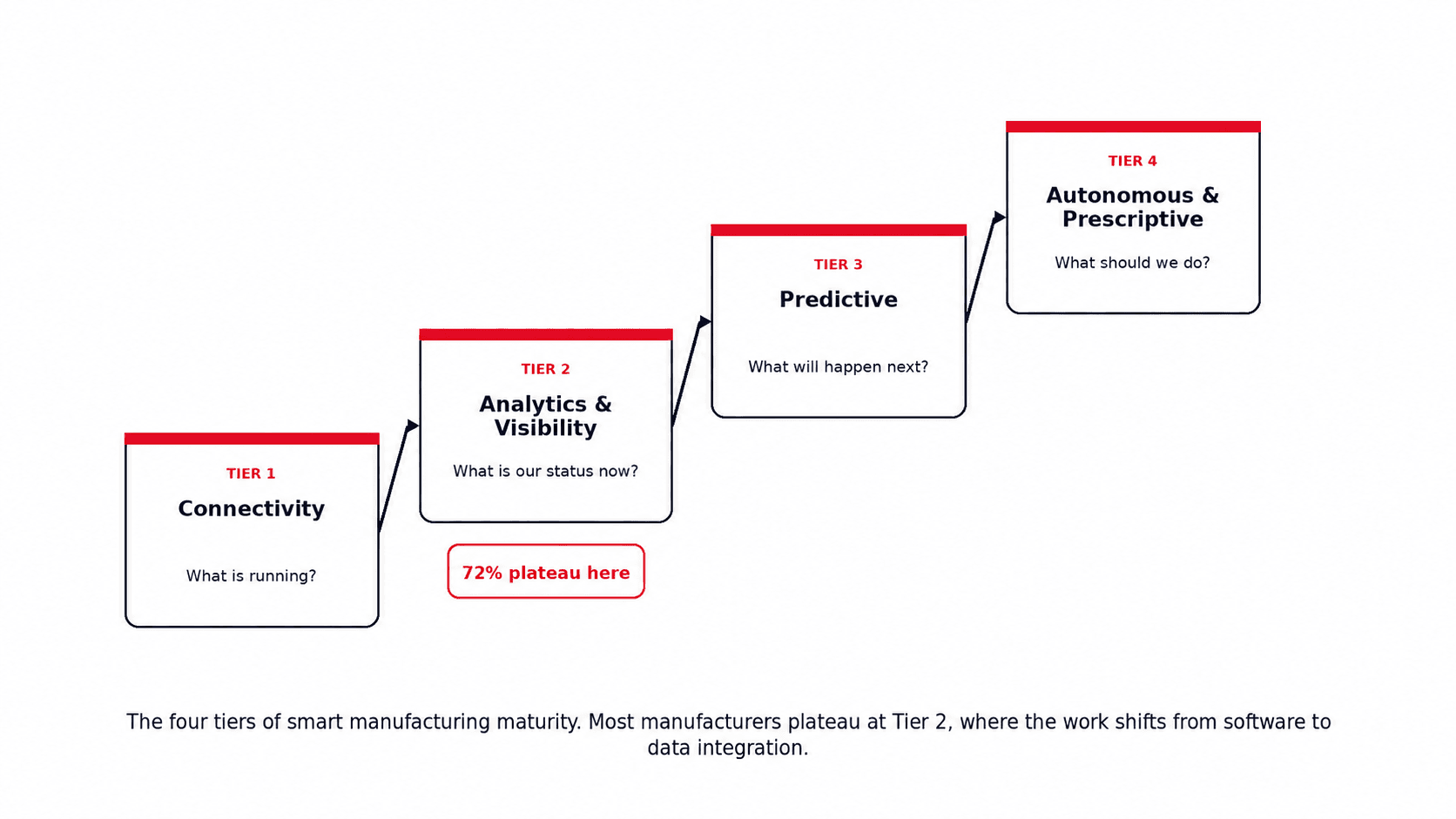
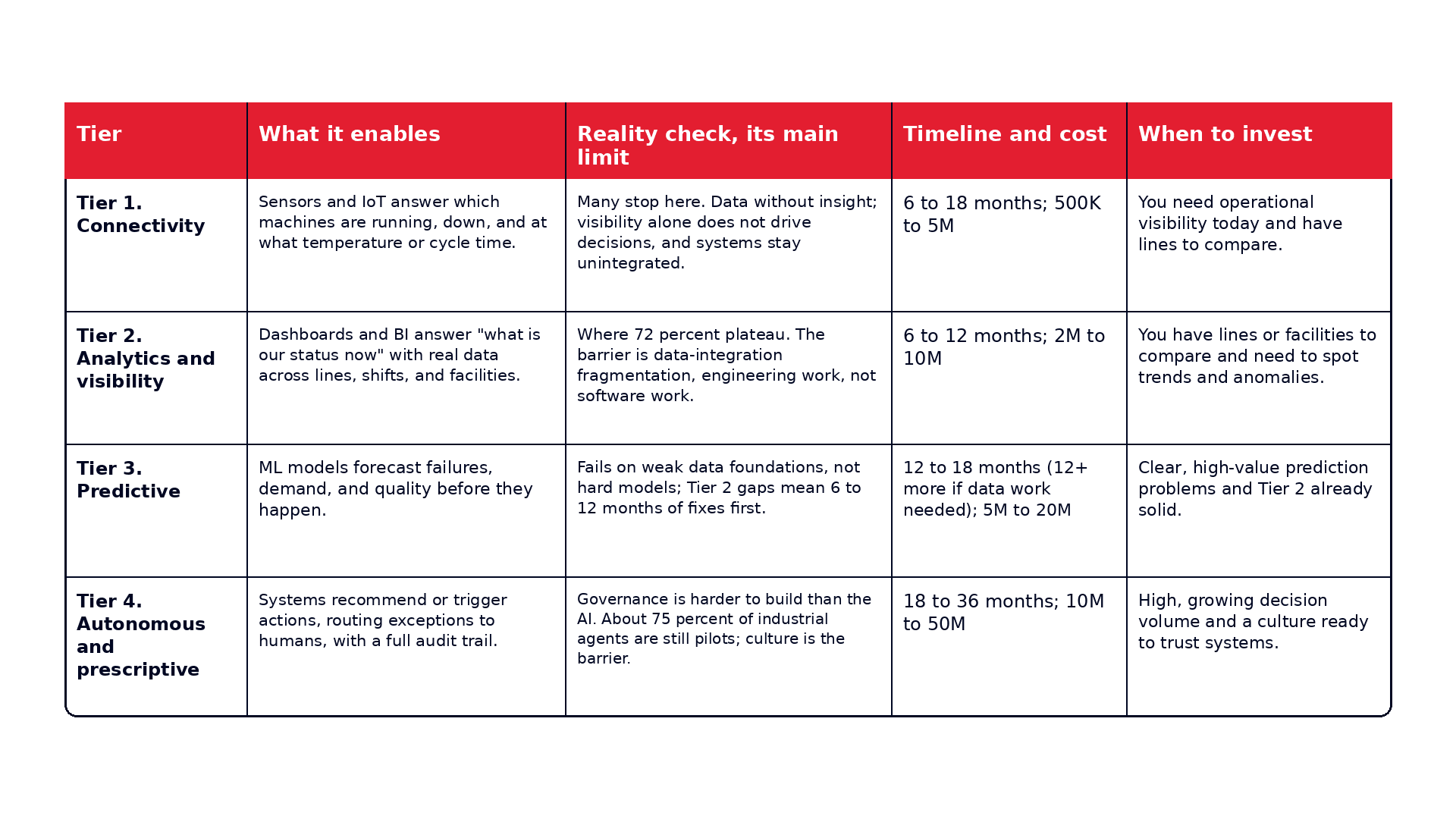
This is not a linear upgrade path where higher is always better. It is a decision tree: each tier solves specific problems and demands specific work.
The real story: why 72% stay at Tier 2
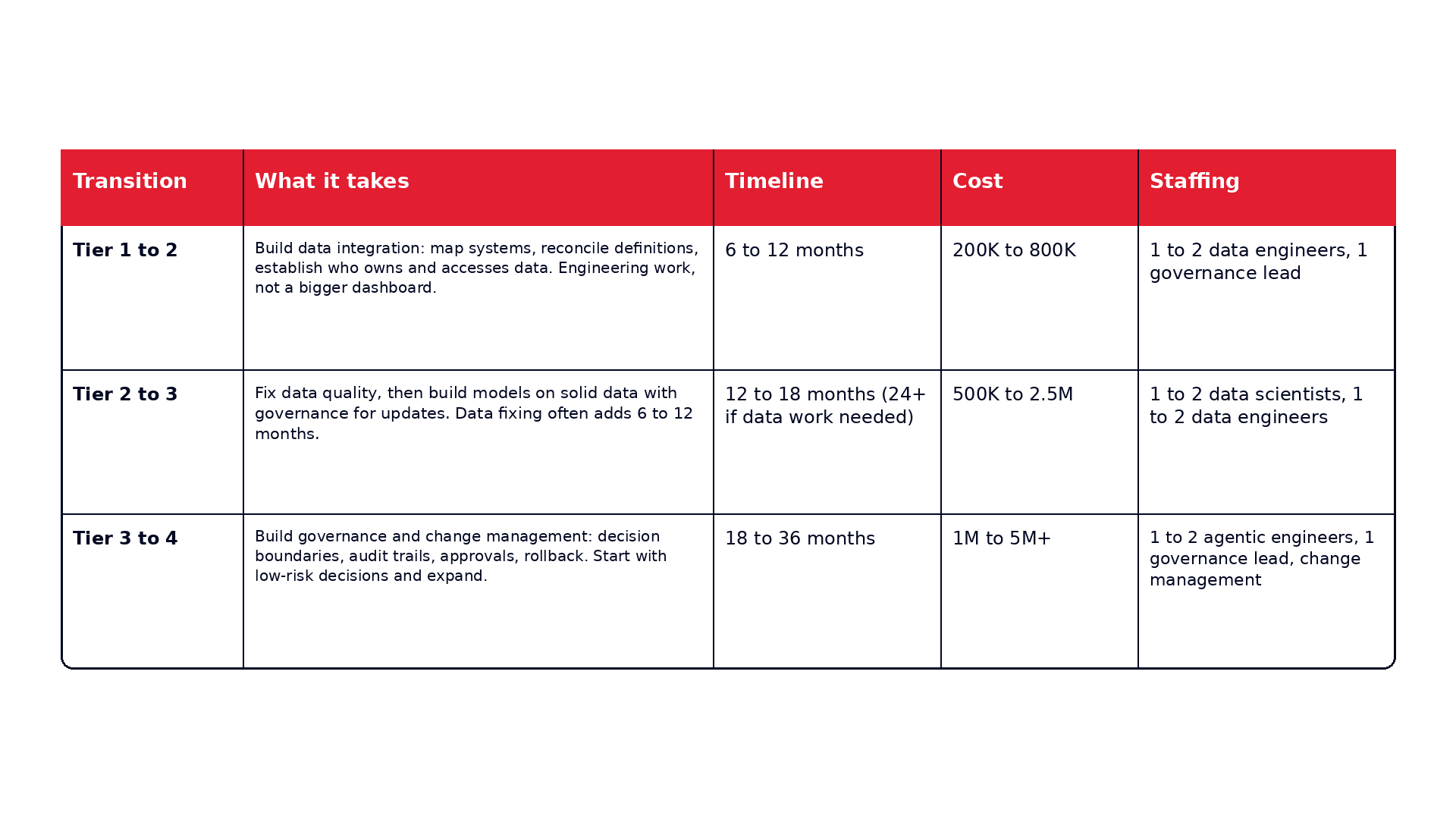
The plateau is structural, not accidental. Tiers 1 and 2 show immediate results, so the investment curve flattens where the longer-ROI, higher-risk work begins. A data readiness gap emerges: most plants cannot model effectively until they fix data quality, which means going backward to invest more in Tier 2. Talent becomes a barrier, since Tiers 3 and 4 need data science and governance expertise that is expensive and scarce. And organizational readiness is the deepest barrier: the cultural shift of trusting systems with decisions is real and underestimated. The gap between 28 percent smart today and 88 percent expecting to be by 2028 is a realistic read on how hard moving up actually is.
Which tier are you at?
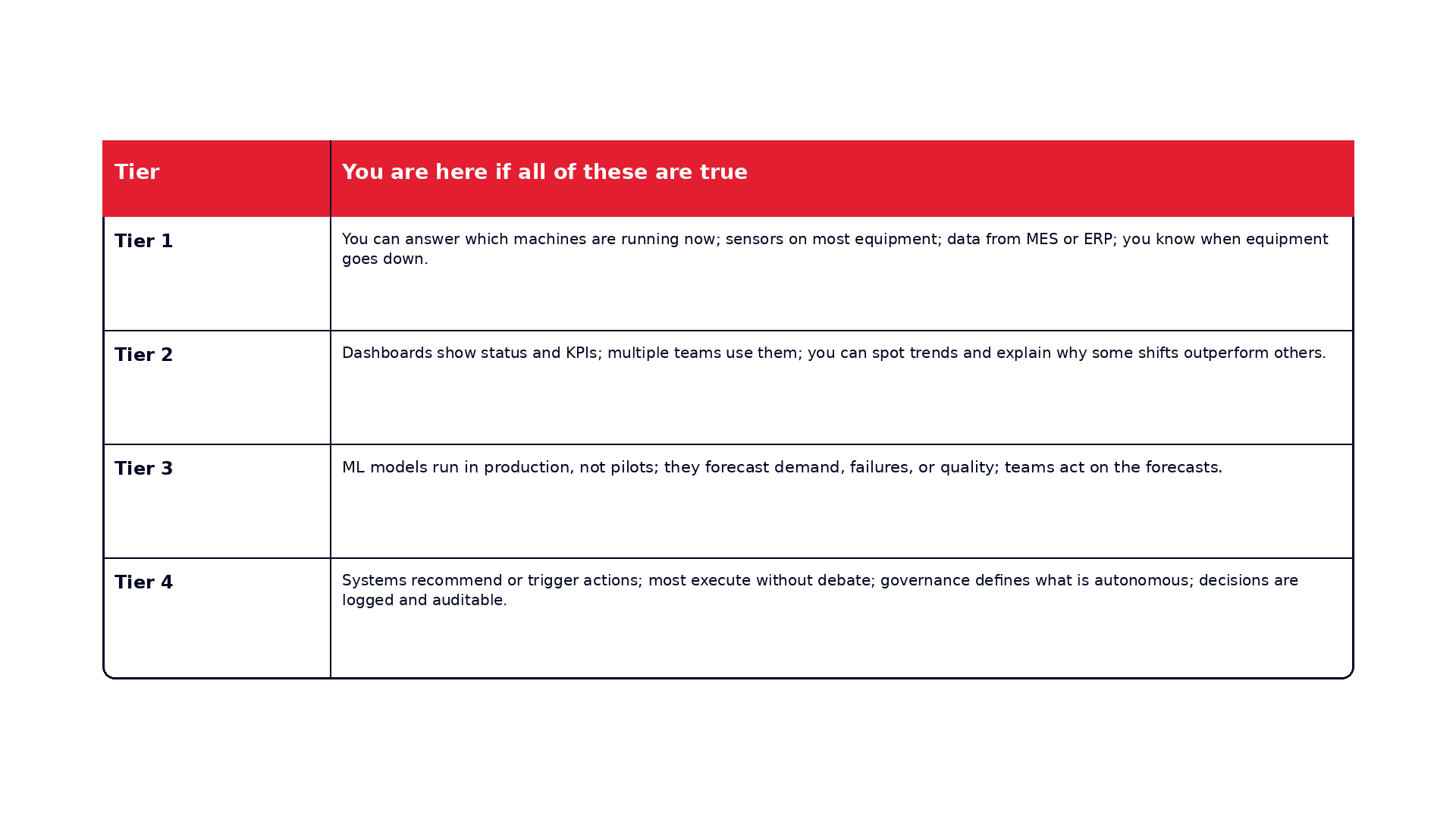
Maturity is what you can actually do in operations, not what you deployed. A dashboard sitting unused does not count as Tier 2; a model in pilot does not count as Tier 3.
What each transition actually requires
Common questions
Why do most manufacturers plateau at Tier 2?
Because the next step is longer-ROI, higher-risk work that needs data science, clean data, and change management most have not built. It is organizational, not technological.
Isn't Tier 4 already normal?
No. About 75 percent of industrial agent systems are still pilots, and most production deployments use supervised autonomy. Governance is the constraint, not the technology.
Can we skip tiers?
No. Predictive models built on fragmented, low-quality data perform poorly, and the failure reads as a technology failure when it is a foundation failure. Each tier is built on the last.
What actually separates success from stalling?
Disciplined data-foundation work and organizational readiness for governance. The manufacturers moving up invest in integration, quality, talent, and governance, not just new platforms.
For a deeper look at how those capabilities translate into practical AI initiatives across manufacturing operations, explore CodeNinja’s AI solutions for manufacturing.