AI in Manufacturing: A Buyer's Guide to Five Use-Case Categories


26 August, 2026

"Use AI" is a prescription without specificity. A predictive maintenance model flags equipment failures from sensor data. A scheduling algorithm sequences production. Computer vision inspects for defects. A digital twin simulates a facility. An autonomous agent decides the next action. Each is AI in manufacturing, and each has different data requirements, timelines, cost profiles, and failure modes. Vendors sell into whichever category they build, so buyers rarely see all five side by side with honest tradeoffs before committing capital. Investing in the wrong category is more expensive than investing in none.
The reality gap
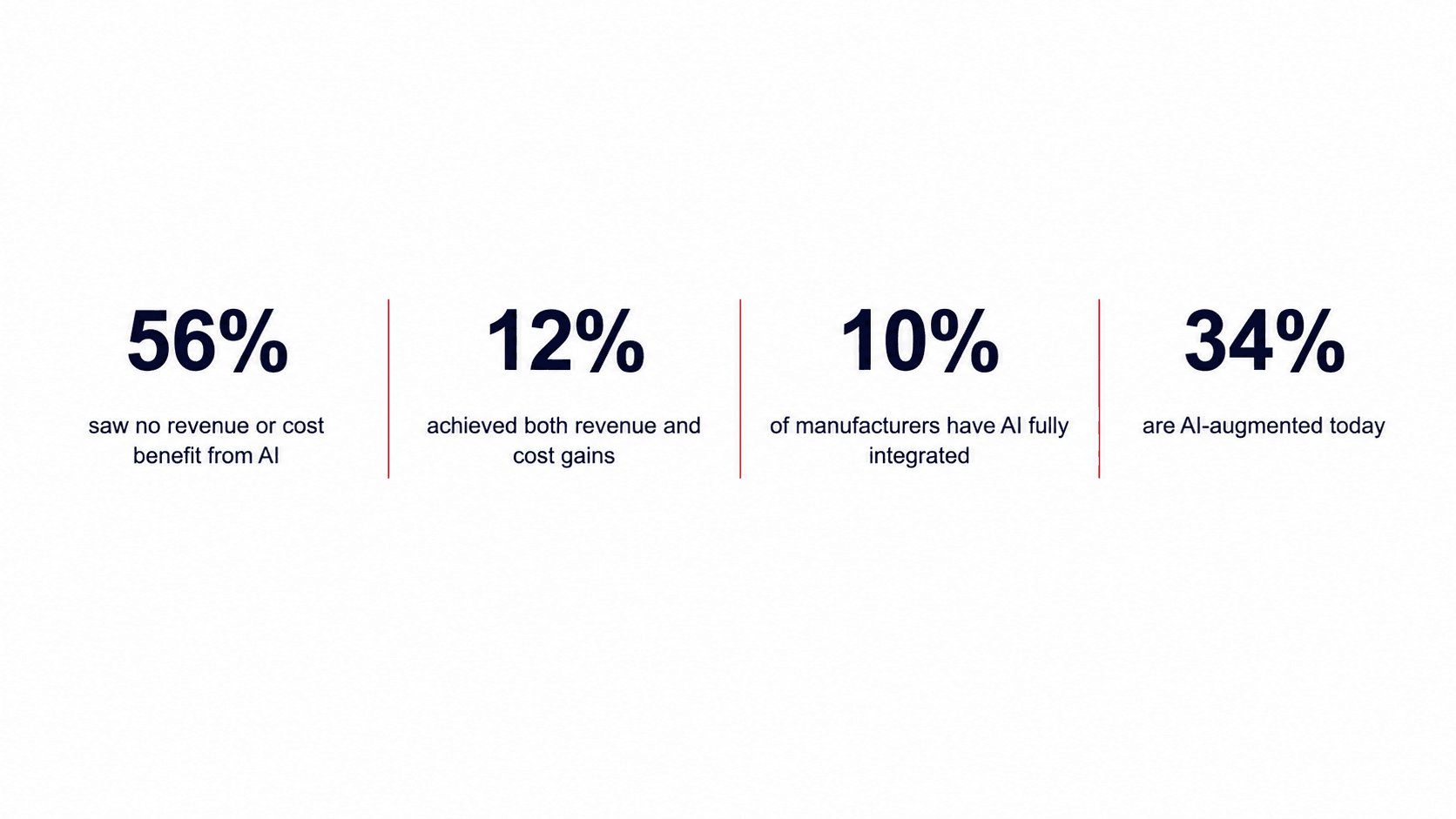
The survey data is stark. In PwC's 29th Global CEO Survey, 56 percent of 4,454 executives reported neither added revenue nor lower costs from AI in manufacturing, and only 12 percent achieved both (PwC, 2026). Across industries, only 14 percent report AI fully integrated into operations, and in the manufacturing-specific cut only 10 percent, with none reporting a significant revenue or cost benefit (Grant Thornton, 2026). Yet 34 percent of manufacturing operations are AI-augmented today, and more than half are expected to be by 2030 (Rockwell Automation, 2026). Manufacturers are investing and deploying, but not seeing the return, and the gap is systemic. It starts with category confusion.
Most projects begin for the wrong reasons: a competitor deployed it, a vendor gave a good demo, budget was available. No costed business problem, no executive accountable for the financial result, no discipline on the category choice. A vision model hits 98 percent defect detection, which is impressive, but if the plant already caught 95 percent, the three-point gain does not move scrap enough to justify 500,000 dollars. Technical success, financial failure. What separates the 10 to 12 percent seeing real results is discipline: they evaluate AI the way they evaluate any capital project. What number will change, by how much, who owns it, and when do we stop if it does not work.
The five categories at a glance
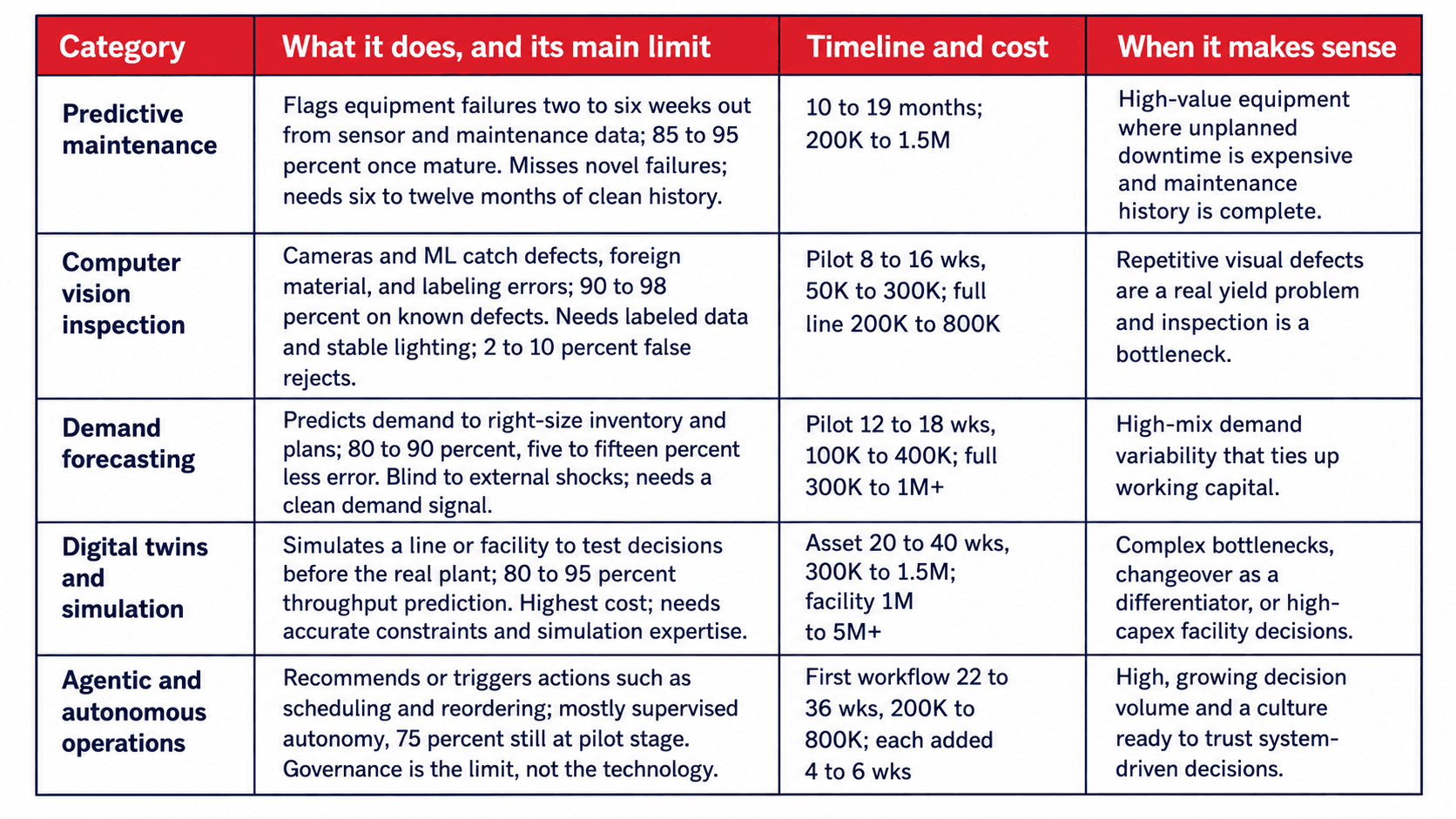
Each category solves a distinct problem, with different data, timelines, and failure modes. Read them side by side before you talk to a vendor.
Choosing the right category
The path is straightforward once you discipline the process and resist chasing technology for its own sake.
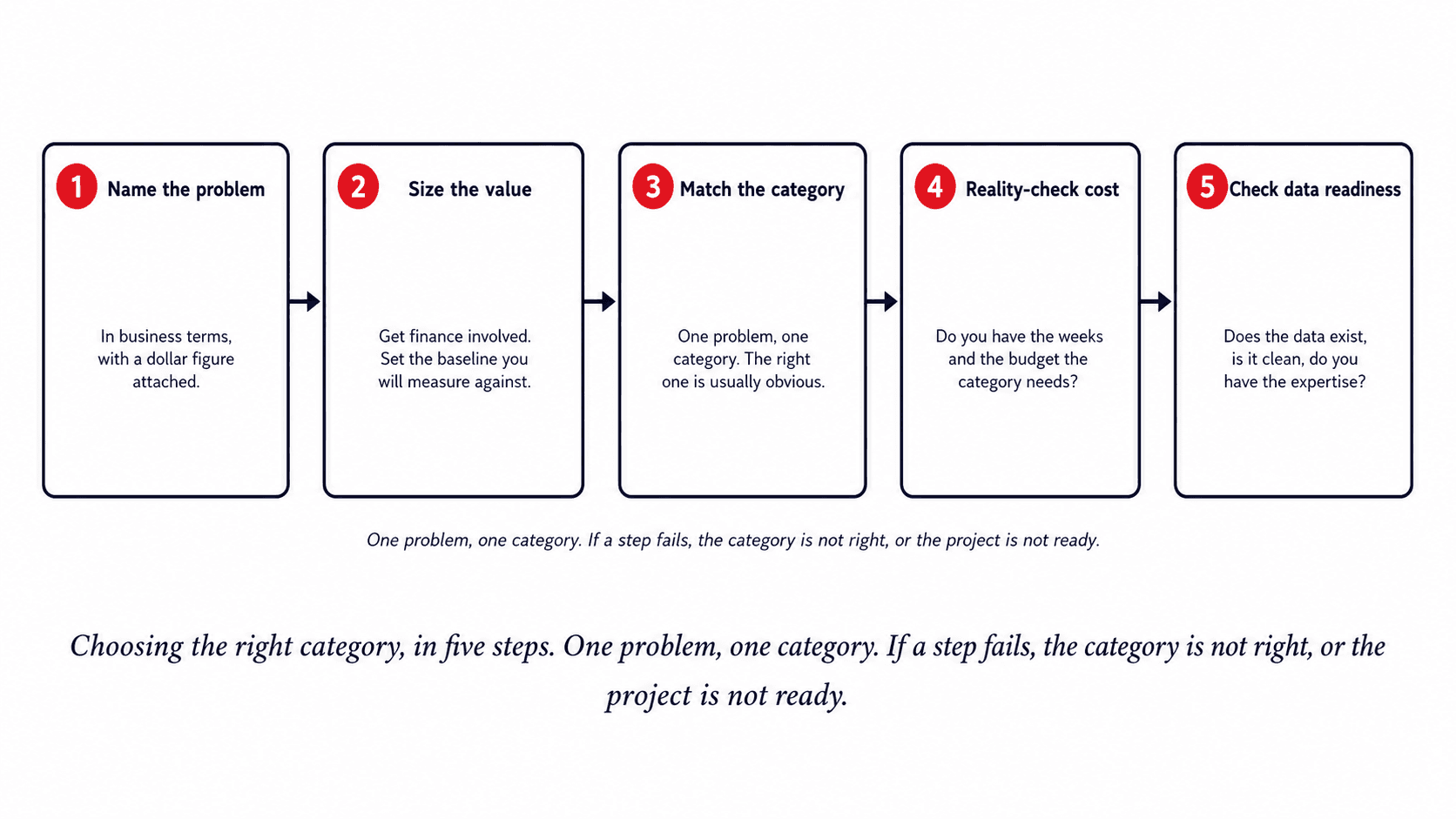
Name the specific business problem in business terms: quality escapes cost us two million a year, unplanned downtime five hundred thousand, forecast misses tie up three million in inventory. The more specific the statement, the more obvious the category. Then size the financial opportunity, get finance involved, and set the baseline you will measure against; if you cannot quantify it, the project is not ready. Match one problem to one category: visual defects point to computer vision, demand-driven inventory to forecasting, high-value equipment failure to predictive maintenance. Reality-check the timeline and cost against the resources you have and whether the opportunity justifies the spend. Finally, check data readiness: does the data exist, is it clean enough, and do you have the expertise in-house or will you need help. If any step fails, either the category is wrong or the project is not ready.
What to demand from any vendor
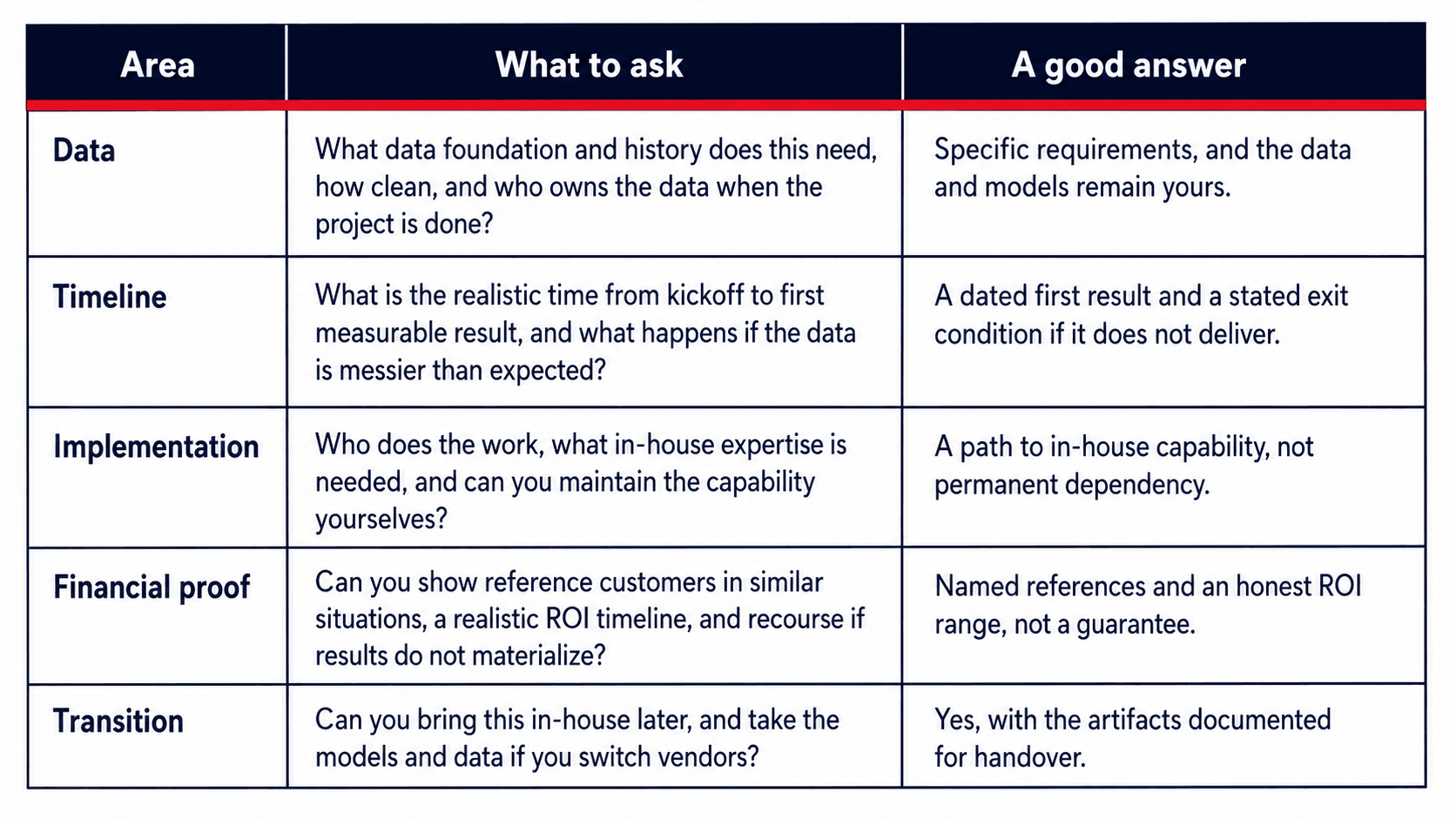
These questions separate credible vendors from the pilot-perpetuation game. A vendor who deflects or answers vaguely is the warning sign.
Common questions
Which category should we start with?
The one that solves your most expensive problem with the clearest financial case. Not the most visible on a plant tour, and not the one a competitor deployed.
What if our data is messy?
Data readiness is the constraint for most implementations. Messy data adds six to twelve months and lowers accuracy, so budget the cleanup explicitly.
How do we know if a pilot is working?
Measure against the specific business outcome you named at the start. If downtime, defect rate, or forecast error did not move as projected, the category may be wrong or the foundation work was incomplete.
Build in-house or buy?
Buying is faster with a good vendor; building is slower but gives ownership and control. Many organizations start by buying, then build internal capability over eighteen to twenty-four months.
Proof of concept or production?
A proof of concept is a hypothesis test. Production needs governance, change management, ongoing support, and a hand-off plan. Ask for the vendor's production-readiness checklist.
The path forward
Choosing the right category is not about technology sophistication. It is about disciplined problem definition and an honest assessment of the data, timeline, and governance you actually have. The manufacturers seeing real results named a specific problem with measurable stakes and chose the category that genuinely addresses it. They chased the most valuable use case, not the most impressive one. CodeNinja’s manufacturing AI solutions are structured around assessing readiness, proving measurable value, and building owned systems within the existing operation.
Sources
- PwC, 29th Global CEO Survey (2026). 4,454 global executives surveyed; AI revenue and cost outcomes across industries.
- Grant Thornton, 2026 AI Impact Survey. Cross-industry and manufacturing-specific analysis of AI integration and revenue outcomes.
- Rockwell Automation, 2026 State of Smart Manufacturing. Current adoption rates and forward projections for AI-augmented operations.
- Industry technical benchmarks and field data (2026). Realistic performance metrics, timelines, and costs by category.