Retaining the Intelligence Your Plant Creates: An Enterprise Evaluation Framework


18 August, 2026

Picture the AI system that increasingly helps run your plant. It flags the deviations that matter, prioritizes the repairs, holds or releases the batch. Now picture your main vendor being acquired, raising its prices, deprecating the product, or shutting the service down. What happens to everything that system learned about your operations?
For most manufacturers the honest answer is uncomfortable. The learning lives on the vendor's platform, and if the vendor changes, it is on their side of the line.
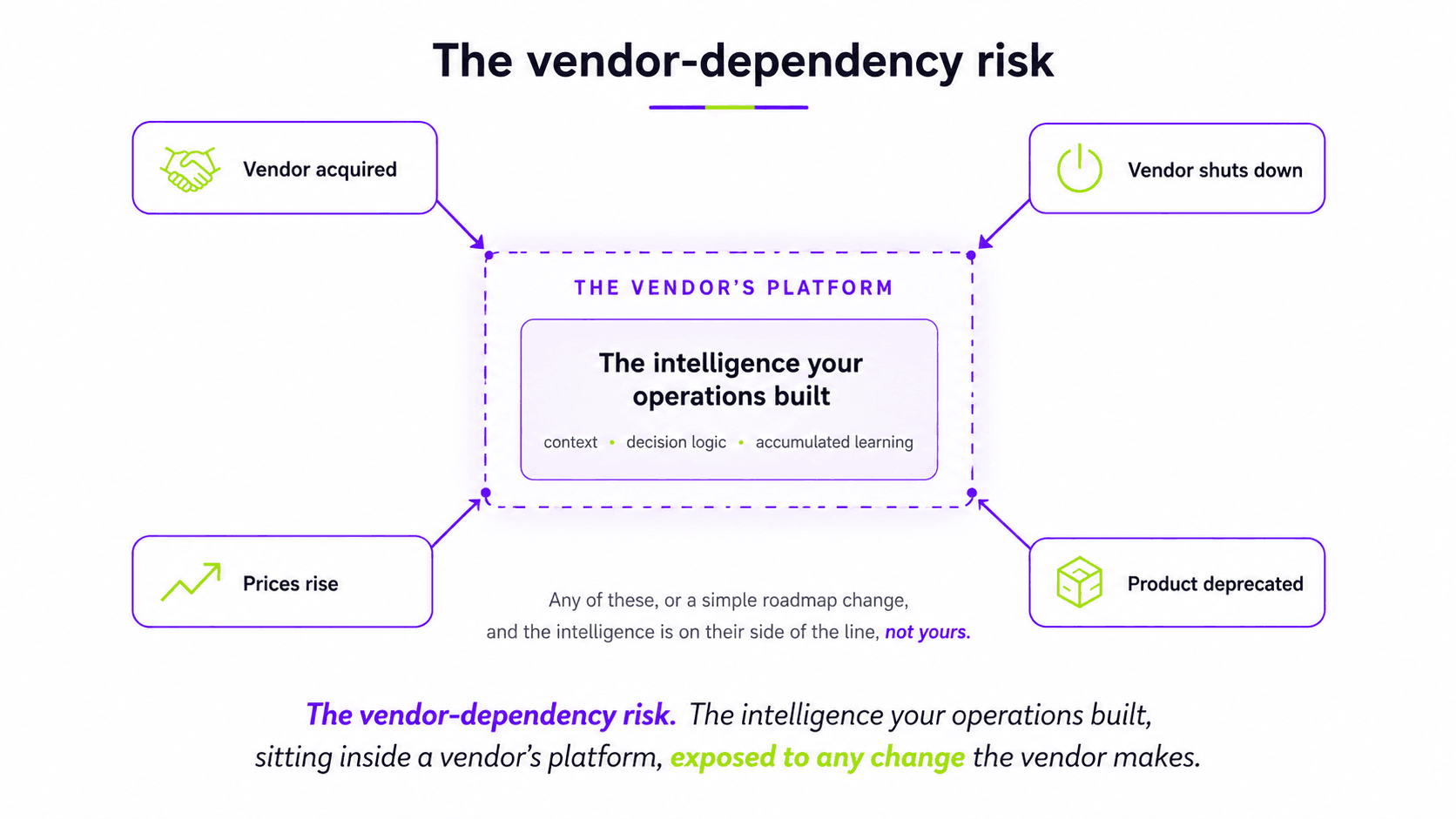
This is not a software problem you solve by exporting data. Your data is the easy part. The hard part is the intelligence built on top of it: what each signal means in your plant, the logic behind each decision, and the judgment accumulated over thousands of calls. If that lives only in a platform, you can use it, but you cannot fully inspect it, correct it when it drifts, or carry it forward when your needs change.
And the market is moving toward this risk, not away from it. The largest automation and industrial-software vendors are folding AI capabilities into closed, integrated ecosystems. That is not about any one company. It is a pattern: the more the platform learns from you, the harder it is to leave, and the more your dependence deepens. The time to weigh it is before you are locked in, not after.
Measure the risk: the evaluation framework
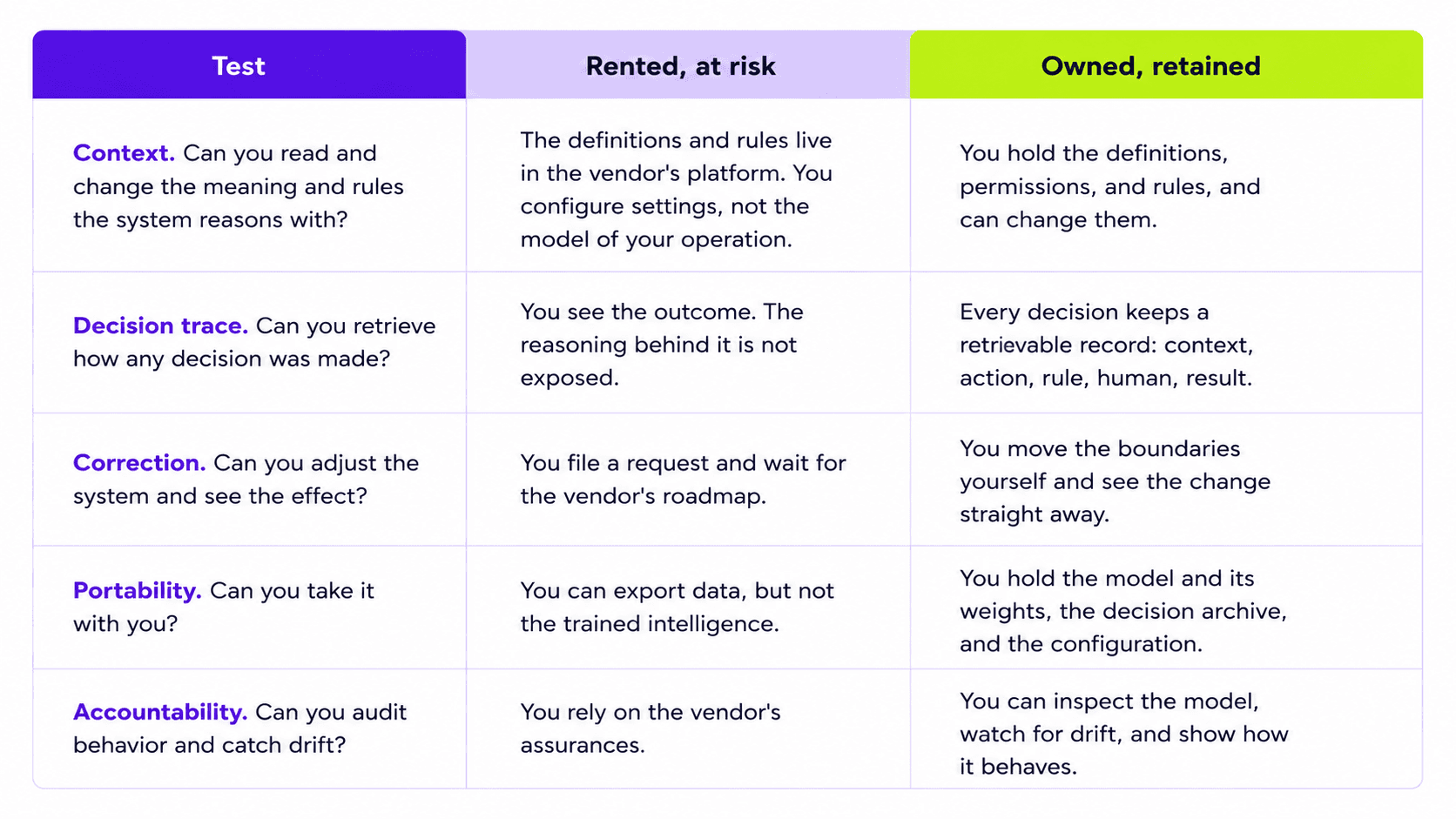
Before you can manage this risk, you have to measure it. Whether you are assessing a system you already run or one you are about to buy, the same five tests decide whether the intelligence is really yours. Score each one honestly.
Why some results mean higher risk
Every test that lands in the middle column is operating intelligence you do not control, but they do not all carry the same weight. If you cannot retrieve a decision trace or audit the system's behavior, you are exposed the moment a decision is questioned, whether by a regulator, a customer, or an internal incident review. If you cannot correct the system, every problem waits on the vendor's roadmap instead of your own schedule. And portability is the test that turns a routine vendor change into a lost capability: if you can export the data but not the trained intelligence, an acquisition, a price increase, or a deprecation takes years of accumulated judgment with it.
So the reading is simple. The more tests that land in the middle column, and the more they cluster on portability and accountability, the higher the chance that a change you do not control becomes a setback inside your plant. A capability that is useful today but fails these tests is a dependency, not an asset.
How we solve it: Hyper Anthologies
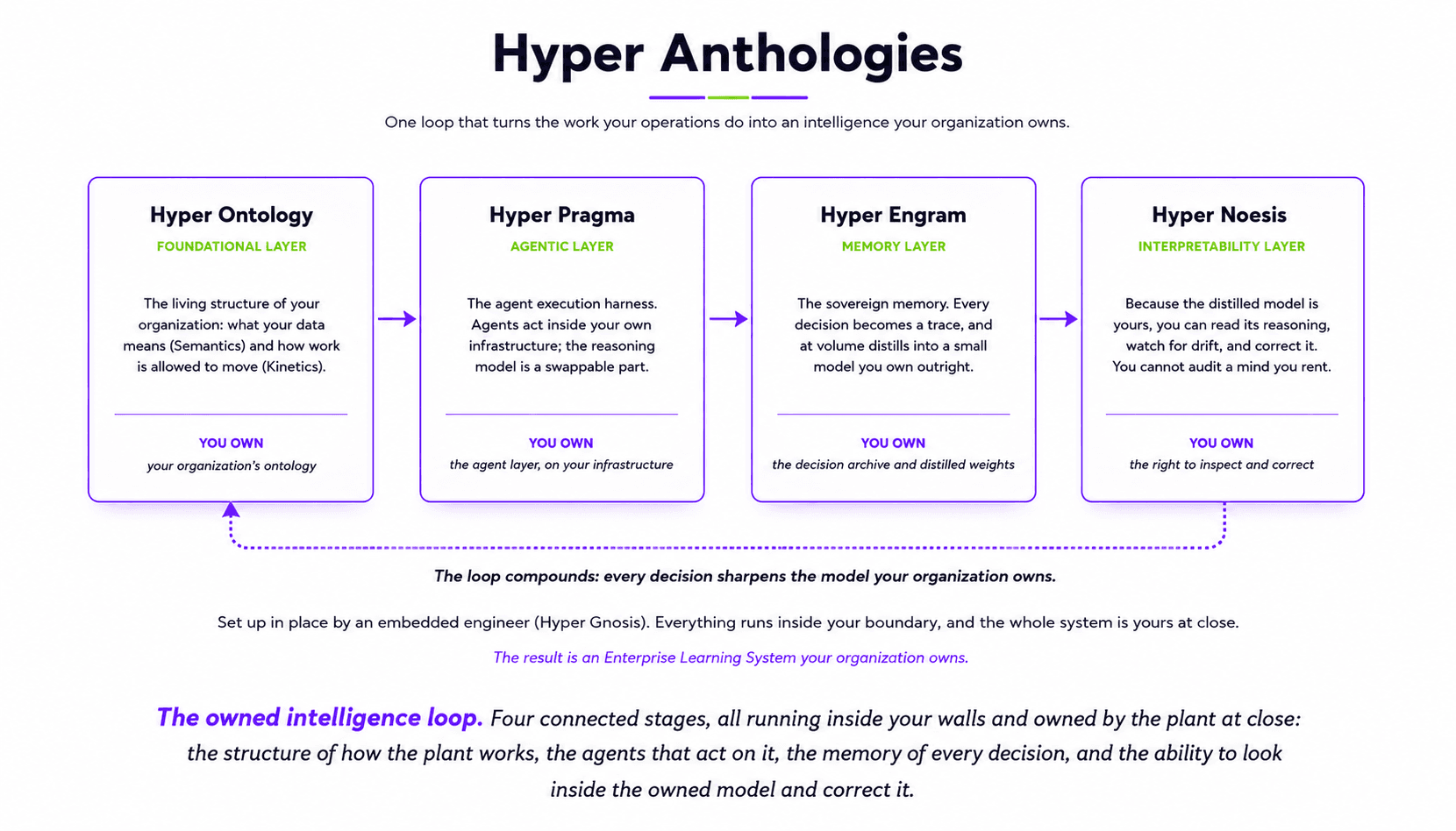
Moving all five tests into the owned column is what CodeNinja is built to do. We deliver it through Hyper Anthologies, four connected pieces set up by an embedded engineer and handed to you at the end of the engagement.
Hyper Ontology
The living structure of your plant: what each signal and record means, and which actions are legal. Agents read their context from here, so they act sensibly instead of guessing. This is your answer to the Context test.
Hyper Pragma
The execution harness where agents act, on your own infrastructure and inside the limits you set. Rule-bound calls run automatically, genuine exceptions use inference, and the hard ones go to a person. The reasoning model is a swappable part, not lock-in. This is your answer to Correction.
Hyper Engram
The sovereign memory. Every decision is recorded as a trace and learned from inside your boundary, and at enough volume it distills into a small model your plant owns outright. This is your answer to Decision trace and Portability.
Hyper Noesis
Because that distilled model is yours, you can look inside it, see what drove a decision, watch for drift, and correct it. You cannot audit a mind you rent. This is your answer to Accountability.
Together the four layers form one loop, a little sharper each cycle: the foundational layer models the operation, the agentic layer acts on it, the memory layer learns from every decision, and the interpretability layer keeps the model honest and feeds corrections back, all inside your boundary. You own it at the end: your ontology, the agent infrastructure and its weights, the full decision archive and the distilled model, and the right to inspect and correct what the system does.
Prove it on one bounded decision
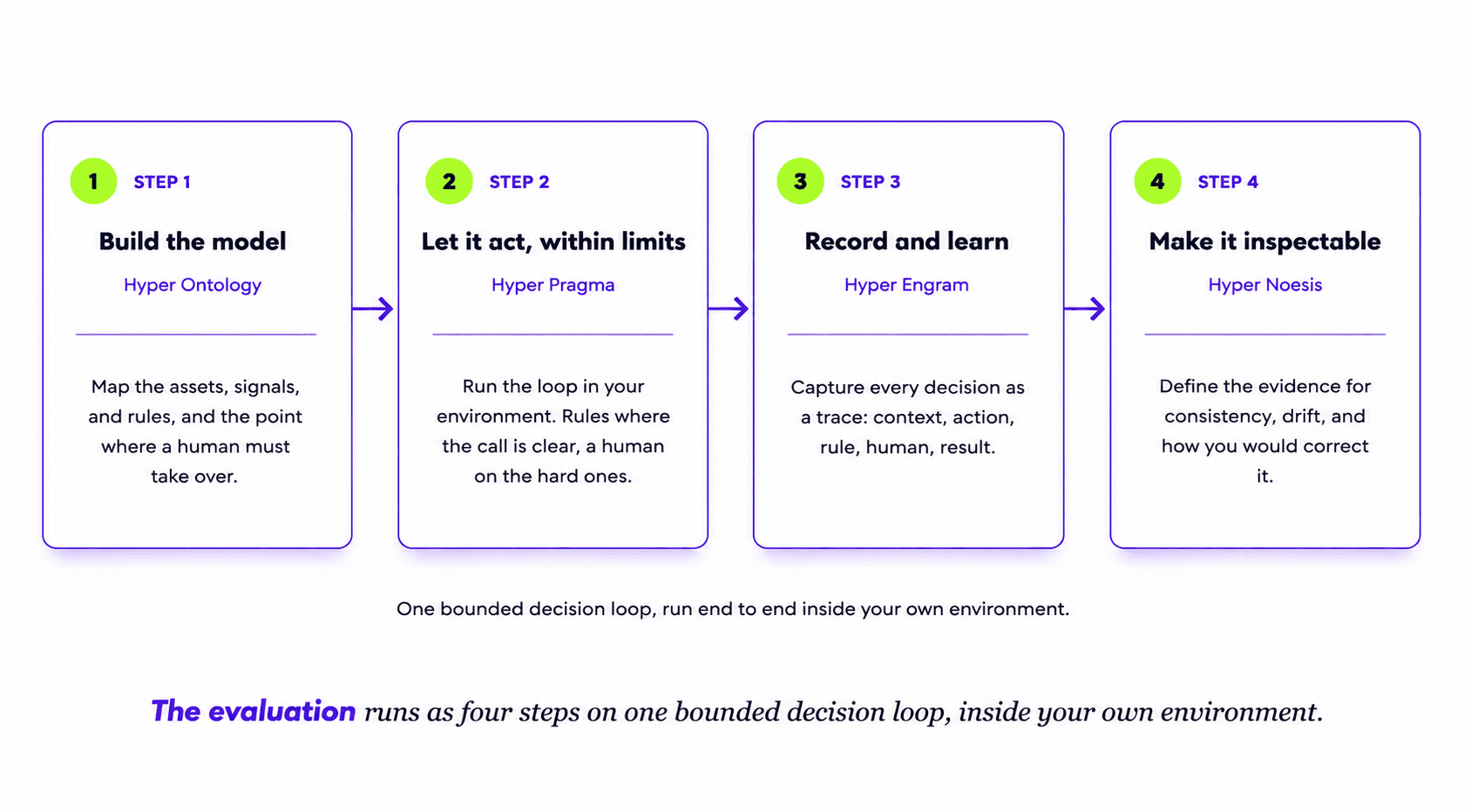
You should not take this on faith, or commit across the whole plant to find out whether it holds. The bounded evaluation is a small, illustrative test: take one real decision, run it through the owned loop inside your own environment, and confirm you can keep the intelligence it produces. It reports only what it measures.
The decision under test
Choose one real, contained decision: which maintenance jobs to prioritize for one class of equipment, whether to release or hold a batch at one production stage, or when to escalate a throughput constraint on one line. It needs a named owner, reachable data, a clear set of allowed actions, and a defined point where a human takes over. Keeping it small is the point.
Where most plants start
Most manufacturers have plenty of data and systems, but no single governed place where the reasoning lives. The interpretation of an exception is spread across a few tools, some spreadsheets, and a handful of people. The plant sees that something happened but cannot reliably capture why the decision was made, what resulted, and what should change next time. This is the gap the evaluation closes, on one loop.
How the evaluation runs
Step 1: Build the model of the decision
Map the assets, signals, roles, terms, constraints, and allowed actions for the chosen decision, and the rules for when a human must be involved. The output is a small, governed model of how this one decision is meant to work.
Step 2: Let the system act, within limits
Run the loop in your own environment. Explicit rules where the decision is deterministic, inference only where it genuinely helps, and a human on anything past the agreed threshold. It never acts outside the boundary you set.
Step 3: Record and learn from every decision
Capture each decision as a trace: the context, the action, the rule or reasoning, any human intervention, and the result. This is structured memory the plant can review and reuse, not a generic log.
Step 4: Make the reasoning inspectable
Agree up front the evidence you will need to judge consistency, drift, and correction. The evaluation does not claim to distill a model. It establishes the conditions under which that would later be possible.
What a pass looks like
A pass means all five tests now land in the owned column, evidenced on the one decision you tested.
.png&w=1920&q=75)
What you walk away owning
The point is not a demo or a dashboard. It is a package you can keep and build on: you can say plainly what you own, where it runs, what you can inspect, and how you would extend it. Any later transfer of a fine-tuned or distilled model is governed by the agreed scope, technical feasibility, and explicit contract terms, and is never implied before it is delivered.
How we handle evidence
The evaluation reports only what it measured in your environment. Benchmarks or projected value are labeled as estimates, with their source and assumptions named. Three things are kept separate: what the evaluation demonstrated, what the technology is capable of, and what a future deployment might project.
The next step
Start the Engagement. Pick the one decision to test, name the executive sponsor and the operational owner, agree what evidence will count, and set the ownership and handover terms before any building begins.