Hierarchy to Holacracy – The Modern Enterprise Design
In today’s dynamic business landscape, traditional hierarchical structures with their rigid approval processes and top-down decision-making are extremely inept for driving sustainable growth. Conventional models often impede innovation and restrict employee empowerment, creating barriers in a market that demands agility and responsiveness. Studies from MIT Sloan indicate that 78% of transformative ideas never reach senior leadership in traditional hierarchies (MIT Sloan n.d).
It’s no surprise, then, that one-third of enterprises are restructuring to eliminate layers (Mercer, 2017), and 93% of companies are planning to restructure toward flatter models (Forbes, 2018). Leaner organizational structures, with fewer management layers, have proven to drive 25% higher operational efficiency (Forbes, 2025), enabling agile decision-making and empowering teams to innovate.
Modern organizational design now necessitates flatter organizational structures that expedite decision-making and foster a culture of continuous improvement. Global Capability Centers (GCCs) have emerged as critical enablers in this evolution, distributing expertise across geographies and supporting decentralized operations. By eliminating bottlenecks and facilitating cross-border collaboration, GCCs are helping companies become more agile and competitive. As Gartner forecasts, 20% of organizations will flatten their organizational structure by 2026, potentially eliminating over half of current middle management positions (Gartner, 2024). To stay ahead, leaders must re imagine their frameworks, embedding agility and innovation into their organizational design.
The Evolution of Organizational Structures
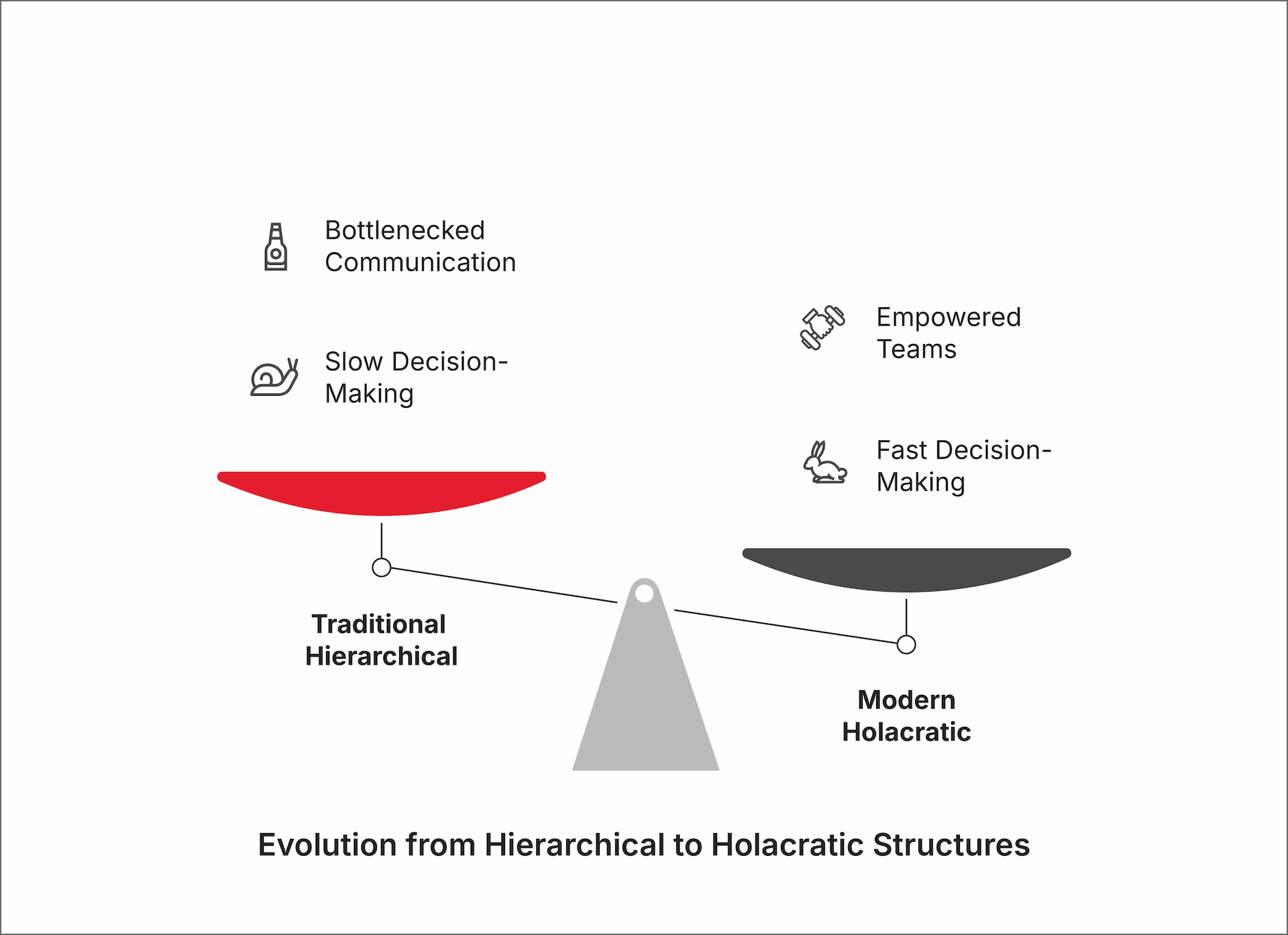
For decades, businesses were built around traditional hierarchical models, a pyramid structure with centralized authority and multiple layers of management. These systems were designed to ensure stability and accountability, but they also created significant limitations. Decision-making was slow due to multiple approval layers, and communication bottlenecks often delayed action.
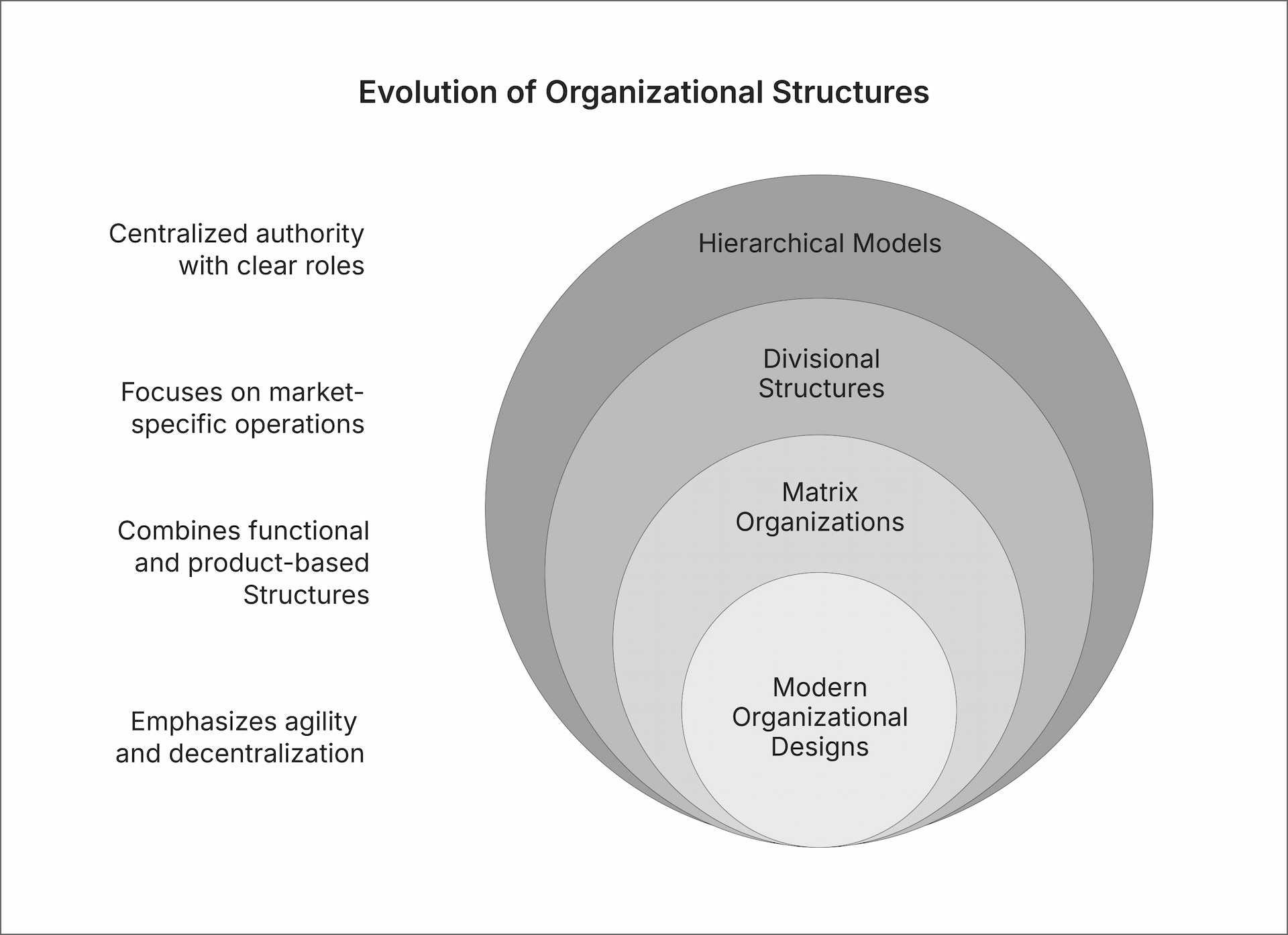
This model, while effective in early industrialized economies, struggled to keep up with rapidly changing markets. Companies like IBM and General Electric (GE) were pioneers of these systems, but as the business environment grew more dynamic, these rigid structures began to hinder innovation and responsiveness. As a result, these once market leaders lost their competitive edge to bureaucracy, their innovative spirit was replaced by corporation and management layers. GE lost 60% of its market capitalization in the 21st century and IBM experienced value loss for multiple consecutive years in 2010s.
The need for agility led to the rise of flatter, decentralized models in the late 20th century. Companies like General Motors introduced divisional structures to enhance responsiveness, where each division operated semi-autonomously to meet specific market needs. While this approach improved focus, it still resulted in fragmented strategic vision and duplication of efforts. In the 1980s, the matrix model emerged, blending functional and product-based structures to encourage collaboration. However, it still struggled with role ambiguity and conflicting priorities, which slowed decision-making.
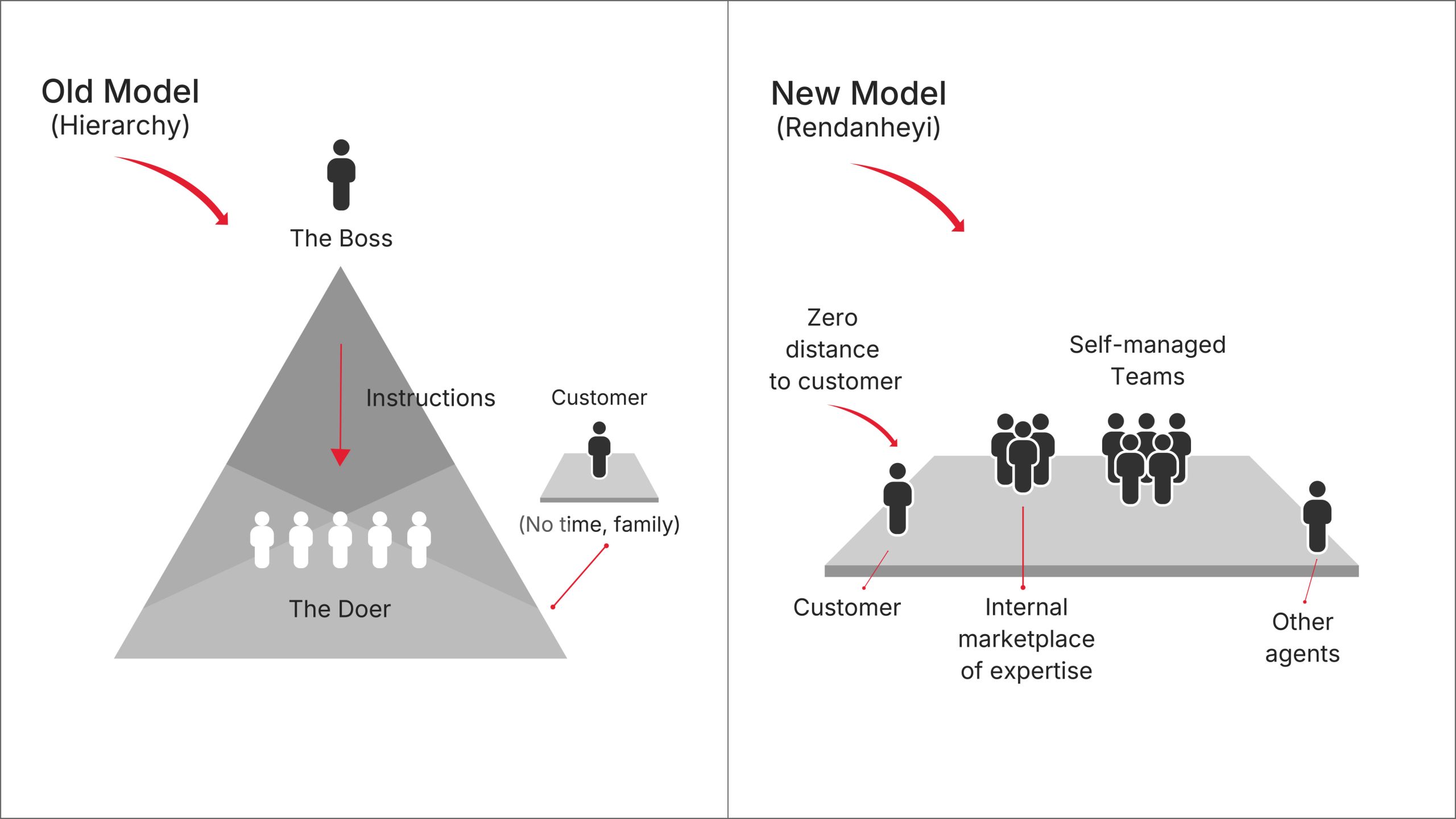
Today, organizations are shifting toward more agile structures that employ strategies like holocracy to decentralize decision-making and empower teams to act autonomously. Spotify and Haier exemplify this shift, embracing self-managed teams and distributed authority. In these companies, decision-making is faster, more informed, and closer to the work being done.
The Role of GCCs in Enabling Flatter Structures
Historically, centralized decision-making led to bureaucratic bottlenecks, slowing down response times and hindering innovation. Today, GCCs are redefining modern organizational design by empowering enterprises to adopt flatter, more agile structures that transcend traditional centralization.
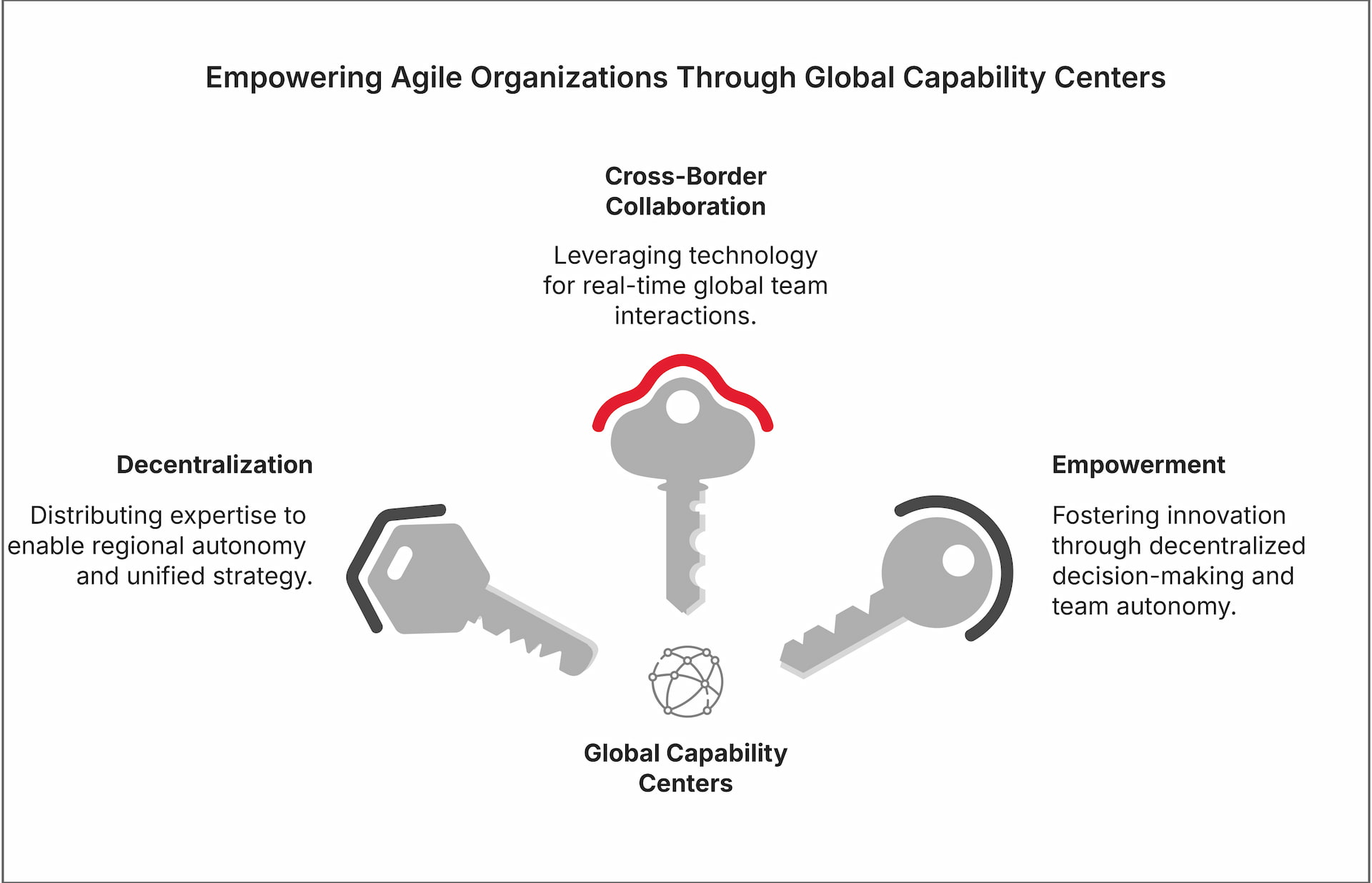
By distributing expertise across various geographic locations, GCCs allow regional teams to operate with autonomy, making decisions that are informed by local insights and specialized knowledge. This ensures a responsive and dynamic organization capable of adapting quickly to market shifts.
Spotify, for instance, embraced a flatter structure early on, empowering small, self-managed teams called "squads" to work autonomously while still contributing to the company’s broader vision (McKinsey, 2020). This decentralized approach enables Spotify to react quickly to user needs and innovate continuously, a flexibility traditional hierarchies could not offer (Harvard Business Review, 2017).
The cross-border collaboration enabled by GCCs is equally vital. Through advanced digital communication tools, GCCs foster seamless interaction between teams across different time zones and regions. This connectivity allows for real-time collaboration and knowledge sharing, driving innovation at a faster pace. Google operates a similar model, where teams around the world collaborate on projects, drawing on local expertise while working toward unified goals. This fluid exchange of ideas and resources enhances both innovation and operational efficiency, keeping companies ahead in a competitive environment.
Through distributed expertise, decentralized decision-making, and cross-border collaboration, GCCs enable organizations to evolve into more agile, innovative, and responsive entities. By adopting these structures, businesses can break free from the constraints of traditional hierarchies and thrive in today’s fast-paced, globalized market.
Now, flatter, decentralized structures are redefining innovation and success (HBR, 2024). Haier’s self-managed micro-enterprises (McKinsey, 2021) and Spotify’s squad model empower teams to act autonomously, accelerating decision-making and fostering continuous innovation (HBR, 2017)
Haier, once structured with multiple layers of management, struggled to keep pace with the rapidly changing global market. The rigid hierarchy slowed decision-making, stifled innovation, and created operational bottlenecks, preventing the company from seizing new opportunities in competitive industries like consumer electronics.
Under CEO Zhang Ruimin’s leadership, Haier restructured its organization, eliminating middle management and creating over 4,000 self-managed micro-enterprises (McKinsey,2021). Each micro-enterprise was accountable for its own profit and loss, empowering teams to make swift decisions and operate with autonomy. This shift toward a holacratic structure not only sped up decision-making but also fostered a culture of creativity and entrepreneurship (Haier, 2024).
The move towards self-managed units led to faster innovation cycles and enhanced responsiveness to market demands. Empowered teams drove innovation and operational efficiency, positioning Haier as a global leader. The elimination of middle management streamlined processes, reduced bureaucracy, and created an agile, adaptable organization capable of rapid innovation.
Haier’s success demonstrates that the micro-enterprise model can scale to large, complex organizations. By dismantling hierarchical layers and decentralizing decision-making, Haier created an agile, efficient, and innovation-driven company.
With modern Global Capability Centers (GCCs), organizations can pursue functional division and specialty, creating competence hubs similar to Haier's micro-enterprise. Therein, GCCs can be designed for Research and Development, Data Analysis and Insights, or Engineering Capabilities with increased level of autonomy for innovation and breakthroughs. GCCs provide access to specialized expertise and resources, empowering organizations to adapt swiftly and optimize functional output while maintaining alignment with overall strategy. Just as Haier’s micro-enterprises.
Navigating the Shift to Flatter Structures
Creating a modern ecosystem through the use of GCCs and holacratic organization models can be transformative for organizations pursuing agility, but these structures are not without their own challenges. Cultural misalignment can arise when teams from diverse regions struggle to collaborate effectively due to differing work practices and values. Additionally, communication barriers can impede information flow and delay decision-making. Resistance to change is another common obstacle, particularly from leadership accustomed to traditional hierarchical structures. Moreover, ensuring consistency and maintaining a unified strategic direction across multiple distributed teams can be difficult.
To address these challenges, organizations must prioritize strong leadership alignment, ensuring that all leaders are united in their vision for the transformation. Cross-cultural training is essential to bridge regional gaps and promote understanding, facilitating smoother collaboration. Implementing digital collaboration tools can also eliminate friction and enhance seamless communication, allowing teams to connect in real time, regardless of geographical boundaries. Furthermore, structured change management processes and aligned performance metrics across regions will help ensure a consistent and effective transformation.
The Future of Enterprise Organizational Design
The evolution of modern enterprises demands a shift from rigid hierarchies to holacratic structures that foster speed, innovation, and autonomy. Global Capability Centers (GCCs) are no longer operational hubs, they are conduits of creating modern micro-enterprise design, where each center specializes in a core function, optimizing for efficiency and innovation while remaining aligned with the broader strategic vision.
Much like Haier’s transformation, GCCs enable organizations to decentralize decision-making and unlock global expertise, ensuring sustained competitive advantage. To thrive in this new era, leaders must re-evaluate traditional structures, embrace holacratic models, and integrate GCCs to build future-ready enterprises. Embrace change, empower your teams, and lead your organization into a new era of agile, sustainable success.
Learn more about CodeNinja's Global Capability As a Service Model
Share What’s In Your <span>Mind</span>
Fill the form, we will get back to you in couple of hours.
By submitting this form you agree to CodeNinja Terms of use and Privacy policy.
Subscribe to our Newsletter!
Subscribe now to get latest blogs updates.
Contributors

Zobaria Asma
Assist. Manager Brand and Communication