The Quiet Disadvantage: How Process Debt Is Outpacing Banking Intelligence
.jpg&w=96&q=75)

11 February, 2026

Key Takeaways:
- Intelligence alone is no longer sufficient to compete. Banks today deploy AI models on par with fintech alternatives. What determines market advantage is workflow architecture.
- Process debt is the invisible competitor. Decades of compliance-driven approvals, sequential hand-offs, and administrative checkpoints throttle execution and obscure true operational capability.
- Humans must be re positioned from gatekeepers to orchestration. Judgment, accountability, and relationship-driven decisions are where human capital delivers leverage and value.
- AI-native institutions win by design. Their workflows encode compliance, automate exception resolution, and assign humans only to high-value judgment, making speed a structural, defensible advantage.
- Execution velocity compounds trust. Responsiveness is now a core element of the consumer trust equation: speed without sacrificing fiduciary rigor is the differentiator between banks and AI-first competitors.
- Agentic AI is the orchestration layer bridging intelligence and outcomes. It aligns machine-speed execution with human judgment, orchestrating approvals, compliance, and risk remediation in parallel, while maintaining explain ability and auditability.
- Pilot-led adoption delivers strategic proof points. Constrained deployments in high-friction domains demonstrate measurable improvement in cycle time, operational cost, and compliance, without core disruption.
- The architecture of competitive banking is hybrid by necessity. Institutions that deliberately bifurcate cognition and execution will define the next frontier of operational speed, regulatory resilience, and market primacy.
Commercial banking has evolved through successive waves of infrastructure: physical branch networks in the industrial era, mainframe cores in the computing age, and digital channels in the internet economy. Each wave expanded capability without fundamentally redesigning the operational substrate beneath it (Everest Group, 2025). Legacy processes accumulated. Controls multiplied. Compliance structures hardened. Stability was rewarded, but speed was not.
This architectural inheritance worked. Until intelligence itself became operational.
Today, traditional banks deploy the same algorithmic sophistication in credit decisions, risk assessment, and fraud detection as AI-native financial institutions. The same models. The same data. The same predictive techniques. Yet where AI-native lenders approve and resolve exceptions in minutes, banks still require hours or even days (The Financial Brand, 2025). The intelligence gap has closed, whereas the execution gap has widened.
More than ‘technology’, it is rooted in an architectural problem.
Decades of compliance-driven process design optimized banking operations for control, auditability, and human oversight. Manual checkpoints, sequential approvals, and document hand-offs served legitimate regulatory purposes, and many still do. But these same structures now throttle the very intelligence they were built to govern. Machine-speed decisions collides with human-speed bureaucracy, producing friction that no model improvement can overcome.
The question facing banking leaders is no longer ‘where to add intelligence.’ That work is largely done. The harder, more consequential decision is where human judgment belongs, and where it has been mistakenly consumed by administrative, low-value work for decades.
" The first step in banking’s AI journey is dismantling the process debt that prevents existing intelligence from executing at market speed. The leaders who understand this are asking how to reallocate intelligence across the institution. "
The Structural Moat Is Eroding
Workflow architecture is not the only advantage being contested. The market position that traditional banks built around credit card infrastructure, including transaction data, interest income, loyalty ecosystems, and customer relationships, is being dismantled one layer at a time.
BNPL platforms such as Affirm, Klarna, and Afterpay bypass card rails at the point of decision. Digital wallets route transactions through proprietary networks, stripping banks of the behavioral data card transactions historically provided. Embedded finance lets merchants offer credit and financial services natively, eliminating the bank as a touch-point altogether.
Each alternative captures a layer of value banks previously owned exclusively, including the transaction relationship, the credit relationship, the data relationship, and the loyalty relationship, and does it more cheaply, more contextually, or more conveniently.
What makes this particularly threatening is not product quality. It is cost structure. Alternative providers built natively on cloud infrastructure, automated compliance from inception, and designed mobile-first without legacy organizational weight. Their cost per transaction, per acquisition, and per product iteration is structurally lower, not temporarily, but permanently.
That asymmetry was manageable when regulatory frameworks kept challengers at the margin. It becomes existential when regulatory pressure simultaneously compresses the revenue pools that funded banks' higher cost structures.
Regulatory Pressure Intensifying the Urgency
U.S. State Department's call for a 10% cap on credit card interest rates has sent shock-waves through the industry (NBC News, 2026). The proposed cap would fundamentally dismantle the economics that have sustained consumer credit for decades.
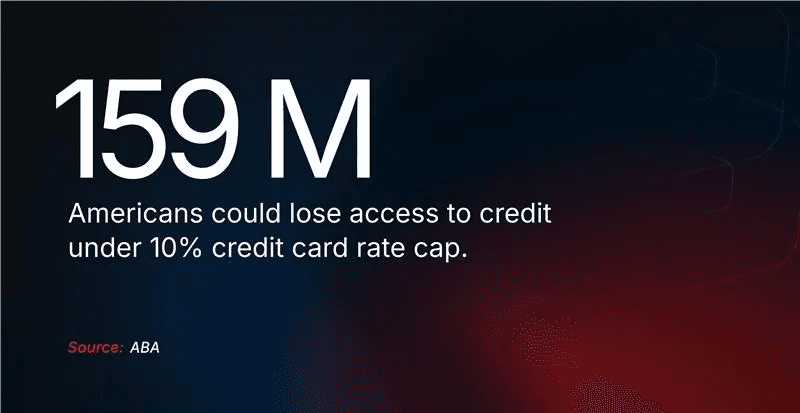
High interest rates have financed an entire rewards ecosystem. They enabled banks to offer lucrative cashback programs, travel points, and premium perks that keep consumers carrying multiple cards. 85% of open credit card accounts nationwide are expected to face closure or drastically reduced credit lines, affecting 159 million cardholders (ABA, 2026).
Banks operating with higher process costs will have to cut rewards, accept losses, or exit segments entirely. Newer entrants with lower operational costs and leaner process structures will absorb these changes far more easily.
The better banks optimize processes and reduce structural costs now, the more defensible their position becomes against both regulatory pressure and competitive encroachment.
The Disadvantage That Compounds
AI adoption is no longer the differentiator. What determines competitive advantage is workflow architecture: AI-native firms build processes for intelligence from the ground up, while banks retrofit intelligence onto inherited operational structures.
Consumer Perception Is Shifting Toward Speed and Responsiveness
This disadvantage materializes in consumer perception. When consumers interact with fintech apps or digital wallets, the value proposition is immediate: speed, convenience, and friction less execution.
Take the example of PayPal, 60% of consumers trust PayPal more than their bank for storing payment credentials, primarily due to faster fraud resolution and dispute handling (PYMNTS, 2023). This perceived responsiveness creates a paradox for traditional banks.
Trust Remains Banking’s Advantage
Banks retain a critical advantage: trust in high-stakes transactions. Consumers still prefer bank-issued credit cards for large purchases because they trust the underlying architecture, regulatory oversight, and documented recourse mechanisms.
This trust reflects genuine operational capability. Banks know how to architect systems that protect consumers, withstand audits, and absorb regulatory change. That infrastructure competency is the foundation, but only if execution speed catches up.
" Trust without speed is becoming a liability. Consumers are learning they don't have to choose. "
Learn More: Disruption at the Door - AI and the Re-Architecture of Commercial Banking
How AI-Native Financial Institutions Build Speed by Default
Meanwhile, AI-native financial institutions design workflows assuming automation by default. They eliminate approvals instead of digitizing them, encode compliance as software rather than bureaucracy, and deploy humans only where judgment under ambiguity is required.
Say, a loan exception requiring three manual approvals in a traditional bank takes 48–72 hours. An AI-native lender resolves the same exception within a matter of minutes through encoded exception logic rather than routed workflows.
The result is a fundamentally different cost structure, capacity ceiling, and competitive velocity. This creates a structural disadvantage for banks that compounds quietly in margins, in responsiveness, and in scalability.
Redefining Human-in-the-Loop: From Gatekeepers to Orchestrators
Addressing process debt requires clarity on a question that banks have struggled to answer: where do humans belong in AI-augmented operations?
Humans have been placed in workflows as process gatekeepers. Signing off on exceptions, routing approvals, and validating data transfers. A loan officer spending 90 minutes manually consolidating data from three systems before making a 5-minute credit decision is a gatekeeper. The 5 minutes is judgment. The 90 minutes is the process debt.
The shift to AI-driven operations requires a fundamental re-framing. Humans should exist where judgment, relationships, and accountability matter. Everywhere else, intelligence should execute autonomously.
This re-positions cognitive labor from administrative burden to strategic value creation. Banks still need credit analysts, CPAs, and compliance officers. But their expertise should be applied to decisions that require wisdom, rather than workflow maintenance.
Credit scoring models automate quantitative assessment. What they cannot automate is interpreting how shifting market dynamics should alter risk weightings in emerging sectors. Financial controllers handle reconciliation through AI, but determining reserve calculations when macroeconomic indicators diverge requires interpretive judgment shaped by experience and institutional memory.
AML analysts no longer assemble transaction histories manually. AI performs these tasks with higher precision. What remains distinctly human is determining whether flagged patterns represent criminal behavior or legitimate commerce in volatile environments.
This is how banks preserve trust while operating at fintech speed: AI assembles evidence at machine scale; humans retain authority over consequential judgment.
This division is structural to banks. Data privacy requirements, systemic risk exposure, and fiduciary duty mean certain decisions cannot be delegated to algorithms, regardless of accuracy. The CFPB has made it explicit that federal consumer financial protection laws admit no exemptions for new technologies (CFPB, 2024).
Learn More: Beyond Risk Mitigation - Strategic Positioning Through Proactive AI Governance Infrastructure Development
The Hybrid Intelligence Model for Modern Banking
In banking, intelligence cannot be centralized in either humans or machines; it must be deliberately partitioned to align speed, judgment, and accountability. Once intelligence is deliberately partitioned, the role of humans becomes unambiguous.
Humans intervene only where cognition creates value. Such as market-based decisions under uncertainty, covenant structuring in ambiguous regulatory environments, and relationship management where trust compounds over time.
The future of modern banking intelligence is hybrid by necessity. AI eliminates the administrative friction that has consumed expert judgment for decades. Humans drive strategy, enforce accountability, and maintain the fiduciary trust that defines commercial banking.
" The goal is to place humans in the right loops, where expertise creates leverage, rather than where process creates latency. "
Learn More: AI and the Reinvention of Commercial Banking Handoffs
Where Intelligence Already Exists and Process Strangles It
The latency concentrates where banks have invested most heavily: credit scoring, risk assessment, and mortgage underwriting. The intelligence layer already exists in each. What's missing is the orchestration that allows intelligence to execute without administrative friction.
Credit Decisioning
Credit scoring models assess borrower risk in seconds. Loan approval requires document routing across departments, manual verification, compliance sign-offs, redundant review layers. A decision that takes 30 seconds algorithmically waits hours for human routing.
Mortgage Underwriting
Mortgage underwriting multiplies this lag. Each handoff, title verification, appraisal review, and exception escalation adds days. A process that could complete in hours spans weeks, not because complexity demands it, but because workflow design assumes manual transit.
Portfolio Risk Management
Portfolio risk models flag covenant breaches in real time. Remediation operates on calendar days; case assembly, cross-functional coordination, compliance documentation. By the time action is authorized, market conditions have shifted and the risk calculus is obsolete.
The most algorithmically advanced parts of banking are strangled by administrative processes running machine-speed intelligence through human-speed bureaucracy.
Document routing, manual approvals, compliance checkpoints, exception handling, internal handoffs, redundant reviews. The friction is known and measurable. This is where AI delivers immediate value by removing the barriers that prevent existing intelligence from executing at competitive speed.
Learn More: Rethinking Risk - Why Forecasting Alone Won’t Protect the Modern Enterprise
Agentic AI: The Orchestration Layer Banks Need
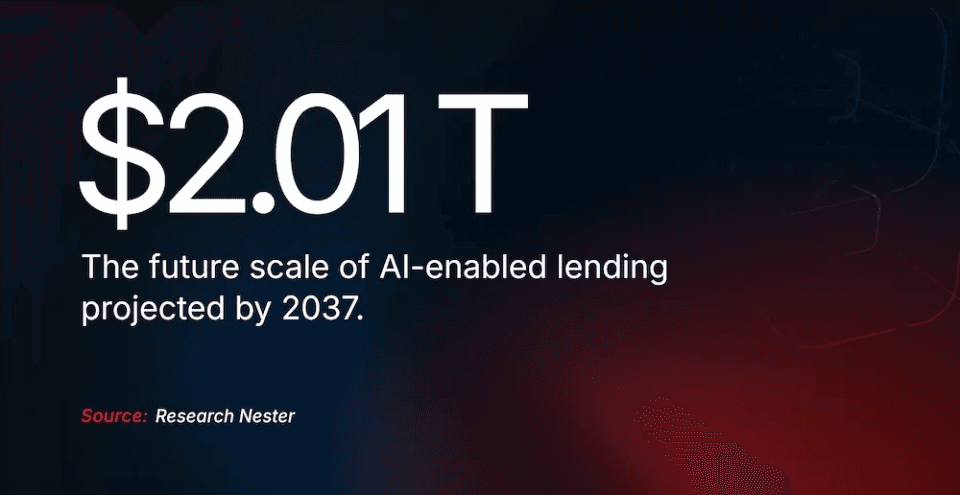
The AI-enabled lending market is projected to reach $2.01 trillion by 2037 (Research Nester, 2025).
While traditional banks are part of the AI platform lending market, the majority of growth is being driven by AI-native and embedded lenders. Banks risk participating only at the margins unless they modernize their lending decision stack. The institutions capturing this value are those eliminating process debt now.
The solution is to deploy an orchestration layer that executes existing intelligence at market speed while preserving regulatory control and audit transparency.
Agentic AI orchestrates end-to-end, eliminates handoffs, handles exceptions intelligently, and coordinates compliance in parallel rather than in sequence. Humans intervene where cognition creates value.
In credit decisions, agentic AI assembles borrower data across systems, validates documentation against policy parameters, and routes to human approves only when judgment is required.
In mortgage underwriting, it coordinates verification and compliance concurrently, compressing weeks to days. In risk management, it stages response protocols before human teams convene, ensuring decisions reflect current conditions, not outdated snapshots.
This is how banks defend trust while operating at fintech speed. Regulatory rigor remains intact. Execution velocity changes.
The Choice Between Monument and Machine
Modern banks are the result of decades of infrastructure evolution; systems designed to safeguard capital, absorb regulatory shock, and sustain fiduciary trust under systemic stress. That architecture remains essential. What no longer works is operating machine-speed intelligence through human-speed bureaucracy.
The question is whether banks will eliminate the process debt that prevents existing intelligence from executing at competitive speed, or whether they will preserve operational monuments while competitors build machines.
AI-native firms did not out think traditional banks. They out built them by designing workflows for intelligence from inception. Banks close this gap by deploying orchestration at the execution layer, on top of existing cores, without disruption.
CodeNinja works with commercial banks to identify high-friction domains where intelligence already exists but execution lags. We deploy constrained, agentic AI pilots, typically within 60–90 days, that eliminate administrative drag without destabilizing core systems.
The goal is not mere experimentation. It is evidence and proof: faster cycles, lower cost, and defensible compliance at scale.
The institutions that move now will define what operational speed means in regulated finance. The institutions that wait will explain why trust without execution was ever considered a strategy.
Let's build the pilot. 60 days. One domain. Measurable impact. Learn More
Bibliography
- American Bankers Association (ABA). "ABA Research: 159 Million Americans Could Lose Access to Credit Under 10% Credit Card Rate Cap." Banking Journal, January 2026.https://bankingjournal.aba.com/2026/01/aba-research-159-million-americans-could-lose-access-to-credit-under-10-credit-card-rate-cap/.
- Consumer Financial Protection Bureau (CFPB). "CFPB Comment on Request for Information on Uses, Opportunities, and Risks of Artificial Intelligence in the Financial Services Sector." About Us/Newsroom. Accessed February 9, 2026. https://www.consumerfinance.gov/about-us/newsroom/cfpb-comment-on-request-for-information-on-uses-opportunities-and-risks-of-artificial-intelligence-in-the-financial-services-sector/.
- Everest Group. "The Evolution of Core Banking Technology: From Foundations to a New Horizon." Everest Group Blog. Accessed February 9, 2026. https://www.everestgrp.com/blog/the-evolution-of-core-banking-technology-from-foundations-to-a-new-horizon.html.
- The Financial Brand. "Lending Is No Longer a Process, But a Race. Most Banks Are Already Behind." December 29, 2025. https://thefinancialbrand.com/news/banking-products/ai-powered-loans-194670.
- NBC News. "Bank of America Considers New Credit Card Capped at 10% Interest." Business/Consumer, January 2026. https://www.nbcnews.com/business/consumer/bank-america-considers-new-credit-card-capped-10-interest-rcna255495.
- PYMNTS. "60% of Consumers Trust PayPal Over Their Bank with Stored Payment Credentials." Digital Payments, 2023. https://www.pymnts.com/digital-payments/2023/60percent-of-consumers-trust-paypal-over-their-bank-with-stored-payment-credentials/.
- Research Nester. "AI Platform Lending Market." Reports. Accessed February 9, 2026. https://www.researchnester.com/reports/ai-platform-lending-market/4651.