AI and the Next Frontiers of Enterprise: The 2026 Strategic Watchlist
.jpg&w=96&q=75)

18 December, 2025

Key Takeaways:
- AI-native organizational design is the strategic differentiator in 2026; enterprises that architect teams for intelligence amplification outperform those relying on traditional structures.
- Small, senior teams powered by AI will replace large engineering teams, making talent strategy and operating model redesign critical for sustained enterprise innovation.
- Sovereign AI environments and localized AI capability centers are emerging as essential for controlling infrastructure, data governance, and operational risk.
- Physical AI and cross-functional convergence are redefining operational ownership, requiring IT, OT, and domain expertise to integrate under unified decision frameworks.
- Pilot-based AI capability development converts experimentation into measurable ROI, enabling executives to validate feasibility and scale enterprise AI maturity with confidence.
Enterprise leaders in 2026 are discovering that the challenge isn’t keeping pace with AI; rather, it’s making decisions when the ground keeps shifting beneath them.
Markets are volatile, regulations are in flux, and the pace of model evolution outstrips traditional planning cycles. In this environment, advantage belongs to enterprises that can act decisively before certainty arrives.
This is why the AI agenda is diverging. The U.S. AI Action Plan positions 2026 as the beginning of a ‘new golden age’ (White House 2025).
Yet enterprise leaders are quietly re-calibrating. They have shifted from considering, ‘What’s the next AI breakthrough?’ to ‘Which technologies actually strengthen our ability to execute under ambiguity?’
AI technologies that matter in 2026 are the ones that convert uncertainty into operational advantage.
This blog breaks down the AI technology trends that will define 2026. More importantly, what does each one mean for enterprise decision-makers navigating a market where advantage belongs to those who can operationalize intelligence faster than the ecosystem changes?
Strategic AI Tech Trends 2026: What Enterprise Decision-Makers Need to Prioritize Now
Redesigning Teams for an AI-Native Enterprise
Gartner research confirms what technology leaders already sense: by 2030, most organizations will operate with radically smaller engineering teams amplified by AI. For example, five two-person teams delivering five applications simultaneously, replacing fifty-person teams bottlenecked on single projects (Gartner 2025).
This overturns three decades of assumptions. For years, delivery bottlenecks were solved by adding headcount. That model collapses when AI multiplies individual output, enabling small, senior teams to outperform traditional, larger structures in speed, impact, and adaptability.
Enterprise leaders face a decisive choice: Are your operating models built to absorb AI-driven productivity gains, or are they still optimized for a world where scale depended on volume, not intelligence?
The future belongs to enterprises that architect team structures and organizational design to leverage AI amplification, retaining institutional knowledge while accelerating decision-making and innovation at scale.
Learn More: The Structure Paradox - How Organizational Design Impacts Innovation Capacity
Governing Multi Agent AI
Gartner documented a 1,445% surge in enterprise inquiries about multiagent systems between early 2024 and mid-2025 (Gartner, 2025). Whereas, Forrester projects the consequence: by year-end 2026, a quarter of CIOs will be pulled from strategic work to rescue AI deployments launched without adequate governance (Forrester 2025).
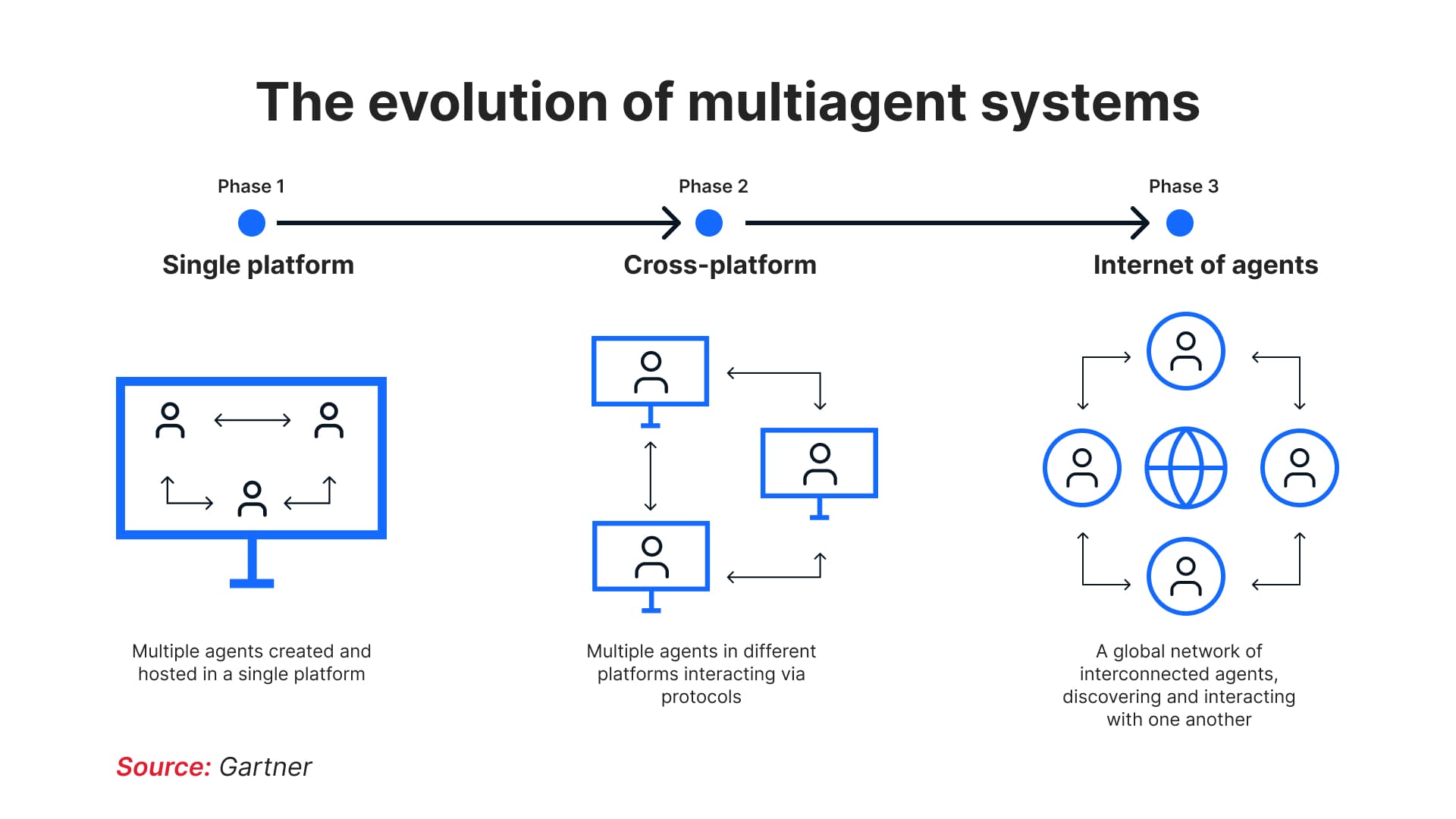
This exposes a structural gap. Business units can deploy autonomous AI agents faster than IT can establish control frameworks. The traditional model where IT reviews each technology cannot match deployment velocity. By 2027, most multi agent systems will rely on narrowly specialized agents that excel at tasks but create orchestration complexity no one designed for (Gartner 2025).
The question for decision makers is whether to establish governance frameworks that guide autonomous AI or let operational risk dictate the enterprise’s pace.
The organizations that define AI governance in 2026 will control the velocity, reliability, and strategic impact of multi agent systems, transforming potential risk into a competitive advantage.
Sovereignty as the New Strategic Imperative
By 2030, three-quarters of enterprises will shift workloads from hyperscale clouds to sovereign environments (Gartner 2025). Forrester highlights the rise of neoclouds like CoreWeave and Lambda, poised to capture $20 billion annually, chipping away at hyperscaler dominance in generative AI infrastructure (Forrester 2025).

This disrupts a decade of cloud consolidation strategy. Organizations standardized on single hyperscalers for simplicity. Now geopolitical pressure forces diversification. Cloud provider selection has compressed from multi-year decisions into annual reassessments.
The critical question is no longer whether to adopt sovereign deployment, but how quickly AI capability centers can operationalize it.
Enterprises that embed intelligence and data governance in stable geographies position themselves to turn sovereignty into competitive advantage, safeguarding innovation while retaining control over critical infrastructure.
Learn More: The Sovereign Enterprise- Reclaiming Innovation in the Post-Consulting Era
Physical AI: Bridging the Digital-Operational Divide
By 2028, 80% of warehouse operations will integrate robotics and automation systems (Gartner 2025). Physical AI combines sensors, actuators, and AI models to automate logistics, predictive maintenance, and safety protocols. This integration dissolves the long-standing boundary between IT and operational technology.
Historically, enterprises managed digital and physical systems under separate leadership, procurement, and vendor frameworks. Physical AI demands organizational convergence many are unprepared for.
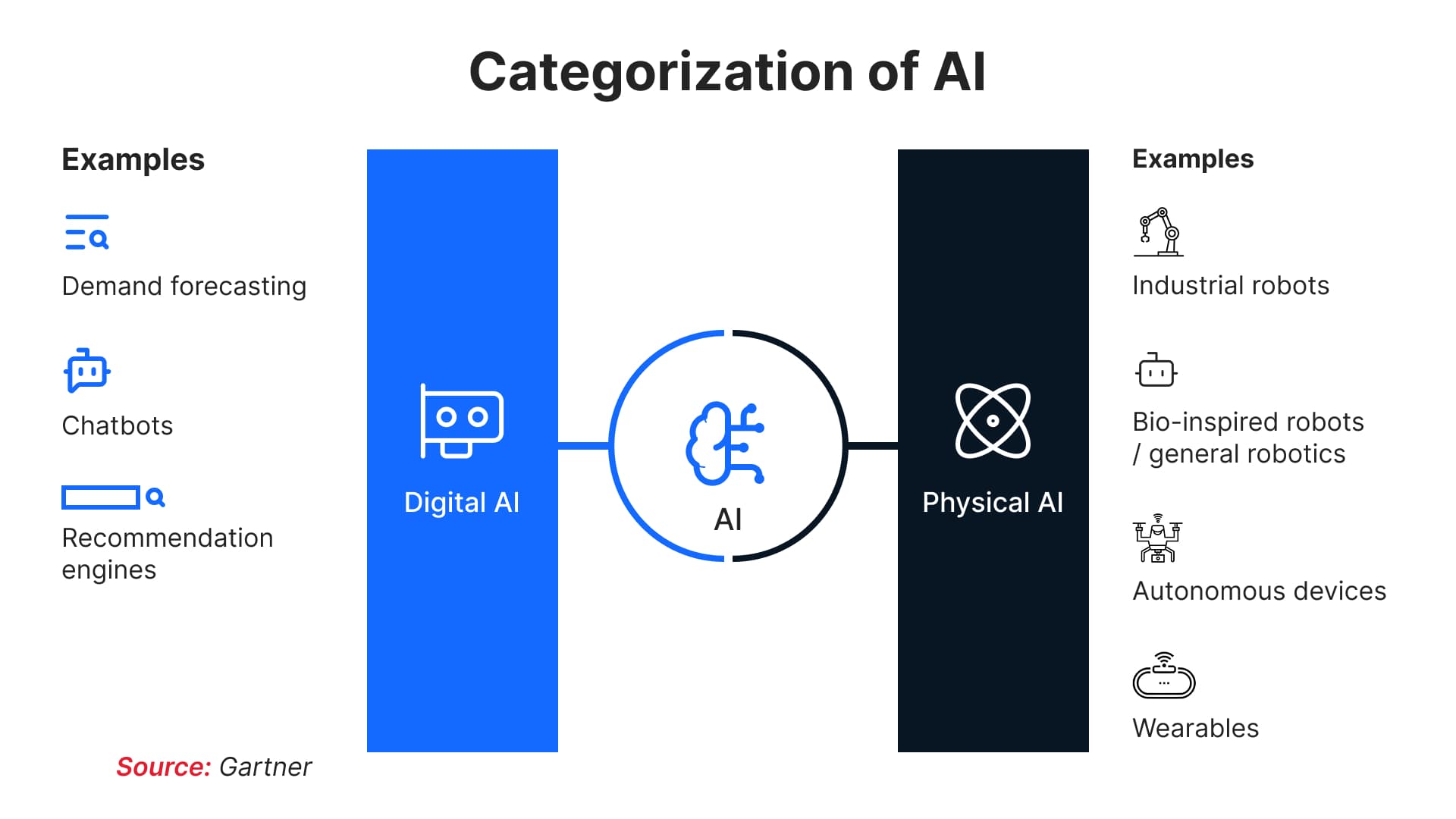
The strategic question for executives to consider is ‘Who would own deployment when AI spans both digital intelligence and physical infrastructure?’
Enterprises with digital twin and computer vision capabilities can harness automation at scale. But only if they architect cross-functional structures that unify IT, operational technology, and domain expertise into a single decision-making framework.
Learn More: Redefining Industrial Resilience - How AI Infrastructure Delivers Adaptive Advantage
AI Acceleration Is Straining the Developer Pipeline
Forrester predicted a counterintuitive trend: as AI accelerates software development, time to fill developer positions will double (Forrester 2025).
Enterprises are pairing AI tools with senior developers while scaling back entry-level hiring. 58% of CEOs are recruiting for AI-specialized roles that didn’t exist a year ago (IBM 2025).
This shift disrupts the traditional talent pipeline. Junior developers historically learned on production systems under senior mentorship. When AI absorbs entry-level tasks, enterprises eliminate the training ground that produces the next generation of senior engineers.
A major strategic challenge for executives is how do they cultivate senior engineering talent when entry-level roles vanish?
The 2026 AI talent shortage will push leaders beyond domestic markets. Regions offering 90% retention versus 20–25% attrition fundamentally reshape cost models, but only if distributed teams are architected to meet enterprise standards.
Learn more: Owning Intelligence: The Case for Enterprise Sovereignty in the AI Era
The Operational Proving Ground
In 2025, only 32% of AI initiatives delivered expected ROI, and just 26% achieved enterprise-wide scale (IBM 2025).
Success in 2026 won’t come from isolated technology investments alone. It demands integrated orchestration of infrastructure, talent, and AI-native workflows.
The moment for strategic validation is now. At CodeNinja, we architect AI capability centers (AICC) that turn ambition into measurable outcomes. Our 8-12 weeks pilots enable enterprises to test in-house AI capabilities, retain complete ownership, and embed governance, all without vendor dependencies or protracted scoping cycles.
The insights gained inform scaling decisions and establish a foundation for sustainable enterprise AI maturity.
The hype has ended. The proving ground is open. Enterprises that treat AI as an operational capability will convert experimentation into an enduring competitive advantage.
Deploy AI in a high-impact domain over 8–12 weeks. Validate ROI, prove feasibility, and blueprint your enterprise AI capability.